
Car hit by US drone strike in Kabul had no ISIS bombs planted; evidence reveals
California-based group, the driver’s employer who was killed in the US strike said that he [alleged "ISIS felicitaor"] was doing his duties for the nonprofit.
- World News
- 8 min read


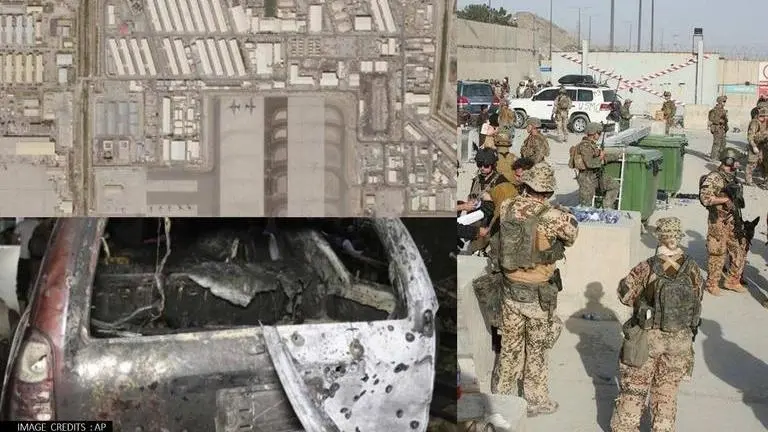
Just two days before the final US military plane C-17 departed the Hamid Karzai International Airport carrying the last US troops, a hellfire missile was launched off a reaper drone on August 29, that targeted a parked white sedan in a Kabul neighbourhood. US officials said that the drone strike blew up the vehicle carrying several suicide bombers from Afghanistan’s Islamic State affiliate [ISIS-K] who were planning another explosion during the final phase of the Kabul drawdown.
US President Joe Biden had directed the US Armed Forces to conduct the drone attack in retaliation for the deadly suicide bombing that killed 13 US military personnel, and nearly 170 Afghans.
Pentagon announced that the strike neutralized “high-profile facilitator and a planner" for the ISIS-K. Pentagon also revealed that there were just two men on the scene at the time when the strike was authorized by President Biden - the driver and one other man that Pentagon was “confident” had links with IS. The drone strike, according to a US official’s statements, on condition of anonymity, was ordered by Defense Secretary Lloyd Austin.
US military had first announced that at least one person was killed, later rectifying, “We were able to recognize that another was killed as well and one wounded.” Pentagon spokesman John Kirby said at a Defense Department briefing, “I won’t speak to the details of these individuals and what their specific roles might be, they were ISIS-K planners and facilitators and that’s enough reason.”
Advertisement
Kirby had also declined to identify the terrorists at the presser, though in a statement shortly made public, US Central Command said that it believed its strike killed “no civilians.” USCENTCOM described the target as having ties with Islamic State-Khorasan and that the vehicle would have produced “significant secondary explosions” as it indicated a “substantial amount of explosive material.”
The missile took about half a minute to reach the white sedan, a report carried by US newspaper New York Times claimed, adding that three children approached the car just seconds before the car was blown off.
Advertisement

[Afghan people are seen inside a house after U.S. drone strike in Kabul, Afghanistan. Credit: AP]
The paper attributed the claims to a senior US military official, speaking on the condition of anonymity, giving details from the ongoing military investigation. All the children were killed and another seven people had also died. Ahead of the drone attack, the US President addressed the reporters at the White House, promising ‘revenge’.
US President said: “We will hunt you down and make you pay.”
White House press secretary Jen Psaki said that Biden’s national security team had advised the president and vice president about another lethal attack in the closing days of a frantic US-led airlift. The State Department had advised the US citizens to stay away from Kabul airport, especially from the “New Ministry of Interior gate.” In the aftermath of the strike, US Army Gen. Mark Milley, chairman of the Joint Chiefs of Staff, confirmed to the media that an Islamic State “facilitator” was killed.
“I'm not going to talk about specific capabilities ISIS may have lost in this strike," Kirby had told reporters at the White House briefing on US-commanded drone strike. "They lost a planner, and they lost a facilitator, and they've got one wounded. And the fact that two of these individuals are no longer well longer walking on the face of the earth — that's a good thing.”
In shocking details revealed on Friday, Sept. 10, imagery of the damage on the site of the US drone strike provided by Washington Post, and dozens of US military assessments of the operation by weapons experts, analysis by physicists, former bomb technicians, non-profits that employed the driver that drone targeted found that there was no evidence that the car contained explosives.
At least two experts, whose names were not disclosed due to security concerns, said that all evidence gathered from the scene point to the ignition of fuel tank vapours after the US strike on vehicles. And this, perhaps, was the potential cause of the second blast, indicating that the car in fact had no ISIS bombs as such.
Separately, the victimised driver’s employer shot down suspicions on the driver and said, “US military may have misinterpreted what he was doing as he moved from place to place and loaded packages into the vehicle,” they said, according to a report carried by Washington Post.

[Credit: AP]

[Emal Ahmadi shows a photo of his family member who was killed during a U.S. drone strike. Credit: AP]

[Afghans inspect damage of Ahmadi family house after U.S. drone strike in Kabul. Credit: AP]
A relative of the other civilian casualties had earlier told CNN reporters on ground that the US drone strike killed ten members of one Ahmadi family, including seven children. The youngest victims of the “imminent” airstrike, as Pentagon officials described, were two 2-year-old girls. This was confirmed by family members and neighbours. One of the children named Malika’s remains were found in the rubble, although it remains unclear if she was inside the car or playing around when the compound was hit by a drone strike.
“We are not ISIS or Daesh and this was a family home -- where my brothers lived with their families. This, was an ordinary family," statement of a relative of the victim family read as recorded by CNN. When funeral was held and 10 family members with 2-year-old girls, Malika and Sumaya were laid in coffins, their Afghan relative yelled, “Death to America.”
Army Maj. Gen. William Taylor of the Joint Staff later that day on Aug. 30 told a press briefing: "We are aware of reports of civilians casualties. We take these reports extremely seriously.”
Gen. Mark A. Milley, the chairman of the Joint Chiefs, meanwhile defended the drone operation, as he called it a “righteous strike” that not only foiled the terror attack plans of Islamic State affiliate in Afghanistan but saved lives of American troops.
"We're investigating this. I'm not going to get ahead of it. But if we have significant -- verifiable information that we did take innocent life here, then we will be transparent about that, too. Nobody wants to see that happen, "Pentagon spokesman John F. Kirby told a media briefing in a change of initially made statement.
“Were there others killed? Yes, there are others killed,” Milley said a few days later in the press conference, adding “Who they are, we don’t know.” US Central Command, meanwhile, had refrained from a response to the agencies in the US, but as per NYTimes, they launched an official investigation.
Site struck out of 'reasonable certainty'
In a statement separately, US Military officials said that the Army had ‘credible intelligence’ about another bomb threat at Hamid Karzai airport and that the white sedan was going be used for the same. Out of “reasonable certainty,” the vehicle was surveilled and followed by military forces for over eight hours, a US Army official told NY Times on condition of anonymity.
The operation kicked off on the morning of August 29 and the military then zeroed in on a building that they suspected was a safe harbor for ISIS-K linked to a bomb blast near Abbey Gate. Intercepted communications found that the car was supposed to meet a motorcycle and then leave the location with 10 on board. As the white sedan pulled into the courtyard in the northwestern Kabul neighborhood of Khaje Bughra, it was struck, the official said.
Officers had obtained 450-square-foot yard satellite imagery where the drone strike was conducted days ahead. US Defense Department declined to publicly release video of the attack, citing the ongoing probe. However, it is being reported that the courtyard may not have been a highly sensitive area, but had a tree surrounded by four walls where a red Toyota SUV was parked to the west and the white sedan that was struck in the back.
White Sedan belonged to 'charity business', says California based firm
California-based Nutrition and Education International (NEI), the US company that operated the white sedan, said that the car belonged to a charity business. Steven Kwon, the president of NEI claimed that the driver was Zamarai Ahmadi, a technical engineer for the Non-Profit and the other casualty was an emergency food aid program worker who had arrived that morning to discuss aid for displaced Afghan people. Both had left to run errands with the car, Kwon told the paper.
While Pentagon argued that there was “significant secondary explosions” observed on drone footages, Ferenc Dalnoki-Veress, an explosives expert with the Middlebury Institute of International Studies that prepared a 19-page blast analysis, argued that there was no substantial amount of explosives in the car and blast occurred due to fuel vapors. It further stressed that the walls in the courtyard would have sustained catastrophic damage had the explosives gone off.
“My theory is: The [Hellfire] explosives themselves ruptured the gas tank, released the vapor, and because of the fire that happened a short time afterward, it detonated and caused something that may have been explosion-like,” he reportedy said in a statement.
A former Air Force bomb technician, Brian Castner, reviewed the analysis data and the site, and concluded that the gas tank was ruptured by the fire and that the other signs of a big explosion were missing.