
Lebanon Burns Despite Ceasefire: 4 Killed As Israel Bombs Ambulance, Contradicts Pakistan’s ‘Truce Everywhere’ Claim
Israel has made it clear that its military operations in Lebanon will continue. In an official statement, the Israeli Prime Minister’s Office said the temporary truce applies strictly to direct hostilities involving Iran and does not extend to Lebanon. However, in a post on X, Pakistan PM Shehbaz Sharif announced ‘immediate ceasefire everywhere including Lebanon and elsewhere’.
- World News
- 3 min read

;'%3e%3cpath%20d='m8,15.99c4.41,0,7.99-3.58,7.99-7.99S12.41,0,8,0,0,3.59,0,8s3.58,7.99,7.99,7.99Z'%20style='stroke:%23fff;%20stroke-miterlimit:10;%20stroke-width:.02px;'/%3e%3cpath%20d='m3.08,3.37l3.82,5.11-3.84,4.15h.87l3.37-3.64,2.72,3.64h2.94l-4.04-5.39,3.58-3.87h-.86l-3.1,3.35-2.5-3.35h-2.94Zm1.27.64h1.35l5.97,7.99h-1.35l-5.97-7.99Z'%20style='fill:%23fff;'/%3e%3c/g%3e%3c/svg%3e)


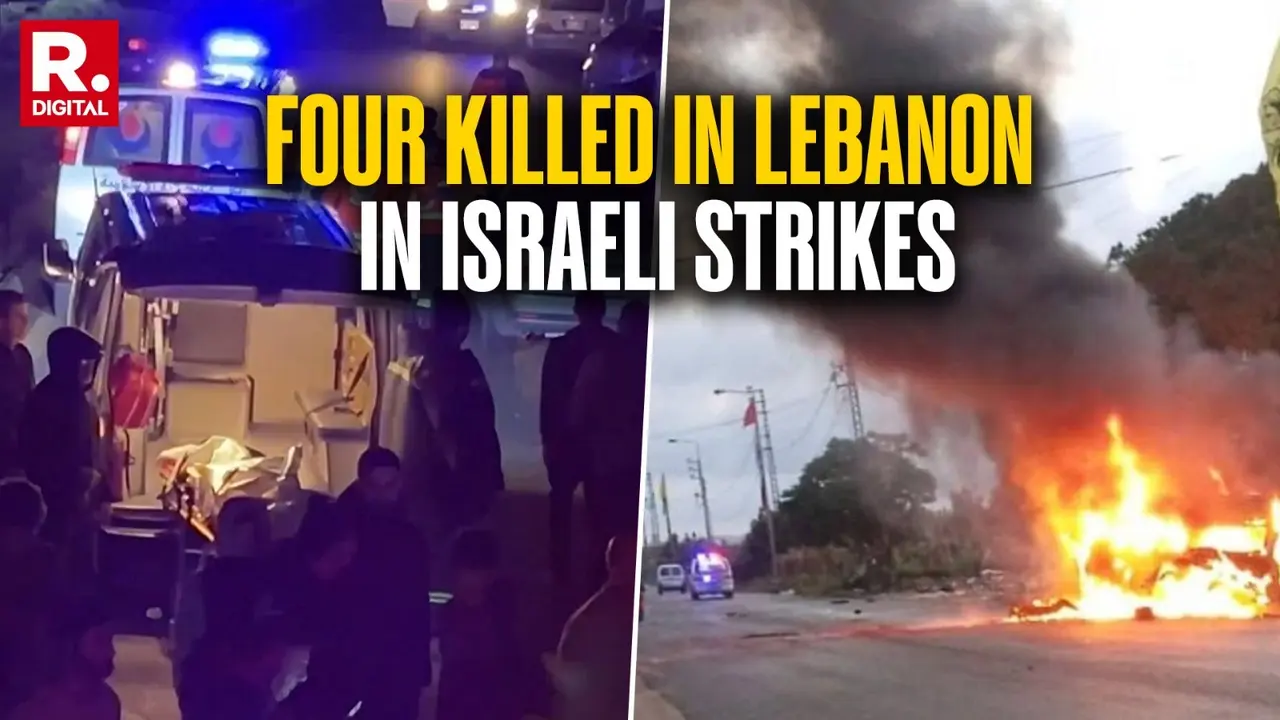
Even as the United States and Iran announced a temporary two-week ceasefire aimed at cooling spiralling regional tensions, fresh violence has erupted in southern Lebanon.
According to reports, an Israeli airstrike targeted an ambulance in the town of Al-Qlailah in the Tyre district of southern Lebanon, killing at least four people. The strike comes hours after the ceasefire announcement, raising immediate questions about its scope and enforceability.
IRIB announced the attack in a post on X.

Israel has made it clear that its military operations in Lebanon will continue. In an official statement, the Israeli Prime Minister’s Office said the temporary truce applies strictly to direct hostilities involving Iran and does not extend to Lebanon.
Advertisement
“Israel supports President Donald Trump’s decision to suspend strikes against Iran for two weeks,” the statement said, adding that the pause is conditional on Iran reopening the Strait of Hormuz and halting attacks on the US, Israel and regional partners. However, it emphasised that “the two-week ceasefire does not include Lebanon”.
Iran’s Peace Plan Vs Ground Reality
The latest escalation appears to contradict Tehran’s 10-point peace proposal, which explicitly calls for a “cessation of war across all fronts”, including conflicts involving Iran-backed groups such as Hezbollah in Lebanon.
Advertisement
Iran’s proposed framework, seen as an ambitious attempt to reset regional equations, includes:
- Non-aggression pact between the US and Iran
- Continuation of Iran’s control over the Strait of Hormuz
- Recognition of Iran’s nuclear enrichment rights
- Lifting of all primary US sanctions
- Lifting of all secondary sanctions affecting third-party countries
- Termination of all UN Security Council resolutions against Iran
- Termination of all International Atomic Energy Agency (IAEA) Board resolutions
- Payment of compensation to Iran for damages
- Withdrawal of US combat forces from the region
- Cessation of war across all fronts, including conflicts involving Iran-backed groups such as Hezbollah in Lebanon
- Ceasefire linked to Hormuz reopening
Despite these provisions, Israel has rejected any linkage between its operations in Lebanon and the US-Iran understanding.
Israel Contradicts ‘Mediator’ Pakistan
Israel’s Prime Minister Benjamin Netanyahu’s statement that the ceasefire does not included Lebanon contradicts an earlier announcement by his Pakistan counterpart Shehbaz Sharif, who has acted as a mediator in the war in the Middle East.
"Israel also supports the US effort to ensure that Iran no longer poses a nuclear, missile and terror threat to America, Israel, Iran's Arab neighbors and the world," Netanyahu's office had said.
His statement came hours after his Pakistani counterpart, Shehbaz Sharif, said that the ceasefire agreed to by the US, Iran and their allies extended "everywhere", including Lebanon.
A Ceasefire Already Under Strain
The divergence highlights the complexity of the regional security landscape, where multiple conflicts intersect but are not uniformly controlled by a single agreement. While Washington and Tehran appear to be testing a diplomatic off-ramp, focused heavily on maritime security and nuclear concerns, Israel’s continued strikes in Lebanon risk widening the fault lines.
The Israeli position also reflects longstanding concerns over Hezbollah’s presence and operations along its northern border, which it views as an immediate security threat independent of broader US-Iran dynamics.