
'Left Over From History': China Deepens Interference in Kashmir Via New Pakistan Joint Statement, Seeks UNSC Engagement
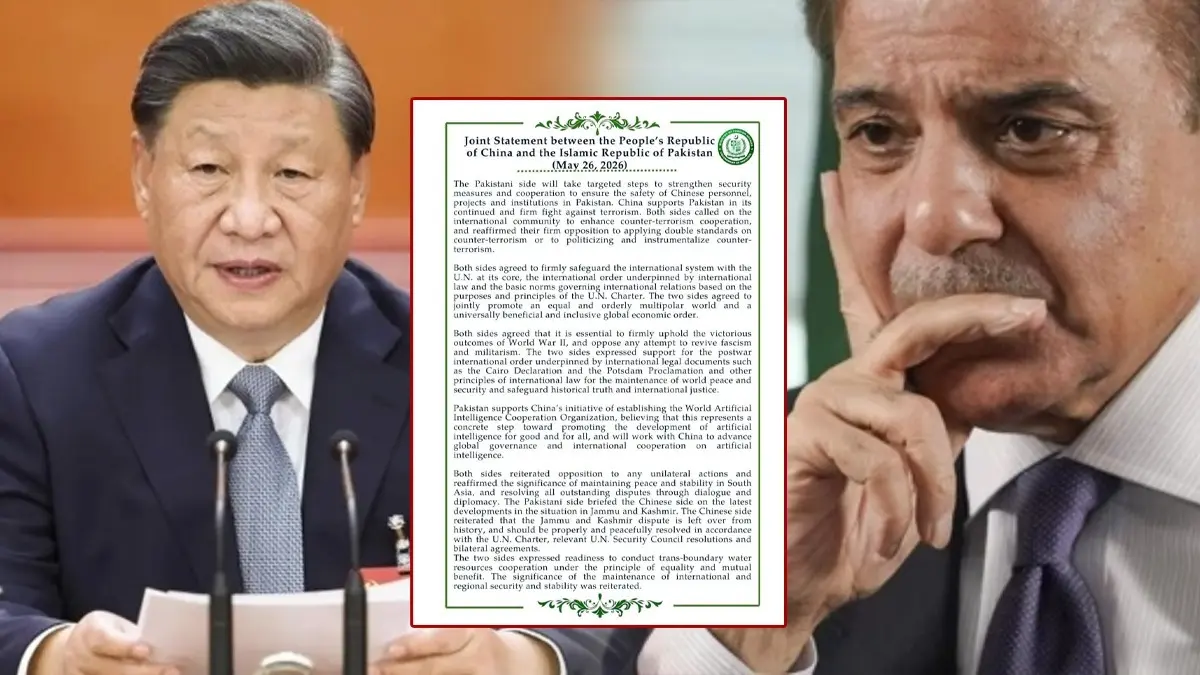
The joint statement notes that the Pakistani delegation provided the Chinese side with an update regarding the "latest developments" concerning Jammu and Kashmir.
- World News
- 2 min read

;'%3e%3cpath%20d='m8,15.99c4.41,0,7.99-3.58,7.99-7.99S12.41,0,8,0,0,3.59,0,8s3.58,7.99,7.99,7.99Z'%20style='stroke:%23fff;%20stroke-miterlimit:10;%20stroke-width:.02px;'/%3e%3cpath%20d='m3.08,3.37l3.82,5.11-3.84,4.15h.87l3.37-3.64,2.72,3.64h2.94l-4.04-5.39,3.58-3.87h-.86l-3.1,3.35-2.5-3.35h-2.94Zm1.27.64h1.35l5.97,7.99h-1.35l-5.97-7.99Z'%20style='fill:%23fff;'/%3e%3c/g%3e%3c/svg%3e)


New Delhi: In a move viewed as a calculated provocation against New Delhi, China has once again reignited tensions with India.
In a joint statement released on May 26, China and Pakistan reaffirmed their stances on regional matters, including Jammu and Kashmir.
Beijing once again characterized the dispute as a historical legacy, calling for it to be resolved peacefully through established international frameworks.

‘Left over from history’
The joint statement notes that the Pakistani delegation provided the Chinese side with an update regarding the "latest developments" concerning Jammu and Kashmir.
Advertisement
The statement highlighted China's recurring position that the Jammu and Kashmir issue is “left over from history”, asserting that it must be resolved peacefully and appropriately, guided by the U.N. Charter, applicable U.N. Security Council resolutions, and existing bilateral agreements.
This reference underscores Beijing’s persistent alignment with Islamabad’s stance on Kashmir in their bilateral diplomacy. Furthermore, the statement emphasized the necessity of preserving peace and stability across South Asia by addressing remaining disputes through diplomatic channels and dialogue.
Advertisement
Counter-terrorism, AI
Beyond the issue of Kashmir, both nations emphasized the expansion of their strategic partnership, specifically targeting collaboration in counter-terrorism, global governance, artificial intelligence, and regional security.
The statement also outlined plans for cooperation regarding trans-boundary water resources, grounded in the principles of equality and mutual benefit.
New Delhi's Stance
Conversely, India has consistently asserted that Jammu and Kashmir is an integral and inalienable part of the country, categorically rejecting any third-party involvement in regional affairs.
New Delhi maintains that all matters concerning the region must be handled bilaterally and views any constitutional or administrative decisions regarding the Union Territory as strictly internal.
While Pakistan has spent recent weeks positioning itself as a key intermediary in U.S.-Iran de-escalation efforts, the conclusion of the Beijing summit signals a decisive swing back toward strengthening its "all-weather" strategic partnership with China.