
Little Boy & Fat Man: How America Dropped The Dirty Bomb On Hiroshima & Nagasaki? Timeline
Let's have a look at that timeline that lead to one of most devastating attack mankind has ever witnessed - the bombings of Hiroshima and Nagasaki, Japan, which began on August 6, 1945.
- World News
- 3 min read

;'%3e%3cpath%20d='m8,15.99c4.41,0,7.99-3.58,7.99-7.99S12.41,0,8,0,0,3.59,0,8s3.58,7.99,7.99,7.99Z'%20style='stroke:%23fff;%20stroke-miterlimit:10;%20stroke-width:.02px;'/%3e%3cpath%20d='m3.08,3.37l3.82,5.11-3.84,4.15h.87l3.37-3.64,2.72,3.64h2.94l-4.04-5.39,3.58-3.87h-.86l-3.1,3.35-2.5-3.35h-2.94Zm1.27.64h1.35l5.97,7.99h-1.35l-5.97-7.99Z'%20style='fill:%23fff;'/%3e%3c/g%3e%3c/svg%3e)


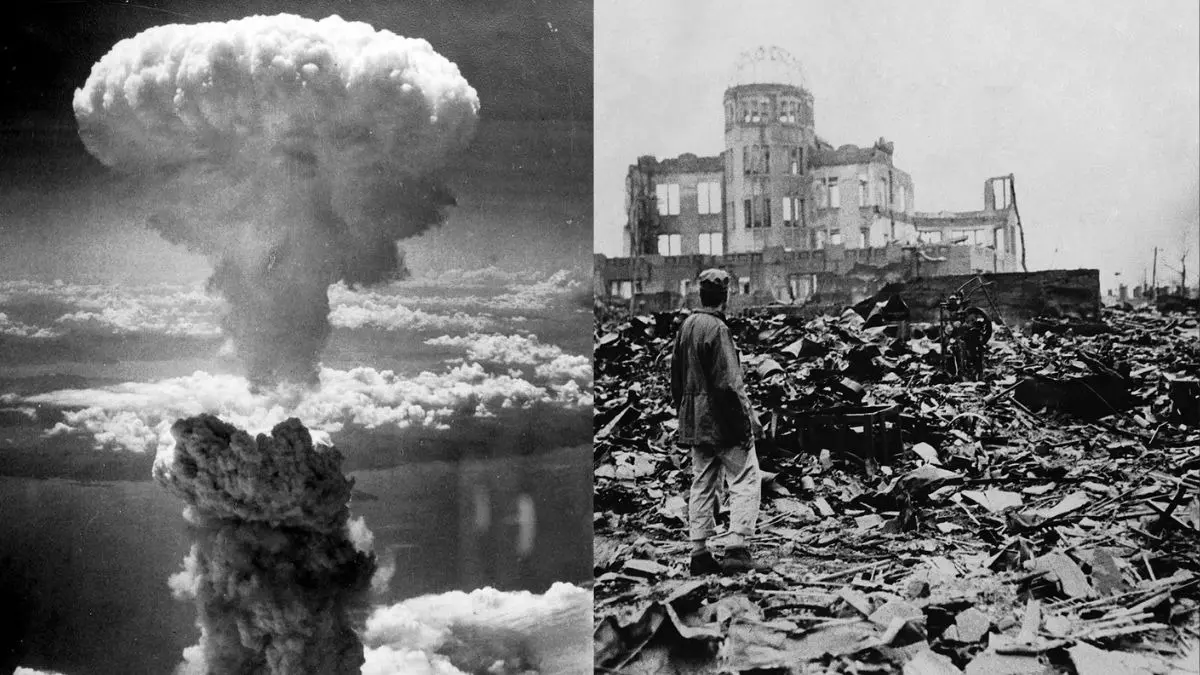
The US bombarded Hiroshima, and Nagasaki in Japan 80 years ago, however, the echoes of destruction still whisper the human sufffering and other devastating effects of waging an atomic war.
The dreaded attack spearheaded by the US occured on August 6, 1945, which altered the way warfare was conducted after it dropped a 10-foot-long uranium bomb that weighed 9,788 pounds called "Little Boy on Hiroshima, leading to demolition of reportedly 62,000 buildings, and instant deaths of 80,000 indiviuals.
Let's have a look at the timeline that lead to one of most devastating attack that mankind has ever witnessed.
Discovery of Nuclear Fission, 1938
German chemist Otto Hahn and his assistant Fritz Strassmann discovered nuclear fission, the science behind the existence of an atomic bomb. The events that occured six years later would forever be eteched in the 1944 Nobel Prize winner's memory.
Advertisement
Alarm Bells Raised Over Possible German Atomic Bomb In 1939
Physicist Leo Szilard wrote a letter inked by Albert Einstein, which warned the then US President Franklin D Roosevelt of the possibilty of a German nuclear weapon project. This letter led to Roosevelt's creation of the atomic programme in 1941 that would later become the Manhattan Project. Reportedly, no German atomic bomb was developed during the period of this war.
Advertisement
The Pearl Harbour Attack
In December 7, 1941, Japan struck Pearl Harbor in Hawaii drawing the US into World War II. A total of 2,403 Americans were killed, including 2,335 military personnel and 68 civilians, alongside 64 Japanese airmen and submariners, as per media reports.
Self-Sustaining Nuclear Chain Reaction
On December 2, 1942, the first self-sustaining nuclear chain reaction was conducted by Nobel physicist Enrico Fermi at the University of Chicago. The experiment, part of the Manhattan Project, paved the way for the building the first atomic bomb.
Battle Of Leyte Gulf
Considered the naval encounter during World War II, this four-day-long encounter, which began on October 26, 1944, cleaned out the Japan's Imperial Navy carrier fleet, confirming the country's definite defeat in the war.
US Firebombs Tokyo
Despite Japan's effort to arrange a surrender, the US on March 10, 1945 launched a major operation that dropped 1,665 tonnes of bombs on Tokyo. This lead to the deaths of 1,00,000 Japanese citizens.
The Trinity Test
Trinity was the codename for the first detonation of a nuclear weapon. The test was conducted near Los Alamos, in the US state of New Mexico, over two months after Germany surrendered. By then, it appeared the US was intent on using the bomb on Japan.
Hiroshmia Bombing
More than two months post Germany's surrender in Europe, the US aircraft Enola Gay, dropped "Little Boy" on August 6, 1945 over the centre of Hiroshima, killing 1,46,000 civilians and 20,000 Japanese armed personnel. The total destruction reportedly covered 1.6 kilometres, with resulting fires across a 11 square foot kilomtres in land area.
On September 2, six days after the bombing of Nagasaki, Japan announced its surrender.
Nagasaki Bombing
Three days after Hiroshima on August 9, 2025, the "Fat Man" was dropped over Nagasaki. The second of the only two nuclear weapons ever used in warfare, it killed as many as 40,000 people.