
'Lone Wolf...Influenced By Islamist Jihadists," Claims Former Mossad Official Oded Ailam After Flydubai Incident
Highlighting the ideological drivers behind radicalisation, ex-Mossad official Oded Ailam noted that even "a lone wolf is influenced by the pack of wolves", pointing out that the attacker was definitely influenced by Islamist jihadists, fundamental slogans, the current situation in West Asia & Iran.
- World News
- 6 min read

;'%3e%3cpath%20d='m8,15.99c4.41,0,7.99-3.58,7.99-7.99S12.41,0,8,0,0,3.59,0,8s3.58,7.99,7.99,7.99Z'%20style='stroke:%23fff;%20stroke-miterlimit:10;%20stroke-width:.02px;'/%3e%3cpath%20d='m3.08,3.37l3.82,5.11-3.84,4.15h.87l3.37-3.64,2.72,3.64h2.94l-4.04-5.39,3.58-3.87h-.86l-3.1,3.35-2.5-3.35h-2.94Zm1.27.64h1.35l5.97,7.99h-1.35l-5.97-7.99Z'%20style='fill:%23fff;'/%3e%3c/g%3e%3c/svg%3e)


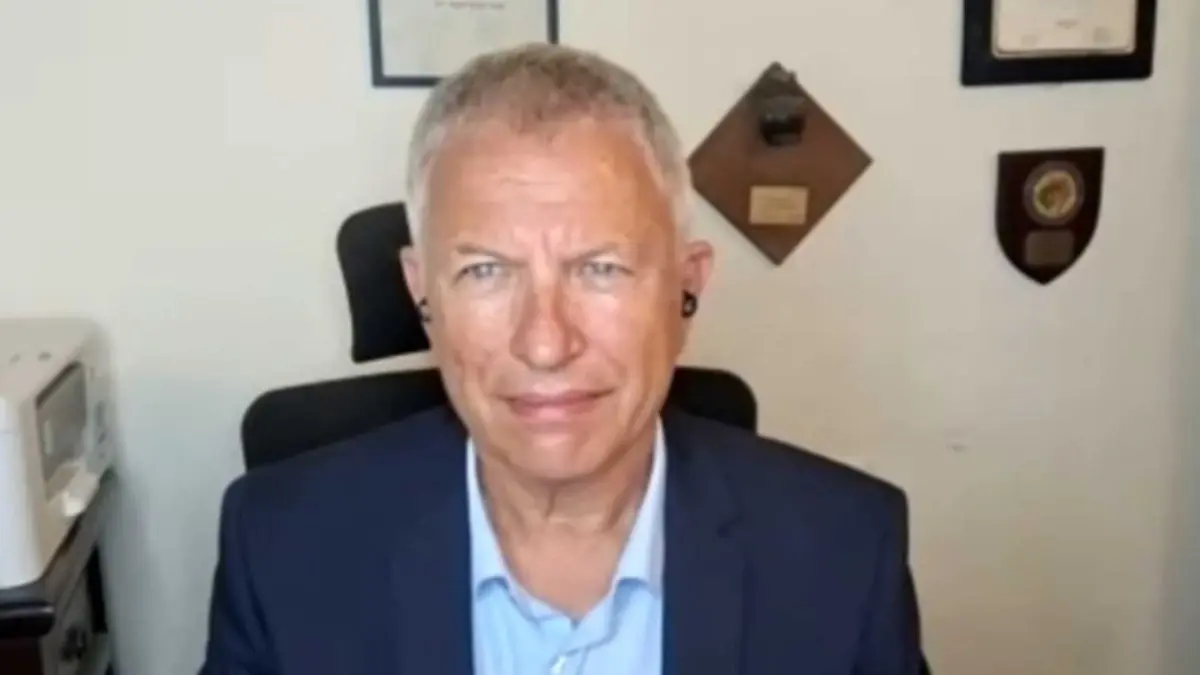
Tel Aviv, Israel: Analysing the evidence surrounding the flydubai flight security crisis, former Mossad counter-terrorism chief Oded Ailam indicated on Friday that the attacker co-pilot likely operated as a "lone wolf" rather than as part of an organised terrorist network, though he emphasised that he was heavily influenced by "Islamist jihadists" and Iranian state influence.
Speaking on the investigation, Ailam, who currently serves as a researcher at the Jerusalem Centre for Security and Foreign Affairs (JCFA), explained the complex psychological effort required to orchestrate such an attack.
“Just from my standpoint of view, because I'm not in the inquiry, it seems that—and I ought to be very, very cautious—that it's a lone wolf. The reason why I see it that way, in order to recruit, handle and manage to pursue such a pilot to conduct such a horrific suicide act, it takes, first of all, a long time. It's a long process. You have to work on the psychological mechanism... It takes time; it takes a lot of experience. And I don't see it happening right now, certainly not by a country, and I don't even think it's by an organisation," Ailam stated, while cautioning that early findings could evolve as the inquiry progresses.
Highlighting the ideological drivers behind radicalisation, Ailam noted that even "a lone wolf is influenced by the pack of wolves", pointing out that the attacker was definitely influenced by Islamist jihadists, fundamental slogans, the current situation in West Asia, and Iran.
Advertisement
Referring to reports regarding the suspect's origin, he added that if the suspect is an Omani Shia, he is far more likely to be influenced by Iranian and jihadist propaganda given the close diplomatic ties between Muscat and Tehran.
“Even the lone wolf is influenced by the pack of wolves. What I mean by that is that he was definitely influenced by Islamist jihadists. It was definitely influenced by fundamental slogans. He was definitely influenced by the situation right now in the Middle East, and definitely was influenced by Iran," he said.
Advertisement
He added, “If he's what they say is from Oman—let's not forget Oman is one of the friendliest countries to Iran in the region... It's more likely that if he's a Shia—and it seems to be that he's a Shia from Oman—it's more likely that someone like him will be influenced more by Iranian propaganda and jihadist propaganda than somebody who is from India or from Iran or whatever.”
Ailam confirmed that an intensive joint probe is actively underway to determine the full scope of the plot, adding that because the suspect is in custody, intelligence agencies will likely piece together “the overall picture” soon.
“I can assume that there is a very intensive inquiry being conducted right now by the Emiratis, a joint venture of the Mossad and the CIA, in order to try to elicit as fast as possible and as much as possible all the info regarding this incident, and perhaps to try to eliminate further incidents because if he's a part of a group or part of a plot, then it's essential to get all the information as soon as possible,” he noted.
Praising the heroics of the plane's commander, Captain Smit Machchhar, who saved the passengers despite being severely wounded after an attack by the co-pilot, Ailam expressed deep gratitude on behalf of Israel, extending his deep appreciation to the Indian pilot for the bravery and heroism that saved the aeroplane and everyone on board.
“I want to say my deep appreciation for the Indian pilot, Mr Samit Mutar, for his bravery and heroism that helped to save the aeroplane. It’s just unbelievable the things he did and saving this aeroplane, and we all here in Israel thank him for that,” Ailam said.
Detailing the unprecedented nature of an insider threat inside a commercial flight deck, Ailam pointed out how rare such hijackings are in aviation history.
“This is a very, very unusual incident. Since the first incident in 1982, of an airline pilot trying to crash a passenger air flight, there have been around 10 incidents like that. All of them were on the basis of some mental issues with the pilot or the co-pilot. I cannot recall even one incident, except maybe the EgyptAir 990 in 1999, in October, that flew from JFK to Cairo, where there was affiliation with a terror act,” he explained.
Ailam observed that traditional aviation security measures were never built to stop the flight crew itself because the pilot is effectively the ruler of the kingdom in the aeroplane. He stressed that a co-pilot attempting a hijacking is an extremely rare event.
“Most of the measurements and the procedures and the security devices are meant to make some sort of the cockpit as a stand-still space against the exterior, against people trying to penetrate it, but not against the pilots themselves. You have to remember the pilot is the ruler of the kingdom in the aeroplane. He is the king of the cockpit. So, such an event of a co-pilot trying to take over and hijack is extremely, extremely rare,” he stressed.
However, Ailam cautioned against creating an environment of suspicion around all aviators, explaining that authorities must balance strict security needs with the fundamental trust placed in flight crews.
“We have to be very careful on the other way. We don't want to make all the pilots suspects. We don't want to deter pilots, and we don't want to make them... some sort of criminals. The one that we have to follow up with, we have to do it in a very delicate, wise way in order to balance between the need for security and the need to trust our pilots. We trust them... and since we cannot make them, as I said, suspects," he stated.
As international investigations intensify into the mid-air security scare, Israel’s i24 News, based on an Emirati source, claimed that among the belongings of the Omani co-pilot were leaflets and publications from “Free Palestine” groups, alongside pro-Palestinian material.
According to i24 News, the pilot had repeatedly expressed support for the Palestinians and hostility towards Israel.
This is consistent with the broader investigation, which is examining the co-pilot’s Islamic radicalisation and possible terrorist motives.
Meanwhile, Jerusalem Post cited sources close to the investigation and reported that the Omani co-pilot did not hold any second nationality. Questions were raised about how a national without diplomatic relations with Israel was cleared to fly the route.
The identity of the flight's co-pilot has not yet been publicly disclosed, though an Omani official verified to CBS News that the assailant was born in Oman and possesses Omani citizenship, even though Muscat has not formally acknowledged his citizenship publicly.