
Massive Floods in China: Typhoon Maysak Leaves Two Dead and Triggers Dam Collapse
The situation rapidly escalated by Monday morning. State broadcaster CCTV reported that the Guangxi Hydrological Centre issued an orange flood warning, the region's second-highest alert level.
- World News
- 4 min read

;'%3e%3cpath%20d='m8,15.99c4.41,0,7.99-3.58,7.99-7.99S12.41,0,8,0,0,3.59,0,8s3.58,7.99,7.99,7.99Z'%20style='stroke:%23fff;%20stroke-miterlimit:10;%20stroke-width:.02px;'/%3e%3cpath%20d='m3.08,3.37l3.82,5.11-3.84,4.15h.87l3.37-3.64,2.72,3.64h2.94l-4.04-5.39,3.58-3.87h-.86l-3.1,3.35-2.5-3.35h-2.94Zm1.27.64h1.35l5.97,7.99h-1.35l-5.97-7.99Z'%20style='fill:%23fff;'/%3e%3c/g%3e%3c/svg%3e)


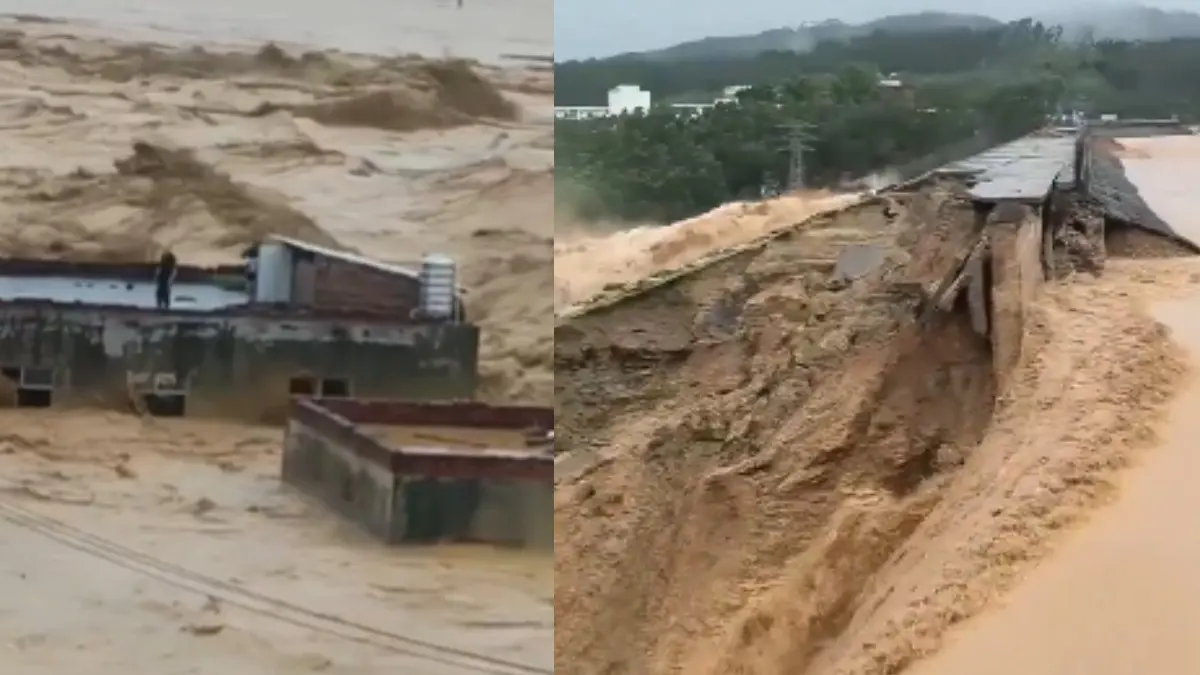
China is grappling with severe devastation after its 10th typhoon of the year left a trail of destruction across the country's southern region. Tropical Storm Maysak initially battered the Guangxi Zhuang Autonomous Region with days of unrelenting torrential rain. The resulting historic floods have claimed two lives, impacted roughly 55,000 people in the city of Nanning, and forced nearly 48,000 residents to flee their homes.
The severe weather has pushed multiple reservoirs to their limits, sent rivers surging past danger thresholds, and submerged numerous villages. In Nanning, local officials confirmed the two fatalities late yesterday, while social media footage captured the moments a local dam structure buckled under the immense water pressure.
Multiple Landfalls and Surging River Alerts
Typhoon Maysak first struck land on Friday in the southern island province of Hainan, grounding flights and halting ferry operations. By Saturday, the storm made a second landfall in Quang Ninh, Vietnam, right along the border with Guangxi.
The situation rapidly escalated by Monday morning. State broadcaster CCTV reported that the Guangxi Hydrological Centre issued an orange flood warning—the region's second-highest alert level. According to forecasts from the Nanning Hydrological Centre, the Yujiang River at the Nanning gauge is expected to peak around 71 meters tomorrow, significantly exceeding the official warning line of 69.4 meters.
Advertisement
Reservoir Breaches and High-Tech Drone Rescues
The infrastructure strain has reached a critical breaking point. Early yesterday, water levels at Hengzhou’s Liulan Reservoir climbed to 111.20 meters—0.91 meters above its maximum flood design capacity—while the nearby Yunbiao Reservoir also began overtopping. Severe breaches and widespread flooding have been documented across multiple reservoirs in Hengzhou and Binyang county.
To relieve the pressure, the Liulan Reservoir fully opened its floodgates. However, the dam suffered a major breach at 11:00 AM yesterday, directly threatening downstream communities. The China Business Network reported that the structural failure tore a 50-meter (164-foot) gap in the dam, unleashing a massive wall of muddy water.
Advertisement
Online videos show the torrent engulfing agricultural fields and utility poles, with stranded residents waving for help from their rooftops. In response, emergency teams deployed more than a dozen DJI drones to airdrop critical supplies and coordinate evacuations. In one dramatic rescue clip, a drone utilized a rope tied around a man's waist to pull him safely from the raging floodwaters.
Village Isolation and Disruptions to International Transit
Facility staff reported that more than 300 people living near the reservoir successfully evacuated to higher ground. Built in 1960, the mid-sized Liulan Reservoir holds up to 95.52 million cubic meters (3.37 billion cubic feet) of water and serves as a vital irrigation source for 40 villages.
During a flood-relief briefing, Nanning officials warned that continued rainfall poses a persistent threat. They noted that challenging rescue conditions and the scale of displacement mean the disaster could still worsen. The flooding has also brought regional transportation to a halt. China Railway Nanning Group announced the suspension of international rail lines, including the T8701 passenger train from Nanning to Gia Lam, Vietnam, and the returning T8702 train via Pingxiang.
Escalating Emergency Responses and Relief Funding
The human toll of the disaster continues to unfold. Xiao Xiang, a resident of Fulong village in Hengzhou, shared that her brother and uncle went missing yesterday morning after being swept away by sudden floodwaters while riding an electric bicycle. Meanwhile, a resident in nearby Wangzhuang village reported that water levels reached the second floor of homes, trapping families on third floors as they waited for emergency boats.
In response to the worsening crisis, Guangxi authorities upgraded the flood-control emergency response for Nanning and Guigang to the highest Level I, while elevating the geological hazard response to Level III. Maritime officials also instituted a Level I inland flood-control response, shutting down 201 ferry crossings, 371 passenger ferries, and 27 transit routes.
To bolster the regional response, China's Ministry of Finance and the Ministry of Emergency Management have pre-allocated CNY 160 million (USD 23.5 million) in emergency disaster-relief funds to support Guangxi and five other impacted provinces. Additionally, authorities have dispatched 150,000 units of essential relief supplies to the flood zones.