
NASA Artemis II Launch: Liftoff To Splashdown, All Your Questions Answered
Four astronauts are due for liftoff aboard NASA's Orion capsule and Space Launch System rocket on April 1 for a 10-day test mission swinging around the moon and back. From liftoff to splashdown, know the full timeline and launch details on republicworld.com.
- World News
- 4 min read

;'%3e%3cpath%20d='m8,15.99c4.41,0,7.99-3.58,7.99-7.99S12.41,0,8,0,0,3.59,0,8s3.58,7.99,7.99,7.99Z'%20style='stroke:%23fff;%20stroke-miterlimit:10;%20stroke-width:.02px;'/%3e%3cpath%20d='m3.08,3.37l3.82,5.11-3.84,4.15h.87l3.37-3.64,2.72,3.64h2.94l-4.04-5.39,3.58-3.87h-.86l-3.1,3.35-2.5-3.35h-2.94Zm1.27.64h1.35l5.97,7.99h-1.35l-5.97-7.99Z'%20style='fill:%23fff;'/%3e%3c/g%3e%3c/svg%3e)


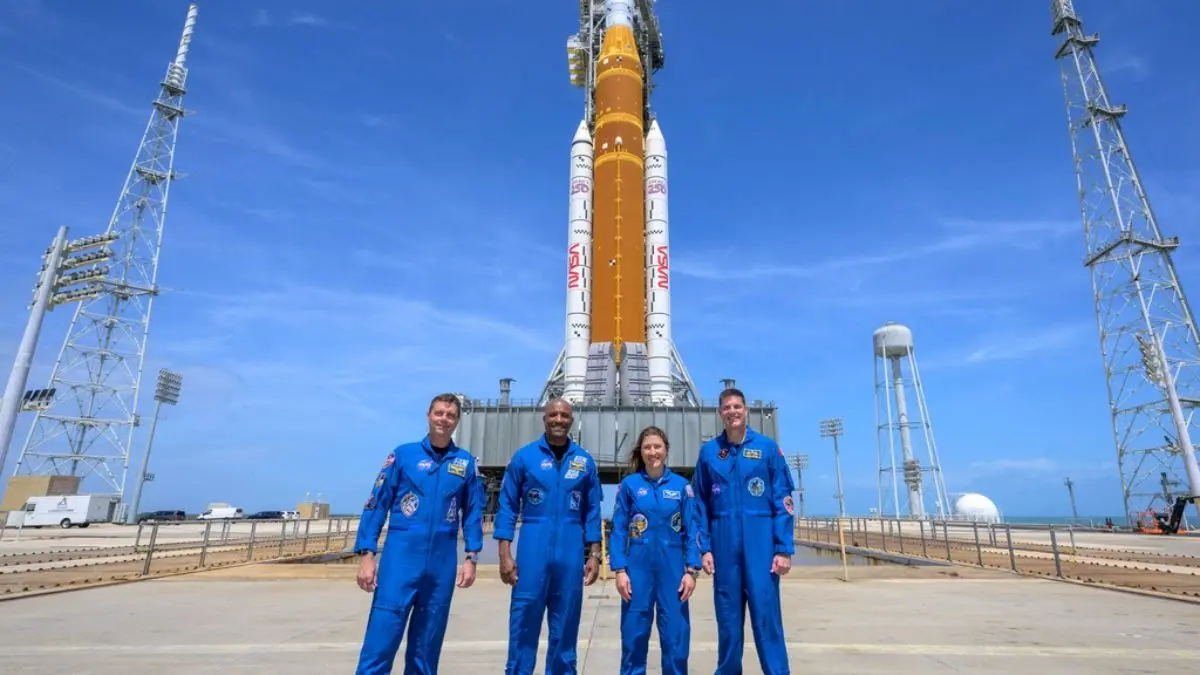
NASA is set to make history again with the launch of its Artemis II mission on April 1, sending humans towards the Moon for the first time in more than five decades. The 10-day crewed test flight aboard the Orion spacecraft and Space Launch System (SLS) rocket marks a crucial step in humanity’s return to deep space exploration.
What is the Artemis II mission?
Artemis II is the first crewed test flight under NASA’s Artemis programme, the United States’ flagship effort to establish a sustained human presence on the Moon and eventually travel to Mars. It will be the first time astronauts travel towards the Moon since the Apollo 17 mission in 1972.
Unlike future missions, Artemis II will not land but will test critical systems needed for upcoming lunar surface expeditions later this decade.
Who is the crew and what makes them historic?
The four-member crew includes NASA astronauts Christina Koch, Victor Glover, Reid Wiseman and Canadian astronaut Jeremy Hansen.
Advertisement
The mission is historic as it includes the first Canadian to travel to the Moon’s vicinity and marks a diverse crew representing international collaboration in deep space exploration.
When is the launch and what is the timeline?
Artemis II is scheduled to lift off on April 1 from Kennedy Space Center aboard the Space Launch System, the most powerful rocket ever built by NASA. Backup launch windows extend through early April depending on weather and technical readiness.
Advertisement
How long will the mission last and what is the trajectory?
The mission is expected to last around 10 days. After launch, Orion will enter a high Earth orbit before performing a translunar injection burn that sends it towards the Moon.
It will follow a “free-return” trajectory, looping around the Moon and naturally returning to Earth without requiring major propulsion adjustments.
What will the crew do during the mission?
Astronauts will conduct extensive testing of Orion’s systems, including life support, propulsion, navigation and communication. They will also evaluate how the spacecraft performs in deep space, farther than humans have travelled before.
The mission is designed to ensure everything functions perfectly before astronauts attempt a lunar landing in future Artemis missions.
How close will they get to the Moon and how far from Earth?
The spacecraft will fly behind the Moon, reaching its maximum distance from Earth during this phase. Artemis II will take humans farther into space than any previous crewed mission, surpassing distances achieved during the Apollo era.
What are the biggest risks and how is safety ensured?
The mission carries significant risks, including deep-space radiation exposure, high-speed re-entry and the performance of life-support systems in extreme conditions.
NASA is testing Orion’s heat shield, one of the mission’s most critical components, as the capsule re-enters Earth’s atmosphere at speeds of about 40,000 km/h. The free-return trajectory also adds a layer of safety, ensuring the spacecraft can return to Earth even in case of system failure.
Why isn't Artemis II landing on the Moon?
Artemis II is strictly a test mission. Its goal is to validate systems, spacecraft performance and crew operations in deep space before attempting a lunar landing.
The first landing under the Artemis programme is planned for later missions, currently targeted towards the latter part of this decade.
How can the public participate or watch?
The launch will be broadcast live by NASA across its official website and social media platforms, allowing viewers worldwide to witness the historic liftoff and key milestones of the mission.
Tune in to the LIVE streams on Republic YouTube and Twitter to ensure you don’t miss a single moment!
What happens after splashdown and what's next for Artemis?
After completing its lunar flyby, Orion will re-enter Earth’s atmosphere and splash down in the Pacific Ocean, where recovery teams will retrieve the crew.
The mission will pave the way for future Artemis flights, including eventual lunar landings and the long-term goal of building a sustainable human presence on the Moon, a stepping stone for missions to Mars.