
Nelson Mandela International Day: Significance, history & things to know about the leader
On the 18th of July, the world is celebrating Nelson Mandela International Day to commemorate the legacy of the great South African leader.
- World News
- 3 min read

;'%3e%3cpath%20d='m8,15.99c4.41,0,7.99-3.58,7.99-7.99S12.41,0,8,0,0,3.59,0,8s3.58,7.99,7.99,7.99Z'%20style='stroke:%23fff;%20stroke-miterlimit:10;%20stroke-width:.02px;'/%3e%3cpath%20d='m3.08,3.37l3.82,5.11-3.84,4.15h.87l3.37-3.64,2.72,3.64h2.94l-4.04-5.39,3.58-3.87h-.86l-3.1,3.35-2.5-3.35h-2.94Zm1.27.64h1.35l5.97,7.99h-1.35l-5.97-7.99Z'%20style='fill:%23fff;'/%3e%3c/g%3e%3c/svg%3e)


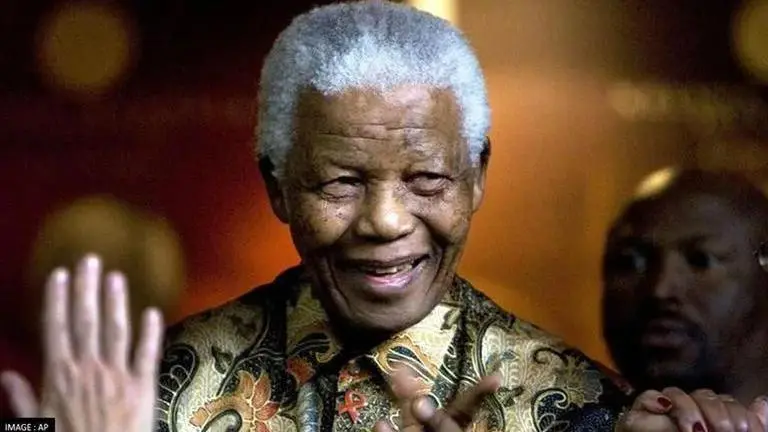
On the 18th of July, the world is celebrating Nelson Mandela International Day to commemorate the legacy of the great South African leader. The annual international day is celebrated every year to mark the birthday of the social reformist and the first President of South Africa. The day is touted as the global call to action that celebrates the idea that each individual has the potential to transform the world.
At the annual event volunteers from around the world join hands and take part in community services around the world. Just like Mandela, the volunteers advocate for equality among all and urge people to have a deep commitment to justice, human rights and fundamental freedoms. “In times of turbulence, Nelson Mandela shows us the power of resisting oppression, of justice over inequality, of dignity over humiliation, of forgiveness over hatred. As the world takes forward the 2030 Agenda for Sustainable Development and strives to overcome new sources of adversity, let us recall the lessons of Nelson Mandela’s life, and the essential humanism that guided him,” UNESCO’s statement on the event reads. Here’s a look at what this international event is all about.
History of Mandela Day
The day was officially recognised by the United Nations after a resolution was passed in the General Assembly on December 1, 2009. “Recognizing the long history of Nelson Rolihlahla Mandela’s leading role in and support for Africa’s struggle for liberation and Africa’s unity, and his outstanding contribution to the creation of a non-racial, non-sexist, democratic South Africa,” the assembly stated in the resolution recognising the annual day. The international body celebrated the first International Mandela Day on 18 July 2010. However, people around the world started celebrating the momentous day in 2009, before the UN passed the resolution. On 27 April 2009, 46664 Aids Foundation and the Nelson Mandela Foundation collaborated and conducted concerts to encourage the global community to celebrate the event.

The Life and Legacy of Nelson Mandela
Rolihlahla Mandela, popularly known as Nelson Mandela, was born into the Madiba clan in the village of Mevzo on 18 July, 1918. His father was the principal councillor to the Acting King of the people of Thembu. Throughout his life, Mandela advocated to promote Human Rights and fought against the notorious Apparthide system that grappled South Africa.
Advertisement
From 1964 to 1982, the revolutionary leader was confined to a notorious prison on Robben Island. Mandela spent his time in prison with several other resistance leaders. He was released in 1990. However, during his imprisonment, he became a rallying point for South Africa's oppressed people. He later became the country’s first president post-independence and a celebrated leader around the world.
What UN has to say?
The UN Secretary-General António Guterres shared a poignant message on the occasion. “Nelson Mandela was a colossus of courage and conviction. A leader of immense achievement and extraordinary humanity. A giant of our times, whose legacy we best honour through action,” Guterres said in a statement. “We commemorate Nelson Mandela’s life and legacy, let us be animated by his spirit of humanity, dignity and justice. Let us stand with women and girls, young people and change-makers everywhere. And let us take action to build a better world,” he concluded. According to the UN website, the General Assembly will commemorate the day at an informal plenary session on the morning of July 20. Other commemorative events will include a Virtual Public Service Activity to spread out the message of Mandela.