
‘Not Distant Events’: Rajnath Singh Flags Strait Of Hormuz Disruption As Direct Threat To India’s Energy, Economy
In Berlin, Defence Minister Rajnath Singh asserted that Strait of Hormuz disruptions directly threaten India’s energy needs, economy and stability, calling them “stark realities” not distant events for India.
- World News
- 4 min read

;'%3e%3cpath%20d='m8,15.99c4.41,0,7.99-3.58,7.99-7.99S12.41,0,8,0,0,3.59,0,8s3.58,7.99,7.99,7.99Z'%20style='stroke:%23fff;%20stroke-miterlimit:10;%20stroke-width:.02px;'/%3e%3cpath%20d='m3.08,3.37l3.82,5.11-3.84,4.15h.87l3.37-3.64,2.72,3.64h2.94l-4.04-5.39,3.58-3.87h-.86l-3.1,3.35-2.5-3.35h-2.94Zm1.27.64h1.35l5.97,7.99h-1.35l-5.97-7.99Z'%20style='fill:%23fff;'/%3e%3c/g%3e%3c/svg%3e)


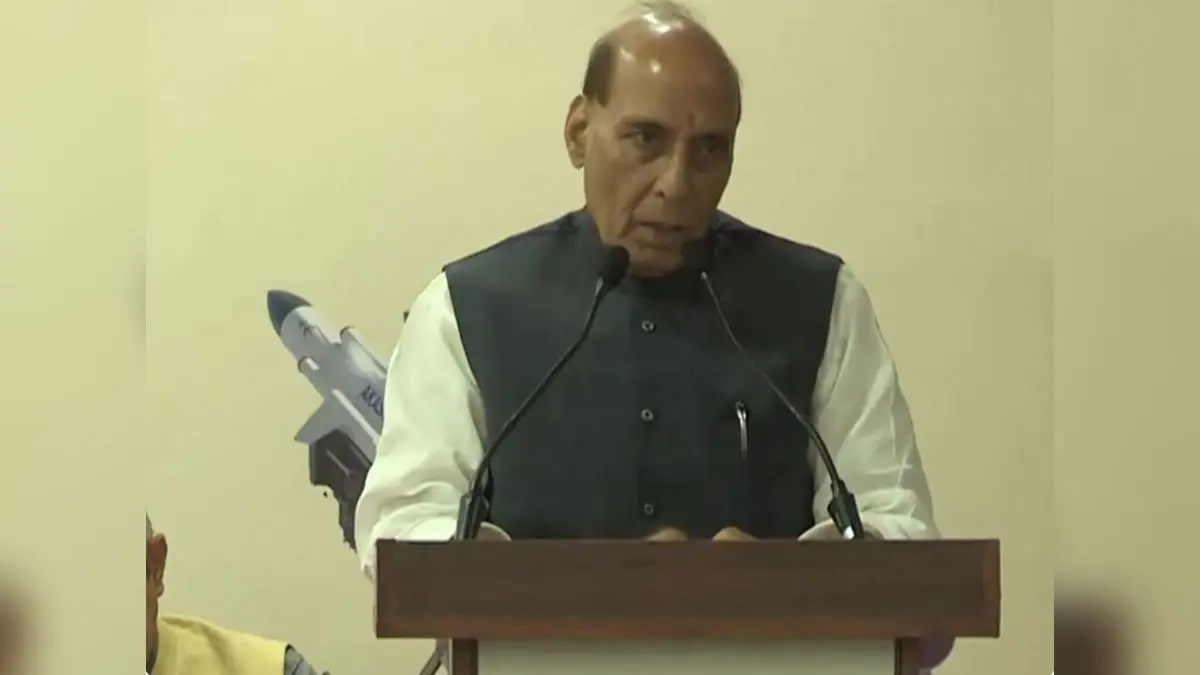
Berlin: Defence Minister Rajnath Singh on Tuesday highlighted India's concerns over energy security, stating that any disruption in the Strait of Hormuz has direct consequences for the country's economy and stability.
He said that for a developing nation like India, which depends heavily on the West Asian region for energy, such disruptions are not distant events but immediate challenges affecting national security and economic interests.
According to a statement from the Ministry of Defence, addressing the German Parliamentary Standing Committee on Defence and Security in Berlin on Day-1 of his three-day visit to Germany, Singh said "... For a developing country like India, which relies on the West Asian region for a significant share of its energy requirements, disruptions in the Strait of Hormuz are not distant events, they are stark realities with direct implications for our security and economic stability."
Further, Singh pointed out that the current geopolitical instability can no longer be viewed as a regional matter. Their consequences are global in scope, he said, describing them as not localised disturbances, but serious developments with far-reaching implications for energy security, food security, and global economic stability, apart from the immense humanitarian cost they entail.
Advertisement
Defence Minister highlighted that in view of these challenges and their direct implications, India adopted a proactive and coordinated strategy. He told the Parliamentarians that a Group of Ministers on West Asia is continuously assessing the evolving situation and recommending timely measures to minimise its impact.
"Bringing together key ministries, our deliberations focused on safeguarding energy supplies, maintaining the availability of essential commodities, containing inflationary pressures, and protecting citizens as well as industry from external disruptions. This reflects India's capacity to respond to global crises with calmness, foresight, and effective institutional coordination," he said.
Advertisement
He said Aatmanirbhar Bharat is not merely a procurement programme; it is an invitation to co-create, co-develop, and co-innovate, as he made a strong pitch for enhanced collaborations between the defence industrial ecosystems of India and Germany.
Defence Minister asserted that the world today is faced with new security threats, and the technological transformation has made the situation highly complex and intricately connected. A new approach with the willingness to adapt to the changing environment is the need of the hour, he said.
Defence Minister asserted that India, under the visionary leadership of Prime Minister Narendra Modi, is witnessing an unprecedented transformation in the defence sector, and increased partnerships with the German industry can yield significant mutual gains.
"We recognise the established strengths of Germany's leading industrial enterprises, while also admiring the vigour and dynamism of the renowned German Mittelstand (small & medium-sized companies) in advanced and emerging technologies. In India too, our start-ups and enterprising private companies are rapidly enhancing and complementing the capabilities of our larger and established defence enterprises. This is an area where India and Germany naturally complement each other, and our partnership can deepen further," Singh said.
To deal with modern-day global challenges, Rajnath Singh underscored the need for coordinated responses and trusted strategic partnerships.
"Prime Minister Narendra Modi and German Chancellor Friedrich Merz have placed strong emphasis on advancing this strategic partnership. We also see a clear convergence of views at the European Union level, reflected in the growing momentum to engage with India, including through the India-EU Defence and Strategic Partnership," he said.
Defence Minister reiterated that India and Germany are not only strategic partners, but also consequential voices in shaping the global discourse of the present times.
"We are established democracies bound by shared values, and dynamic economies driven by resilience, innovation, and a determined industrial spirit. As lawmakers and esteemed members of the Committee, your guidance, voice, and support can further strengthen and enrich the future course of our defence and strategic cooperation. When the chronicles of this era are penned, the India-Germany partnership will stand as a paragon of diplomacy, crafted not in response to crisis, but through the steady resolve of two mature democracies choosing to walk this path together," he stated.
Member of Parliament and Chairman of the Committee, Thomas Roewekamp, had received Rajnath Singh for the interaction with the Parliamentarians.