
Pakistan left red-faced as China stops work on CPEC project after fatal bus blast
In further trouble for Pakistan, China stopped the work on the Dasu Hydropower Project after 9 Chinese nationals were killed in the Khyber Pakhtunkhwa province.
- World News
- 3 min read

;'%3e%3cpath%20d='m8,15.99c4.41,0,7.99-3.58,7.99-7.99S12.41,0,8,0,0,3.59,0,8s3.58,7.99,7.99,7.99Z'%20style='stroke:%23fff;%20stroke-miterlimit:10;%20stroke-width:.02px;'/%3e%3cpath%20d='m3.08,3.37l3.82,5.11-3.84,4.15h.87l3.37-3.64,2.72,3.64h2.94l-4.04-5.39,3.58-3.87h-.86l-3.1,3.35-2.5-3.35h-2.94Zm1.27.64h1.35l5.97,7.99h-1.35l-5.97-7.99Z'%20style='fill:%23fff;'/%3e%3c/g%3e%3c/svg%3e)


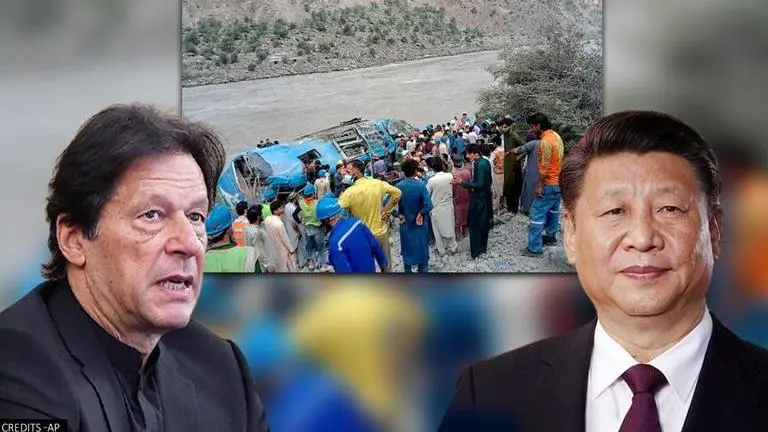
In further trouble for Pakistan, China stopped the work on the Dasu Hydropower Project after 9 Chinese nationals were killed in the Khyber Pakhtunkhwa province. The China Gezhouba Group Company (CGGC) was constructing a hydroelectric plant on a river near Dasu as a part of the China Pakistan Economic Corridor. While lauding the efforts of everyone who participated in the rescue efforts, the CGGC announced that it will retain the bare minimum Pakistani staff for maintenance.
In a statement, the CGGC stated, "CGGC Dasu HPP Management has regretfully decided to terminate employment with all Pakistani personnel, complying with the Pakistan Industrial and Commercial Ordinances, other than some necessary personnel to maintain on-site maintenance and operation. 14-days half-month wages (from July 15th to July 28th, 2021) and Gratuity will be paid in line with the stipulations as specified in the above ordinances, and the salary of this month will be paid until July 14th, 2021. The aforesaid money will be paid at one time."
Termination of employment contracts of Pakistani personnel by DASU HPP Management (Chinese) is extremely worrying development. Imran Niazi Govt’s handling of national affairs has landed Pakistan in seriously sad state of affairs. Time to get rid of this incompetent &corrupt Govt! pic.twitter.com/unkfpb06gg
— Ishaq Dar (@MIshaqDar50) July 17, 2021
Bus blast rocks Pakistan
At least 12 persons including 9 Chinese citizens were killed at around 7 am on July 14 when a shuttle bus carrying working staff on the Dasu Hydropower Project fell into a ravine following an explosion. Initially, Pakistan's Ministry of Foreign Affairs stated that a "mechanical failure" resulted in leakage of gas that caused the blast. However, the Chinese Communist Party's mouthpiece Global Times asserted that the explosion was “clearly an act of terrorism that is both carefully planned and supported by information."
A day later, Pakistan changed its stance citing the trace of explosives, and admitted that terrorism cannot be ruled out. On Friday, Chinese premier Li Keqiang raised the issue with Imran Khan during a phone call where he stressed the need for Pakistan to use "all necessary measures" to probe the incident and hold the culprits accountable. Addressing the media on Saturday, the country's Interior Minister Sheikh Rashid Ahmed revealed that 15 Chinese officials had arrived in Pakistan for the investigation and added that the injured are being treated at the Pakistan Army Hospital.
Assuring that the security of Chinese nationals will be strengthened further, he also mentioned that Pakistan PM Imran Khan had told him and Foreign Minister Shah Mahmood Qureshi to visit China. Meanwhile, the Chinese ambassador to Pakistan visited the site of the shuttle bus explosion to investigate the cause, together with the Pakistani military and a Chinese team. In the briefing, Pakistani officials claimed that terrorists used homemade explosives with no ball bearings.
Advertisement
CPEC's importance in Pakistan-China ties
Launched in 2015, the CPEC is the flagship project of China’s Belt and Road Initiative (BRI). It was expected to bring in massive investment from China, creating thousands of job opportunities for the people of Pakistan. When Nawaz Sharif was the PM, several projects were close to completion. However, Imran Khan’s regime has witnessed the stalling of the CPEC projects owing to the dire economic situation and non-cooperation of the bureaucracy due to the prevailing fear of the National Accountability Bureau (NAB).
Political instability has also hindered progress as the NAB has been regularly arresting leading opposition leaders in Pakistan. On his part, Khan has repeatedly assured that the timely completion of CPEC projects is a top priority for the Pakistan government. Recently, debt-ridden Pakistan requested Beijing to forgive debt liabilities owed to China-funded energy projects established under the CPEC.