
'People Didn't Feel the War at All': President Pezeshkian Says Coordinated Governance, Local Leaders Helped Iran Withstand West Asia Conflict
Iranian President Masoud Pezeshkian stated that coordinated governance and regional cooperation helped Iran manage the West Asia conflict, allowing citizens to remain largely unaffected by infrastructure attacks. He praised government agencies for maintaining normalcy, emphasizing minimal public perception of power outages.
- World News
- 3 min read

;'%3e%3cpath%20d='m8,15.99c4.41,0,7.99-3.58,7.99-7.99S12.41,0,8,0,0,3.59,0,8s3.58,7.99,7.99,7.99Z'%20style='stroke:%23fff;%20stroke-miterlimit:10;%20stroke-width:.02px;'/%3e%3cpath%20d='m3.08,3.37l3.82,5.11-3.84,4.15h.87l3.37-3.64,2.72,3.64h2.94l-4.04-5.39,3.58-3.87h-.86l-3.1,3.35-2.5-3.35h-2.94Zm1.27.64h1.35l5.97,7.99h-1.35l-5.97-7.99Z'%20style='fill:%23fff;'/%3e%3c/g%3e%3c/svg%3e)


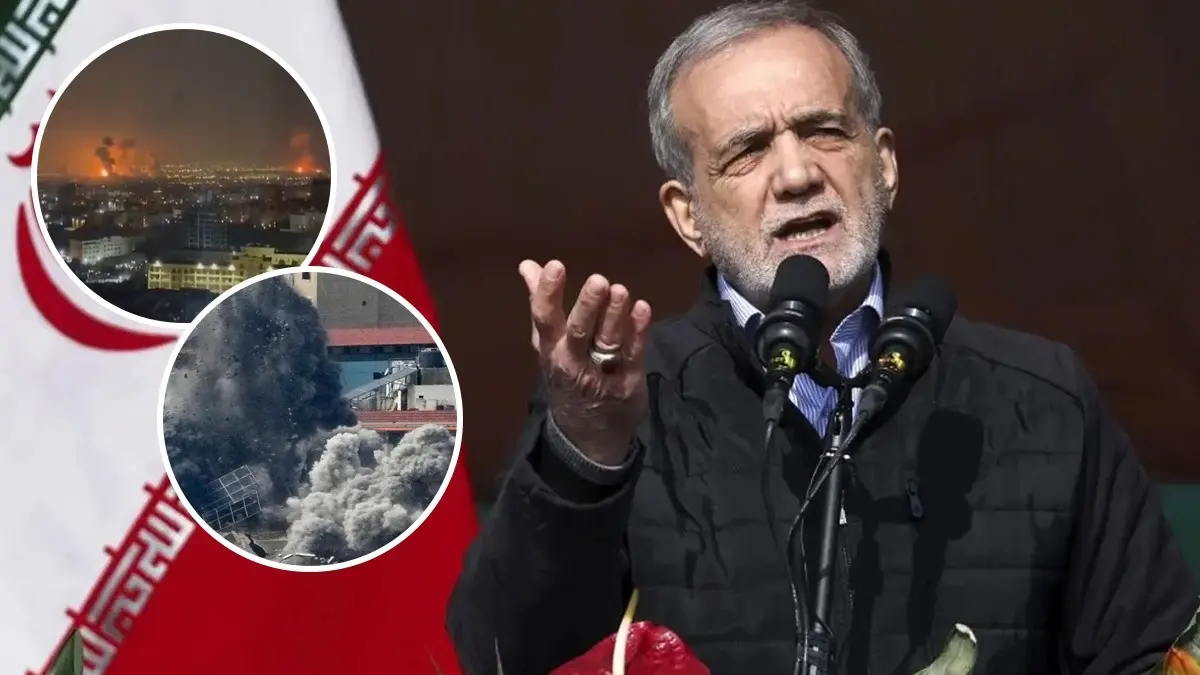
Tehran: Iranian President Masoud Pezeshkian on Thursday (local time) said coordinated governance, effective crisis management and cooperation from neighbouring countries helped Iran withstand the ongoing West Asia conflict, asserting that ordinary citizens "didn't feel the war" despite attacks on key infrastructure.
In a televised address to the nation, Pezeshkian credited government agencies, provincial administrations and cabinet coordination for maintaining normalcy during the conflict.
"The people didn't feel the war at all; they only realised something had happened when they were struck somewhere or saw the images on television. This situation was shaped thanks to our managers, governors, county governors, and the coordination of our ministers," Pezeshkian said.
He added that despite attacks on critical infrastructure, including power facilities, the impact on the public remained limited.
Advertisement
"Why didn't the people feel the power outages? Many of our power plant sites were struck, but the people didn't feel that there was any problem," he said.
The Iranian President also highlighted improving ties with neighbouring countries, saying regional cooperation had strengthened significantly in recent years.
Advertisement
"Iran's relationship with its neighbours is much better than in the past, and neighbouring countries are very cooperative," Pezeshkian said.
According to the President, one of the objectives of Iran's adversaries during the conflict was to trigger instability along the country's border regions.
"One of the enemies' plots during the war was to incite unrest and tensions in the northwest and southeast. They claimed that people would enter from those sides to cause disturbances, but our neighbours did not let that happen," he said.
Pezeshkian also outlined infrastructure priorities for the capital, saying expanding the Tehran metro network to surrounding cities remains on the government's agenda.
"Connecting the cities around Tehran to the metro is on the agenda. The arteries around Tehran, such as Islamshahr, Qods City, Robat Karim and Shahriar, if connected to the metro, will definitely reduce travel time and air pollution," he said.
His remarks come amid heightened regional tensions. Earlier, Iran's Acting Defence Minister Brigadier General Majid Ebn-e-Reza said the country's Armed Forces were fully prepared to counter any external threat, stressing that Iran's military readiness was backed by its domestic defence industry.
The latest statements also follow renewed tensions between Tehran and Washington after US President Donald Trump warned that Iran would be "hit very hard" if the Strait of Hormuz was not reopened soon. However, Iran has rejected US claims of ongoing negotiations, with Foreign Ministry spokesperson Esmaeil Baqaei stating that Tehran is not currently engaged in talks with Washington.