
‘Phoney, Hollow Gimmick’: India Tears Into Pakistan Over Rs 70 Lakh Masood Azhar Bounty, Demands Concrete Action
India slams Pakistan’s Rs 70 lakh bounty on Masood Azhar as a “phoney” move, calling Islamabad’s terror crackdown hollow and demanding concrete action.
- World News
- 6 min read

;'%3e%3cpath%20d='m8,15.99c4.41,0,7.99-3.58,7.99-7.99S12.41,0,8,0,0,3.59,0,8s3.58,7.99,7.99,7.99Z'%20style='stroke:%23fff;%20stroke-miterlimit:10;%20stroke-width:.02px;'/%3e%3cpath%20d='m3.08,3.37l3.82,5.11-3.84,4.15h.87l3.37-3.64,2.72,3.64h2.94l-4.04-5.39,3.58-3.87h-.86l-3.1,3.35-2.5-3.35h-2.94Zm1.27.64h1.35l5.97,7.99h-1.35l-5.97-7.99Z'%20style='fill:%23fff;'/%3e%3c/g%3e%3c/svg%3e)


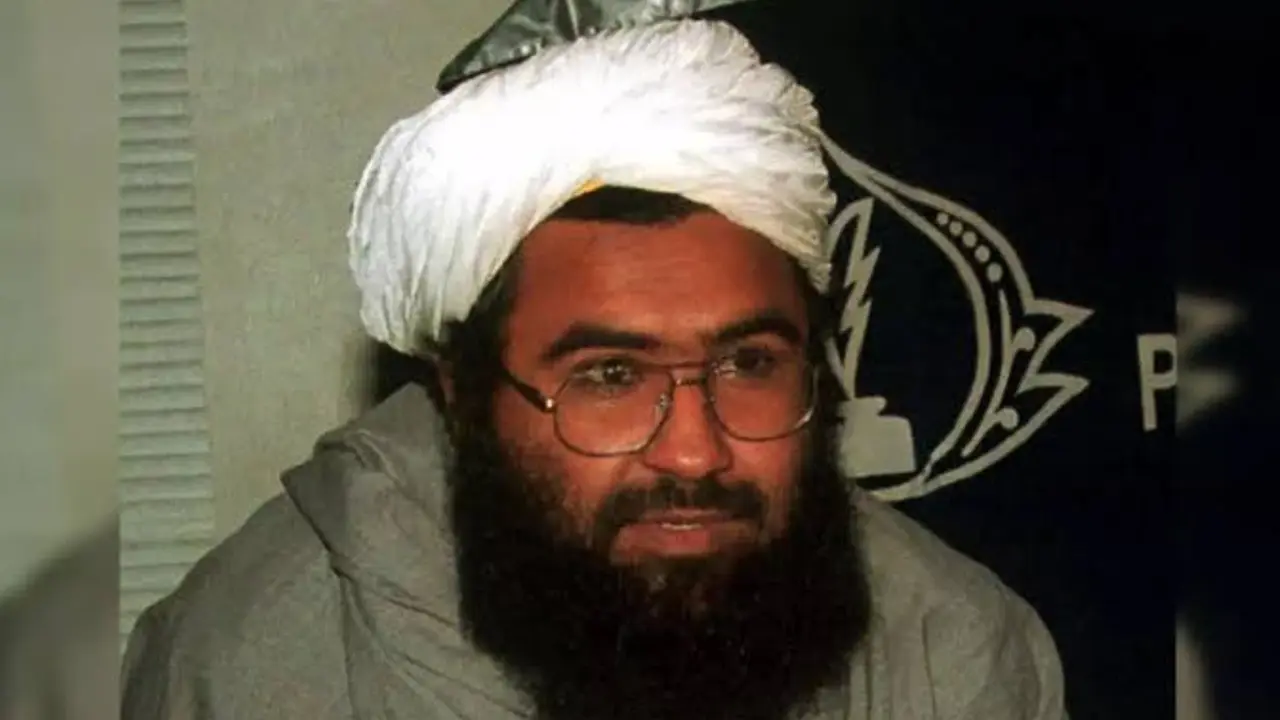
New Delhi: Pakistan’s decision to retain Jaish-e-Mohammed (JeM) chief Masood Azhar on its list of most-wanted terrorists and increase the reward for information leading to his arrest or conviction has drawn a sharp response from India, with New Delhi calling the move a “phoney” exercise and asking Islamabad to take concrete action.
Ministry of External Affairs spokesperson Randhir Jaiswal, responding to Pakistan’s latest position on the bounty, said such announcements had been made before and had little consequence.
“Such gimmicks and attempts at hoodwinking people by Pakistan are nothing new. We have seen similar gimmicks in the past as well. For a state sponsor of terrorism to make such phoney announcements, we all know how hollow they are. Pakistan must take concrete action rather than make announcements that are ultimately of no consequence...”
Pakistan’s Federal Investigation Agency (FIA) has retained Azhar in its 2026 Red Book of most-wanted terrorists. The reward attached to information that directly leads to his “apprehension or conviction” now stands at PKR 7 million, or Rs 70 lakh, up from PKR 50 lakh when he was first included in the list in 2021.
Advertisement
Pakistan Says He Fled To Afghanistan. Indian Intel Points Elsewhere
The renewed focus on Azhar’s whereabouts comes against the backdrop of a continuing dispute over where the JeM chief is actually based.
Pakistan has maintained since 2021 that Azhar left the country and is hiding in Afghanistan. However, Indian intelligence assessments indicate that he may still be operating from Pakistan. Sources said technical intelligence gathered over the past six months points to Nawabshah in Sindh as a possible location where Azhar is currently hiding.
Advertisement
That assessment raises questions over Islamabad’s repeated claim that the terror chief is no longer in Pakistan. It also puts the latest increase in the bounty under greater scrutiny: while Pakistan publicly lists Azhar as a wanted man, India has long accused the country of providing shelter to terror operatives.
Azhar, the founder and chief of JeM, is wanted in India in several terror cases. His name has been linked to the 2001 Parliament attack, the 2016 Pathankot airbase attack and the February 2019 Pulwama bombing.
India had also sought Azhar among the fugitives it wanted Pakistan to act against after the 2008 Mumbai terror attacks, in which 10 Lashkar-e-Taiba terrorists killed 166 people.
26/11 Fugitives Remain On Pakistan’s List
The questions over Pakistan’s counter-terror action extend beyond Azhar. The latest FIA Red Book contains 19 names linked to the 26/11 Mumbai terror attacks. Of these, 17 remain on the list with details of their alleged roles in facilitating, financing or arranging the sea route used by the attackers. Indian intelligence sources maintain that the 17 fugitives continue to be in Pakistan, despite having evaded capture for 18 years.
The updated records also show changes involving two names, Muhammad Khan from Turbat and Abdul Rehman from Bahawalnagar. Details that were present in the 2021 edition, including photographs, Lashkar-e-Taiba affiliations and specific operational roles, have been removed, leaving their names in the latest record.
Muhammad Khan had earlier been identified as the person who provided the yacht Al-Hussaini, which was used to transport the Mumbai attackers. Abdul Rehman was also listed with his photograph and alleged LeT links.
The FIA’s current list identifies 11 LeT-linked individuals as having allegedly helped facilitate the sea journey using Al-Hussaini and Al-Fauz. They are Muhammad Amjad Khan from Multan, Shahid Gafoor from Bahawalpur, Mohammad Usman from Sahiwal, Ateeq-ur-Rehman from Lahore, Riaz Ahmad from Hafizabad, Muhammad Mushtaq from Gujranwala, Muhammad Naeem from Dera Ghazi Khan, Abdul Shakoor from Karachi, Muhammad Sabir Salfi from Multan, Muhammad Usman from Lodhran and Shakeel Ahmed from Rahim Yar Khan.
Six others have been identified for allegedly providing financial support. They include Muhammad Iftikhar Ali of Faisalabad, accused of spending PKR 70,000 to establish VOIP connections between the attackers and their handlers; Mohammad Zia of Rawalpindi, who allegedly donated PKR 80,000; Mohammad Abbas Nasir of Khanewal, who allegedly donated PKR 2,53,000; Javed Iqbal of Kasur, who allegedly donated PKR 1,86,430; Mukhtar Ahmad of Mandi Bahauddin, who allegedly donated PKR 2,98,047; and Ahmed Saeed of Battagram, who allegedly provided PKR 21 lakh.
The FIA says the 17 suspects connected to the Mumbai attacks have remained at large for 18 years.
Red Book Expands As FATF Review Nears
The scale of Pakistan’s wanted-terrorist list has also grown significantly. The FIA Red Book contained 1,330 names in 2021. The latest edition has 1,804 names, an increase of around 35% in five years.
The timing of the latest developments is also significant, with the Financial Action Task Force (FATF) set to hold its next plenary in Paris from October 26 to 30. Pakistan was placed on the FATF grey list, formally known as increased monitoring, in 2018. It remained there until 2022, when it was removed after completing commitments under two action plans aimed at improving its anti-money laundering and counter-terror financing systems, as well as implementing targeted financial sanctions.
Against that backdrop, the decision to increase the reward for Azhar while retaining him on the most-wanted list is being viewed with scepticism in India. New Delhi has argued that listing wanted terrorists is not enough unless Pakistan follows it with arrests and prosecution.
The issue has gained further significance after India’s Operation Sindoor. During the operation, Indian Armed Forces targeted the JeM headquarters at Markaz Subhan Allah in Bahawalpur, around 100 kilometres inside Pakistan.
The facility, operational since 2015, was described as a major JeM training, indoctrination and operational centre. It had also been associated with the group’s terror planning, including the 2019 Pulwama attack.
The compound was reportedly used by senior JeM figures, including Masood Azhar, Mufti Abdul Rauf Asghar and Maulana Ammar. Azhar had also delivered addresses from the facility, while the centre was used for religious, physical and weapons training of JeM cadres.