
PM Modi Dials Bangladesh's Next PM Tarique Rahman After BNP Sweep, Will This Early Diplomacy Redefine Indo-Bangla Ties?
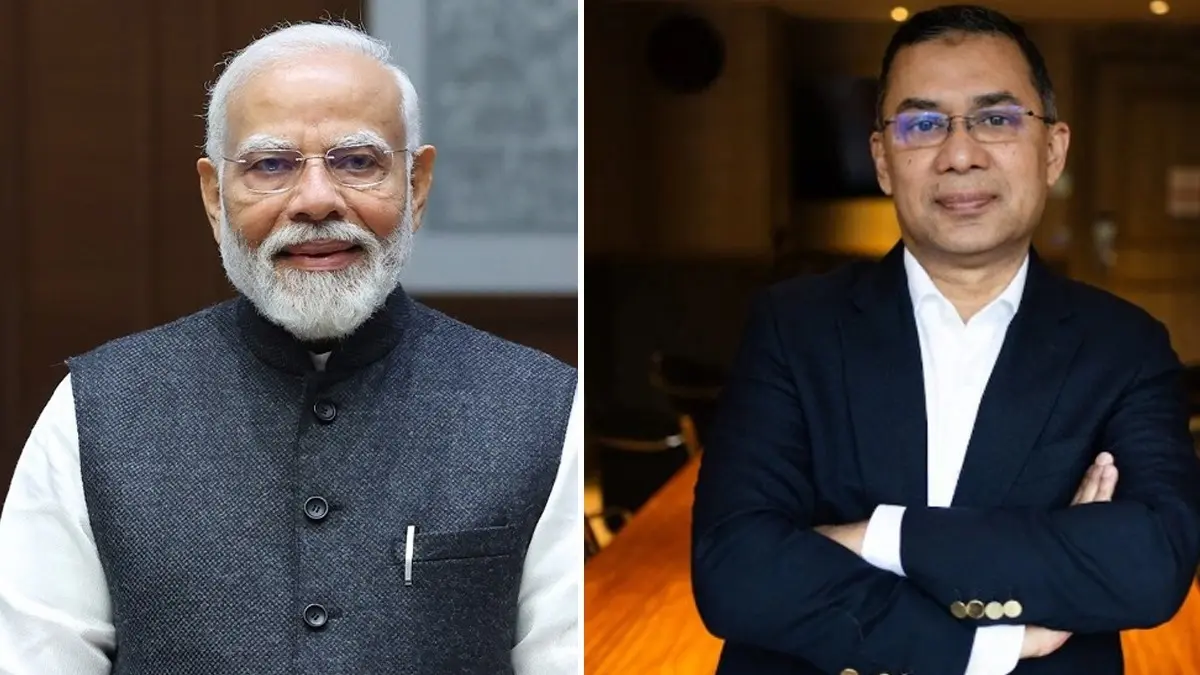
PM Modi congratulated Tarique Rahman via phone call and on X, emphasizing India’s commitment to a "democratic, inclusive Bangladesh". This diplomatic outreach is being perceived by analysts as a smart move to ensure Bangladesh remains aligned with India rather than drifting toward China or Pakistan.
- World News
- 7 min read

;'%3e%3cpath%20d='m8,15.99c4.41,0,7.99-3.58,7.99-7.99S12.41,0,8,0,0,3.59,0,8s3.58,7.99,7.99,7.99Z'%20style='stroke:%23fff;%20stroke-miterlimit:10;%20stroke-width:.02px;'/%3e%3cpath%20d='m3.08,3.37l3.82,5.11-3.84,4.15h.87l3.37-3.64,2.72,3.64h2.94l-4.04-5.39,3.58-3.87h-.86l-3.1,3.35-2.5-3.35h-2.94Zm1.27.64h1.35l5.97,7.99h-1.35l-5.97-7.99Z'%20style='fill:%23fff;'/%3e%3c/g%3e%3c/svg%3e)


In a dramatic shift reshaping South Asia's geopolitical dynamics, the Bangladesh Nationalist Party (BNP), led by Tarique Rahman, has secured a landslide victory in the February 12, 2026, parliamentary elections--the first since the 2024 youth uprising that forced long-time Prime Minister Sheikh Hasina to flee the country.
The BNP and its allies won approximately 212 seats out of 299 contested (with final tallies confirming a strong two-thirds majority in the Jatiya Sangsad), positioning Rahman, son of late former Prime Minister Khaleda Zia, as the likely next prime minister.
For India, the outcome presents both opportunities and uncertainties. Hasina's government had been a reliable partner, deepening economic links, border coordination, and counter-terrorism collaboration. The BNP, historically viewed in New Delhi with caution due to past ties with Jamaat-e-Islami and concerns over minority protections and Islamist influences, now signals pragmatism.
Rahman's December meeting with External Affairs Minister S. Jaishankar hinted at reconciliation. Prime Minister Narendra Modi reinforced this by congratulating Rahman via phone and on X, emphasizing India’s commitment to a 'democratic, inclusive Bangladesh' and shared prosperity. In fact, PM Modi was among the first to congratulate Tarique Rahman, signaling India's willingness to work with the democratically elected government. The road ahead will likely involve diplomatic outreaches where trade and transit remain the primary bridges, even as political and security ties undergo a stress test.
Advertisement
In his social media post, PM Modi also suggested that both countries work together towards their common development goals to further strengthen their relationship. This diplomatic outreach is being perceived by analysts as a strategic move to ensure Bangladesh remains aligned with India rather than drifting toward China or Pakistan.
In a post on X, PM Modi wrote, "I convey my warm congratulations to Mr. Tarique Rahman on leading BNP to a decisive victory in the Parliamentary elections in Bangladesh. This victory shows the trust of the people of Bangladesh in your leadership.
Advertisement
"India will continue to stand in support of a democratic, progressive and inclusive Bangladesh. I look forward to working with you to strengthen our multifaceted relations and advance our common development goals," the prime minister added in the X post.
Later in the day, PM Modi wrote about his phone call with Tarique Rahman and reaffirmed India’s commitment to the “peace, progress, and prosperity” of people of both the countries.
In a post on X, PM Modi wrote, "Delighted to speak with Mr. Tarique Rahman. I congratulated him on the remarkable victory in the Bangladesh elections. I conveyed my best wishes and support in his endeavour to fulfil the aspirations of the people of Bangladesh."
"As two close neighbours with deep-rooted historical and cultural ties, I reaffirmed India’s continued commitment to the peace, progress, and prosperity of both our peoples," he added in the X post.
The Bangladesh Nationalist Party (BNP), after its decisive victory in Bangladesh's 13th National Parliament elections, has expressed gratitude to India following Prime Minister Narendra Modi’s congratulatory message to party chairperson Tarique Rahman.
Speaking at the Election Commission Secretariat in Dhaka, Nazrul Islam Khan, chief of BNP’s polls coordination committee, welcomed Modi’s words and voiced optimism for enhanced bilateral relations.
“We also, on behalf of our party, thank him and believe that under the leadership of our leader Tarique Rahman, the relations between our two countries and the people of these two countries will be strengthened,” Khan remarked.
Several issues could test the reset:
1. The long-stalled Teesta River water-sharing deal may face renewed pressure, as the BNP campaigned on fair transboundary resource allocation, including references to the 1997 UN Watercourses Convention.
2. Border management remains critical, with India seeking commitments to curb infiltration, smuggling, and militancy--tensions that escalated after 2024.
3. Safeguarding Hindu and other minorities, who faced heightened risks post-Hasina, will serve as an early benchmark for the new administration.
4. Economically, potential abounds. Bangladesh's export-oriented growth depends on India for trade, transit, and markets, while the U.S. remains its top export destination. Rahman has pledged balanced ties with both India and the West, emphasizing infrastructure, skills, and stability.
Analysts see scope for stronger bilateral engagement if the BNP delivers inclusive governance and addresses India's core concerns.
Compared to a Jamaat-led scenario (which secured roughly 68–77 seats), the BNP may represent a more manageable partner for India.
Former High Commissioner of India to Bangladesh Veena Sikri has hailed the recent election results in Bangladesh as a major triumph for its people and a clear endorsement of democratic values.
"The election results of last night represent a great victory for the people of Bangladesh," she noted.
Sikri described the outcome as a direct setback to Islamist forces that had aggressively campaigned for power.
"I think that the victory of Tariq Rehman is a victory for democracy because Jamaat-e-Islami had been campaigning very strongly, using financial exhortation and using religious exhortation. They were really with the support of the Western powers and the support of Pakistan. They were really all set to form a government on their own," she said.
The Bigger Picture: Shared Goals, Challenges, Security Concerns
The landslide victory of the BNP in the Bangladesh polls is likely to redefine India-Bangladesh ties amid challenges and security concerns raised from both sides. Key details include:
1. A Shift from "Dependency" to "Equality"
The BNP’s victory marks a transition from the close alignment seen under Sheikh Hasina to a "Bangladesh First" foreign policy. Acting Chairman Tarique Rahman has emphasized that while India remains a vital neighbor, the relationship must now be based on "mutual respect and equality" rather than perceived dependency.
2. Key Areas of Friction
While both nations have expressed a desire for a "clean break" from the past, several flashpoints remain:
-Extradition of Sheikh Hasina: The BNP government has already signaled it will aggressively pursue the extradition of former PM Sheikh Hasina, currently in New Delhi, to face trial for alleged crimes against humanity.
-Water Sharing: The long-pending Teesta River water-sharing pact is at the top of the BNP's agenda. The party has pledged to secure a fair share of water, calling it a matter of national survival.
-Border Security: The BNP has taken a stern stance against "border killings" by India’s Border Security Force (BSF), demanding an end to lethal force along the 4,000 km porous border.
3. Strategic and Security Implications
For India, the return of the BNP brings back memories of the 2001–2006 period, which was marked by a surge in anti-India insurgent activity. However, analysts note that the 2026 version of the BNP appears more pragmatic:
-Counter-Terrorism: India will be watching closely to see if the new administration maintains the strict "zero-tolerance" policy toward anti-India militants that Hasina championed.
-The China-Pakistan Factor: To balance Indian influence, Dhaka is expected to lean further into economic and defense partnerships with China and Pakistan, including potential deals for JF-17 fighter jets.
-Minority Safety: New Delhi has voiced "grave concern" over the safety of the Hindu minority. In response, Rahman has promised that the "state belongs to everyone," aiming to project an inclusive image.
As Rahman prepares to take office, the region watches: Will this mark a new chapter of cooperation, or introduce fresh frictions? The coming months will reveal whether electoral change fortifies or tests the enduring historical and cultural ties between India and Bangladesh.