
Russia: 2,400-year-old silver plate with gods and griffins unearthed in cemetery
A spectacular silver plate, ornate with winged Gods and Griffins, has been unearthed at an ancient grave in Russia. The artefact was discovered inside a grave
- World News
- 3 min read

;'%3e%3cpath%20d='m8,15.99c4.41,0,7.99-3.58,7.99-7.99S12.41,0,8,0,0,3.59,0,8s3.58,7.99,7.99,7.99Z'%20style='stroke:%23fff;%20stroke-miterlimit:10;%20stroke-width:.02px;'/%3e%3cpath%20d='m3.08,3.37l3.82,5.11-3.84,4.15h.87l3.37-3.64,2.72,3.64h2.94l-4.04-5.39,3.58-3.87h-.86l-3.1,3.35-2.5-3.35h-2.94Zm1.27.64h1.35l5.97,7.99h-1.35l-5.97-7.99Z'%20style='fill:%23fff;'/%3e%3c/g%3e%3c/svg%3e)


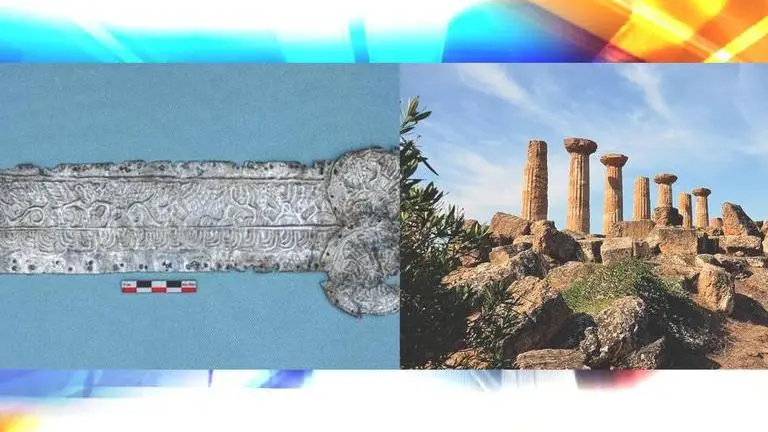
A spectacular silver plate, ornate with winged Gods and Griffins, has been unearthed at an ancient grave in Russia. The artefact was discovered inside the grave of a Scythian warrior who is deemed to have died over 2,400 years ago in Russia. Interestingly, the tomb is situated at Pazyryk burials, a Scythia Necropolis, where multiple treasure troves have been found previously.
The Scythians or Scyths were ancient nomadic people residing primarily over an area known as Scythia, which today comprises the Eurasian steppes of Kazakhstan, the Russian steppes of the Siberian, Ural, Volga and Southern regions, and eastern Ukraine. According to the Heritage Daily, the tomb was discovered by a team of archaeologists affiliated with Don Expeditions from the Institute of Archeology at the Russian Academy of Sciences.

The recently discovered silver Scythian plate depicting fantastical creatures, credits: Russian Accademy of Sciences

The unearthed Scythian burial, Credits: Russian Accademy of Sciences
Advertisement
Later in a press release, Prof. Valeriy Gulyaev from the Don expedition said, “The discovery has made an important contribution to our concepts of Scythian beliefs. Firstly, a particular number of deities are depicted at once on one item. Secondly, it is the first example of an object depicting deities found so far from the main Scythian centres”. However, the names of the dieties and items on the plates still remain unclear.
Roman statues discovered
Late last month, archaeologists in the UK unearthed ‘utterly astounding’ Roman statues while digging the planned route of the UK’s HS2 high-speed railway. The sculptures were found at the site of an abandoned medieval St Mary's church in Stoke Mandeville, Buckinghamshire. The complete statues appear to be of a man and a woman, and another third statue resembled the head of a child. Some other unique findings include large roof tiles, painted wall plaster, and Roman cremation urns.
An extraordinary and unique hexagonal glass Roman jug was also uncovered with large pieces still intact. The vessel, with just one comparable item on display in New York’s Metropolitan Museum of Art, has been buried for over 100 years on the site of excavation. A team of six archaeologists has been working on the railway route for the past six months on the circular ditch, what they thought was the foundations of an Anglo-Saxon tower. The discovery of the remarkable artefacts as a result of work of several months carried out by HS2’s Enabling Works Contractor, Fusion JV, and their archaeological contactor, L-P Archaeology.
Advertisement
Image: Pixabay/Russian Academy of Sciences