
Zelenskyy deepfake showing Ukrainian Prez surrendering to Russia deleted from Facebook
A deepfake video showing Ukraine's President Volodymyr Zelenskyy urging Ukrainians to "lay down arms" against Russia was deleted by Facebook-owner Meta.
- World News
- 3 min read


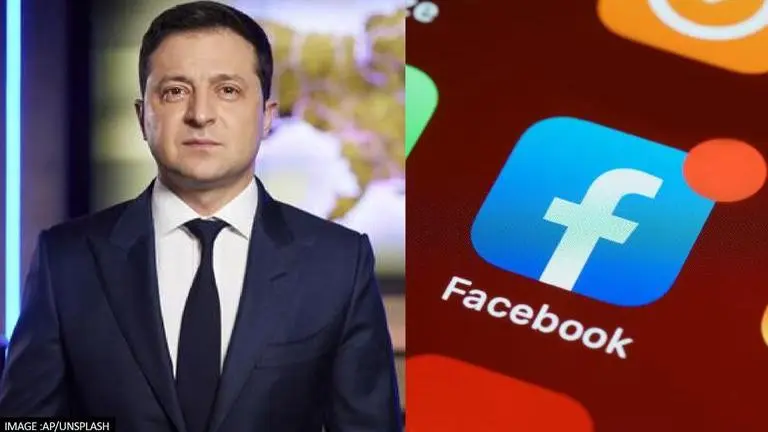
Facebook's parent company Meta, on Wednesday, deleted a "deep fake" video of Ukraine's President Volodymyr Zelenskyy in which he had urged Ukrainians to "lay down arms." The pixelated video was first broadcasted on a Ukrainian news website, TV24 after it was allegedly hacked, Sky News reported.
Taking to Twitter, Meta's security head Nathaniel Gleicher announced that the video was successfully removed from all of the company's platforms. “Earlier today, our teams identified and removed a deep fake video claiming to show President Zelenskyy issuing a statement he never did. It appeared on a reportedly compromised website and then started showing across the internet,” Gleicher wrote. The video, in which Zelenskyy's voice was much deeper than his real voice, circulated rapidly across all social media platforms soon after it was uploaded on the internet on Wednesday. Take a look:
3/ A deepfake'd @ZelenskyyUa calls on soldiers of #Ukraine to lay down their arms.#Zelenskyy, being a quick guy, already has a video mocking it.
— John Scott-Railton (@jsrailton) March 16, 2022
He suggests instead that #Russian soldiers lay down *their* arms.pic.twitter.com/fjCNAO5l17
Zelenskyy surrenders to Russia in 'deepfake 'video
The video was a morphed version of President Zelenskyy's latest address to his nation, which showed him with a comically larger head. In the hoax video, Zelenskyy appeared to have surrendered to Russia and "decided to return Donbass" to Moscow. A version of the edited video was viewed more than 1,20,000 times on Twitter.
ERIFY research analyst found the original photo of Ukraine President Volodymyr Zelenskyy's face used in this deepfake. Fake video shown by the Russian Media of him urging Ukranians to surrender! Not in their DNA! Look at his neck in FAKE video! Deepfake videos becoming common! pic.twitter.com/SYw8sizJfz
— Andrew Russell - Davis (@Diana6197Davis) March 17, 2022
The video was removed after a personal request by Ukraine's chief of state to Meta. In response to the 'deep fake', Zelenskyy on Wednesday posted a video on his Instagram account accusing Russia of "childish provocations." He said, "As for the latest childish provocation with advice to lay down arms, I only advised that the troops of the Russian Federation lay down their arms and return home. We are at home and defending Ukraine."
Advertisement
Notably, the video comes after Meta banned monetisation of Russian content on its platform following Google and YouTube's suit. However, it did not wholly terminate the issue of dissemination of false information, mostly Russian propaganda online, experts believe. "This is the first deep fake that we have seen used in an intentional and brought the deceptive way," said Sam Gregory, programme director of a human rights and technology group, Witness, as quoted by EuroNews.
The developments come against the backdrop of the ongoing Russia-Ukraine war that has stepped into day 22 with widespread devastation evident in key cities of Ukraine. State heads across the world have pushed back against Russian President Vladimir Putin's aggression against Kyiv. Protestors, including citizens of Russia, have also taken to the streets to condemn Russia's "unprovoked and unjust" occupation that has killed thousands, damaged property worth billions, and forced a mass evacuation of up to two million people. The three-week-long unfolding Russian attack has pushed Ukraine to the brink of what human rights activists described as a "humanitarian catastrophe."