
Sadhguru Refused Immediate Evacuation from Tibet to Ensure Safe Exit of Over 700 Isha Members, Says Foundation
Maa Gambhiri, Coordinator of Isha Sacred Walks, detailed the sequence of events during an exclusive interview with ANI following the group's arrival in Kathmandu from Tibet on Saturday.
- World News
- 5 min read

;'%3e%3cpath%20d='m8,15.99c4.41,0,7.99-3.58,7.99-7.99S12.41,0,8,0,0,3.59,0,8s3.58,7.99,7.99,7.99Z'%20style='stroke:%23fff;%20stroke-miterlimit:10;%20stroke-width:.02px;'/%3e%3cpath%20d='m3.08,3.37l3.82,5.11-3.84,4.15h.87l3.37-3.64,2.72,3.64h2.94l-4.04-5.39,3.58-3.87h-.86l-3.1,3.35-2.5-3.35h-2.94Zm1.27.64h1.35l5.97,7.99h-1.35l-5.97-7.99Z'%20style='fill:%23fff;'/%3e%3c/g%3e%3c/svg%3e)


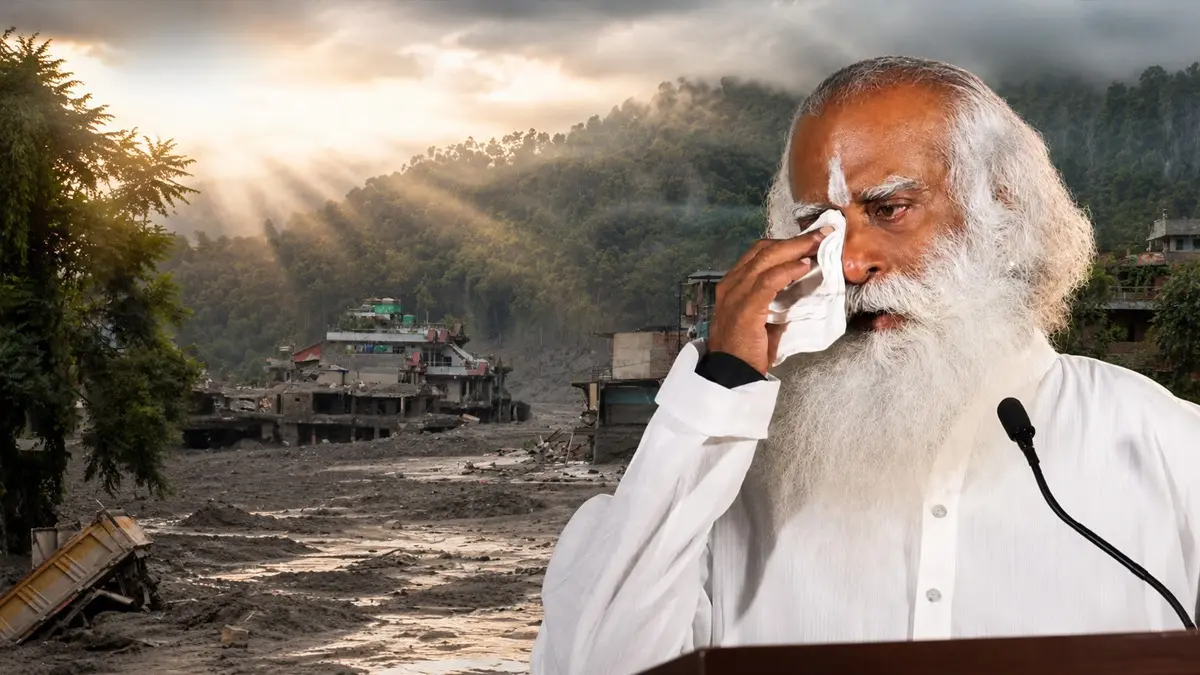
Kathmandu: Despite significant pressure from the Indian government to immediately fly out, spiritual leader Sadhguru opted to remain behind in Tibet to help secure a land route and assist in the aftermath of the catastrophic August 26 Bhote Koshi River flash floods near Gyirong.
Maa Gambhiri, Coordinator of Isha Sacred Walks, detailed the sequence of events during an exclusive interview with ANI following the group's arrival in Kathmandu from Tibet on Saturday. She explained that Sadhguru's decision to stay back was driven entirely by deep concern for the 77 participants directly caught up in the immigration building collapse and the more than 700 Isha members who were still positioned in Tibet.
"There was a lot of pressure from the Government of India that Sadhguru should fly out, but Sadhguru had a completely different intention: he wanted to actually go to ground zero where the incident happened so that he could help in the rescue efforts... Sadhguru wanted to take the land route because there were also about 700-plus of our members who are currently in Tibet. So there has to be a path for them to exit Tibet as well," said Gambhiri.
Gambhiri revealed that the primary reason the group extended its stay in Tibet was their continuous effort to obtain official permissions to reach Gyirong, the site of the flood disaster. However, as military and official Chinese rescue teams had locked down the zone for ongoing search operations, the necessary clearances could not be granted.
Advertisement
"We were trying for various permissions and approvals and making an effort to go as close as possible. So, we stayed longer there, just making this effort," she said. "Unfortunately, that did not happen because army was involved and rescue efforts were going on and we did not get the necessary permissions for that," Gambhiri added.
She identified the emotional weight of uncertainty as the hardest challenge for the organisation. The inability to directly access the site and confirm the fate of the missing 77 members proved to be the most agonising aspect for both the leadership and the families. "Of course, we cannot do what the military can do, but we wanted to be there because 77 of our participants, 77 of our members, were stuck there. So we wanted as much information as we could get about their well-being," she said.
Advertisement
The foundation has been forced to rely on ground visuals, photographs, videos, and media reports from Chinese sources to piece together developments. "I think the challenge was more emotional. The challenge was of our inability to reach that place where we actually wanted to go. So that was a big challenge for us," she said.
"It is just the challenge of not finding what has happened to our members. So I think that was the biggest challenge. And it was also very emotional for us. We also understand what it must be doing to the families of these people," she added. Asked about the current status of the participants caught in the tragedy, Gambhiri said the group had not received any specific or official information and was relying on information emerging from various sources.
"Unfortunately, we do not have any specific news," she said, adding that the group had been monitoring photographs, videos and reports appearing in Chinese media about the rescue efforts. As anxious families wait for information about their loved ones, the Isha organisation has mobilised volunteers across countries to provide assistance and maintain communication with relatives.
"It's not an easy time for any family, for the friends and the family. It's a very harrowing time for them," Gambhiri said. She said volunteers were reaching out to families, including visiting them personally, while helplines had been established for each country from which participants had travelled.
"Our hotlines have been ringing constantly and we have a very large number of volunteers handling these calls, providing all the necessary support," she said. She noted that the Isha Foundation has established a team in Kathmandu to gather available information and relay it to the families. Another team has also been positioned close to Gyirong on the Tibet side to collect whatever information becomes available.
"We have made a team; we have created a team so that they can get all the information that comes and pass it on to us. They are stationed right now very close to Gyirong, where this happened," Gambhiri said. "For the families, the wait is extremely difficult. We are trying to get whatever information we can and share it with them," she added.
In an official update posted on X, the Isha Foundation confirmed that search and rescue operations by Chinese authorities at Gyirong Port resumed around noon on August 28 after a temporary pause due to secondary flood risks. Through ground teams positioned at the closest permissible locations on both sides of the border in Nepal and Tibet, the foundation corroborated visual evidence of the site's destruction.
While stating that findings thus far offer "no encouraging indication of survivors at the immigration office area," the organisation continues to operate round-the-clock helplines and deploy volunteers to support anxious families globally. As developments follow in the wake of the catastrophic August 26 Bhote Koshi River floods in Nepal, rescue and relief operations have intensified, with India stepping up both land and air support.