
Suez Canal to Bosphorus: Here are facts you must know about world's busiest sea routes
In March, the gigantic container ship Ever Given got stuck in Suez Canal giving a bitter reminder to the world about the significance of sea trade routes.
- World News
- 3 min read

;'%3e%3cpath%20d='m8,15.99c4.41,0,7.99-3.58,7.99-7.99S12.41,0,8,0,0,3.59,0,8s3.58,7.99,7.99,7.99Z'%20style='stroke:%23fff;%20stroke-miterlimit:10;%20stroke-width:.02px;'/%3e%3cpath%20d='m3.08,3.37l3.82,5.11-3.84,4.15h.87l3.37-3.64,2.72,3.64h2.94l-4.04-5.39,3.58-3.87h-.86l-3.1,3.35-2.5-3.35h-2.94Zm1.27.64h1.35l5.97,7.99h-1.35l-5.97-7.99Z'%20style='fill:%23fff;'/%3e%3c/g%3e%3c/svg%3e)


In March, the gigantic container ship Ever Given got stuck in the Suez Canal giving a bitter reminder to the world about the significance of sea trade routes. While the Suez Canal-since its inauguration in 1868- has dramatically shortened the distance between Europe and Asia, saving sailors from detouring around Africa, there are scores of other maritime sea routes that keep the global economy going. It is worth mentioning that roughly 90% of global trade is carried over waves, according to an OECD report.
5 Busiest maritime trade routes
English Channel
The English Channel, which connects the southern coast of England from northern France, is deemed as the busiest trade route in the world. Every day, roughly 500 vessels cross the 350-mile long waterway. Hundreds of cargo vessels carrying everything from oil to clothes cross the English Channel along with passenger ferries and occasional swimmers. A recent report estimated the trade to be roughly 20% of global, McGill University.

Image: Pixabay
Advertisement
Strait of Malacca
Situated between the Malay Peninsula and the Indonesian island of Sumatra, the Strait of Malacca serves as the shortest sea route between the Indian subcontinent and far east states. While the width of the waterway is only 40 miles, every day it ferries oil containing freight ships from the middle east to Japan. Notably, the Strait of Malacca has played a crucial route for centuries with Roman, Greek, Chinese, and Indian traders all taking advantage.
Advertisement

Image: 5airam/Twitter
Panama Canal
The Panama Canal not only divides North and South America but also the Atlantic with Pacific oceans. Trade through the man-made canal started in 1914 and today it ferries over 14,000 ships annually. According to a report by DW, nearly 5% of global trade is conducted through the 80-kilometre canal. Back in 2016, the Panama Canal authorities opened a $US5.4 billion expansion, which has tripled the number of freights that can pass through it.

Image: UKP&I
Suez Canal
The Suez Canal connects the Mediterranean to the Red Sea and prevents ships from going all the way around the Cape of Good Hope, South Africa. While it cuts nearly 8,900 kilometres off a sailor’s journey, three major cargo ships have gotten stuck in it since 2008, according to DW. Regardless, the artificially constructed waterway accounts for 12% of global trade with more than 18,880 ships passing through it in 2020, as per the Suez Canal Authority.

Image: AP
Bosphorous Strait
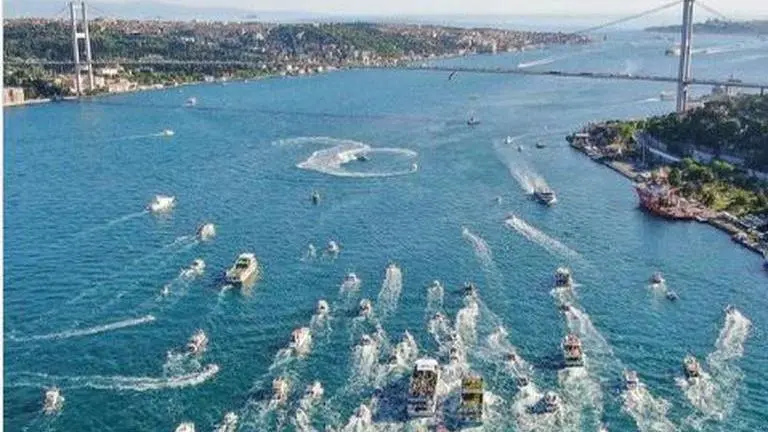
Also known as the Strait of Istanbul, the natural waterway is crucial for the trade of oil between the Middle East and the rest of the world. As per Marine Insight, the 19-mile-long strait makes way for more than 48,000 ships annually, making it three times denser than Suez Canal. Apart from paving way for giant freight ships, it also plays a critical role in facilitating local fishing and ferrying passenger boats across two sides of Istanbul.

Image: Istanbul/Instagram