
Trump Urges Allies to Send Warships to Secure Strait of Hormuz, Threatens More Strikes on Iran’s Kharg Island
U.S. President Donald Trump has called for global allies to send warships to secure the Strait of Hormuz amid escalating tensions with Iran following U.S. strikes on Iranian targets. The Strait is crucial, handling 20% of the world's oil shipments.
- World News
- 4 min read

;'%3e%3cpath%20d='m8,15.99c4.41,0,7.99-3.58,7.99-7.99S12.41,0,8,0,0,3.59,0,8s3.58,7.99,7.99,7.99Z'%20style='stroke:%23fff;%20stroke-miterlimit:10;%20stroke-width:.02px;'/%3e%3cpath%20d='m3.08,3.37l3.82,5.11-3.84,4.15h.87l3.37-3.64,2.72,3.64h2.94l-4.04-5.39,3.58-3.87h-.86l-3.1,3.35-2.5-3.35h-2.94Zm1.27.64h1.35l5.97,7.99h-1.35l-5.97-7.99Z'%20style='fill:%23fff;'/%3e%3c/g%3e%3c/svg%3e)


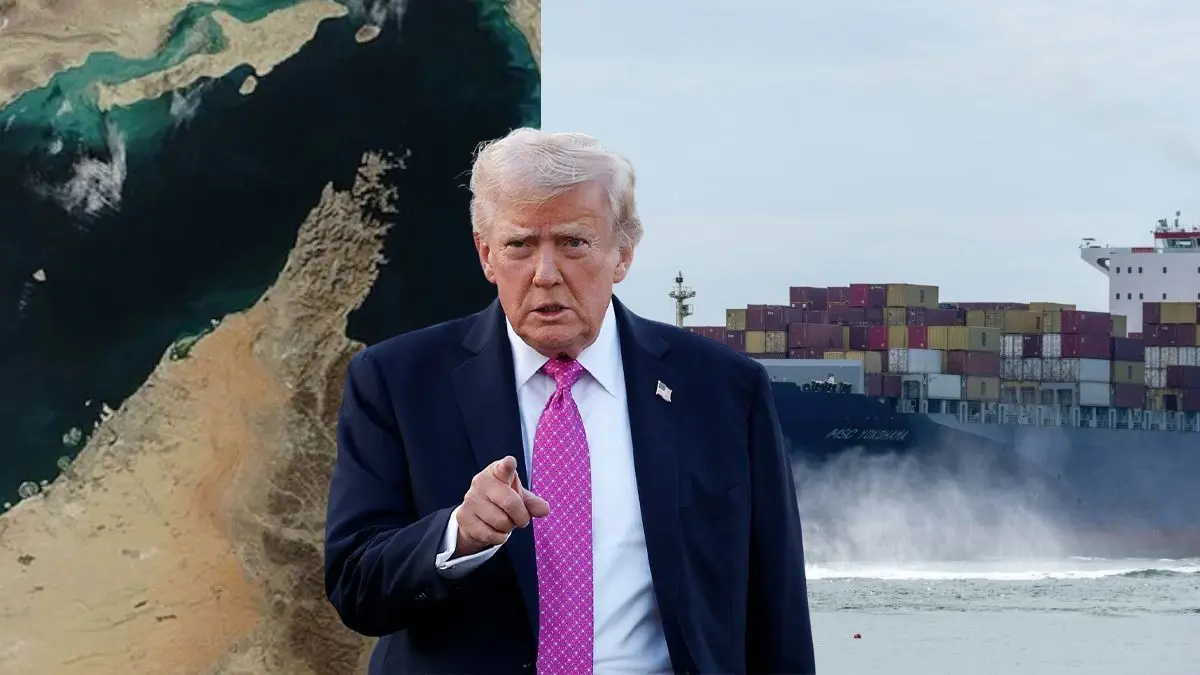
New Delhi: U.S. President Donald Trump has called on global allies to deploy warships to help secure the strategically vital Strait of Hormuz, as tensions with Iran escalate sharply following U.S. strikes on Iranian targets and Tehran’s vow to intensify retaliation across the region.
The appeal comes amid growing fears of a prolonged conflict in the Middle East that has already disrupted global energy markets and raised concerns about the security of one of the world’s most important maritime routes. Roughly 20% of the world’s oil and liquefied natural gas shipments pass through the Strait of Hormuz, a narrow waterway connecting the Persian Gulf to international waters.

Trump calls for naval coalition
In a series of statements on social media and in interviews, Trump urged countries that rely on oil shipments through the strait to share responsibility for protecting the route.
“The countries of the world that receive oil through the Hormuz Strait must take care of that passage, and we will help - a lot,” Trump wrote, adding that the United States would coordinate efforts to ensure safe and smooth shipping operations.
Advertisement
He also predicted that several nations could join the United States in deploying naval forces to keep the strait open, specifically mentioning China, France, Japan, South Korea, and the United Kingdom. However, there has been no immediate confirmation that any of these countries have agreed to send ships to the region.
Trump warned that the U.S. military would continue aggressive operations against Iranian naval threats if necessary. In one message, he said American forces would keep “bombing the shoreline” and targeting Iranian vessels if Tehran attempted to disrupt shipping lanes.
Advertisement
Threat of further strikes on Kharg Island
The U.S. president also escalated rhetoric by threatening additional strikes on Kharg Island, a critical Iranian energy hub located off Iran’s Gulf coast. The island handles about 90% of Iran’s oil exports, making it a key component of the country’s economy.
Trump said earlier U.S. strikes had already “totally demolished” much of the island’s military infrastructure and warned that further attacks could follow if Iran continued to threaten shipping in the Strait of Hormuz.
U.S. Central Command said its forces had struck more than 90 targets on Kharg Island, including naval mine storage facilities, missile bunkers, and other military installations. Washington has maintained that the strikes were aimed only at military sites and not at oil infrastructure.
Iran, however, has played down the scale of the damage and warned that any attack on its energy facilities would trigger further retaliation.
Iran vows retaliation
Tehran has responded defiantly to the U.S. actions. Iranian leaders have rejected the possibility of a ceasefire unless U.S. and Israeli airstrikes stop, signalling that the conflict could continue for an extended period.
Iranian forces have already launched drone and missile attacks across the region, including strikes that disrupted energy infrastructure in the United Arab Emirates. Tehran also warned residents to avoid areas around key ports such as Jebel Ali Port, Khalifa Port, and Fujairah Port, which it said could be targeted due to links with U.S. interests.
Iran’s new Supreme Leader, Mojtaba Khamenei, has taken a hardline stance, signalling that Iran may use the threat of closing the Strait of Hormuz as leverage in the conflict.
War entering third week
The latest developments come as the war between the United States, Israel and Iran enters its third week, after U.S. and Israeli airstrikes launched on February 28 triggered a wave of retaliatory attacks across the Gulf region.
According to reports from governments and state media, the conflict has already killed more than 2,000 people, most of them in Iran. The fighting has also caused what analysts describe as one of the biggest disruptions to global oil supply in recent history.
Global markets are closely watching the situation, as any prolonged disruption to shipping through the Strait of Hormuz could push oil prices sharply higher and trigger broader economic instability worldwide.
Meanwhile, diplomatic efforts to de-escalate the crisis appear to have stalled, with both Washington and Tehran rejecting ceasefire proposals from regional mediators.
With both sides signalling they are prepared for a prolonged confrontation, the conflict threatens to further destabilize the Middle East and deepen uncertainty in global energy markets.