
Turkey discovers new gas reserve in black sea, plans to operate it by 2023
Turkish President Recep Tayyip Erdogan, on June 5, announced that a 135 billion cubic meter natural (bcm) gas reserve has been discovered in the black sea.
- World News
- 2 min read

;'%3e%3cpath%20d='m8,15.99c4.41,0,7.99-3.58,7.99-7.99S12.41,0,8,0,0,3.59,0,8s3.58,7.99,7.99,7.99Z'%20style='stroke:%23fff;%20stroke-miterlimit:10;%20stroke-width:.02px;'/%3e%3cpath%20d='m3.08,3.37l3.82,5.11-3.84,4.15h.87l3.37-3.64,2.72,3.64h2.94l-4.04-5.39,3.58-3.87h-.86l-3.1,3.35-2.5-3.35h-2.94Zm1.27.64h1.35l5.97,7.99h-1.35l-5.97-7.99Z'%20style='fill:%23fff;'/%3e%3c/g%3e%3c/svg%3e)


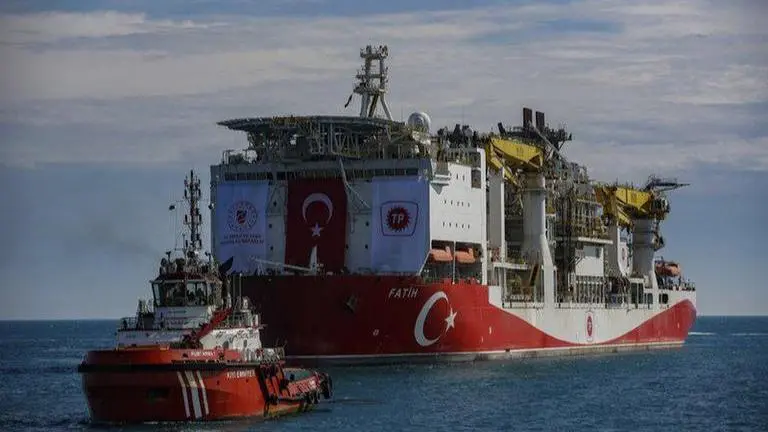
Turkish President Recep Tayyip Erdogan, on June 5, announced that a 135 billion cubic meter natural (bcm) gas reserve has been discovered in the Black Sea. The latest find, which could help satiate the energy-dependent country’s needs, was made by the much-vaunted Fatih drillship in the Sakarya gas field located off the Zonguldak province. With a 405 bcm natural gas deposit discovered last year, the country’s reserves now add up to 540 bcm.
“Our Fatih drillship made a discovery of 135 billion cubic meters of natural gas in the Amasra-1 borehole in the Sakarya gas field," Erdoğan said at the groundbreaking ceremony of the Filyos Port and Natural Gas Operating Facility. "Our new drilling operations around (the borehole) continue. Allah willing, we expect new good news from this region," he added.
3 stages of extraction
At present, Turkey is dependent on Iran, Russia and Azerbaijan for natural gas in addition to the US, Qatar, Nigeria and Algeria for Liquified Natural Gas (LNG). On Friday, Erdogan announced that the country would start pumping natural gas from the newly discovered reserve to its main grid by 2023. Expecting an annual gas flow of 5-10 bcm per annum, he also revealed that the whole process would be done in three stages.
The first stage includes natural gas production systems being established on the seabed, he said, adding that the second stage will see the launch of the facility that will process the natural gas on land and make it ready for use. "The third stage is the pipeline that will provide the connection between the system at sea and the facility on land," Erdogan noted.
“Fatih drilling vessel has discovered another natural gas reserve of 135 billion cubic meters in Sakarya natural gas field’s Amasra-1 well” https://t.co/cQJWqFDO2Y pic.twitter.com/MLGCcPiiLi
— Turkish Presidency (@trpresidency) June 4, 2021
The country has increased its quest for hydrocarbon resources in the recent past. Ankara's search and surveys in the contested Mediterranean sea have triggered multiple disputes with Greece and ethnically bifurcated Cyprus. Both Ankara and Athens have been warring over an oil-rich part of eastern Meditteranean. Earlier this year, both nations resumed talks to solve the long-standing dispute. A representative from both the states met last month in Istanbul, to discuss the bilateral disputes after nearly five months.