
Two US Troops Killed In Jordan By Iranian Fire, Pentagon Confirms First Combat Deaths
The US military confirmed that two American service members were killed in Jordan in an attack attributed to Iran, marking a deadly escalation as officials confirm the strike and prepare to release further details.
- World News
- 6 min read

;'%3e%3cpath%20d='m8,15.99c4.41,0,7.99-3.58,7.99-7.99S12.41,0,8,0,0,3.59,0,8s3.58,7.99,7.99,7.99Z'%20style='stroke:%23fff;%20stroke-miterlimit:10;%20stroke-width:.02px;'/%3e%3cpath%20d='m3.08,3.37l3.82,5.11-3.84,4.15h.87l3.37-3.64,2.72,3.64h2.94l-4.04-5.39,3.58-3.87h-.86l-3.1,3.35-2.5-3.35h-2.94Zm1.27.64h1.35l5.97,7.99h-1.35l-5.97-7.99Z'%20style='fill:%23fff;'/%3e%3c/g%3e%3c/svg%3e)


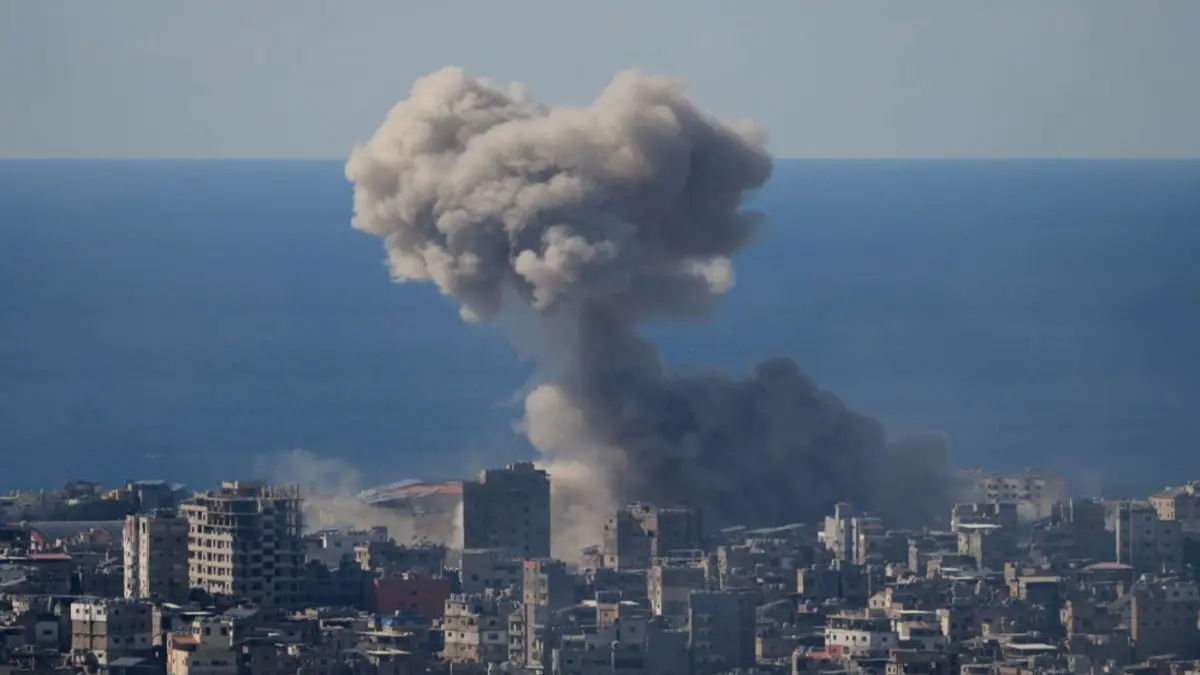
Jordan: The US military confirmed on Saturday that two American service members were killed and a third remains missing following an Iranian attack on a base in Jordan. The incident has fuelled a fresh escalation in the region and has drawn quick attention from the defence officials in Washington. Pertinently, it is the first time US troops have died as a result of direct Iranian fire since the conflict began.
According to the US military, the strike targeted a site in Jordan where the US personnel were stationed. The US officials stated that the Iranian forces carried out the attack, though further details about the location and circumstances are expected to be released in the coming hours.
Reports suggested that the fatalities occurred on Friday as the US and allied forces attempted to repel waves of ballistic missiles and drones. A Pentagon statement confirmed that 4 other personnel were treated in Jordanian hospitals for injuries sustained in the assault and have since been discharged. The names of the US service members killed in the Iranian attack have not been released.
However, the deaths bring the total number of US service members killed since the war started to 16, with over 430 wounded. The Iranian fatal strike followed Iran’s leadership issuing stark new warnings as fighting over the Strait of Hormuz intensified, threatening energy supplies and civilian infrastructure across the Gulf.
Advertisement
Iran Issues New Threats After Attack
In just a few minutes of the US announcement, remarks attributed to Iran’s supreme leader were broadcast on state television. The statement, read out in the name of Mojtaba Khamenei, who has not been seen publicly since the war began, warned that continued US attacks would bring “unforgettable lessons”.
The address also dismissed US President Donald Trump’s signature as “worthless and invalid”, alleging repeated breaches of MoU commitments. Iran’s Deputy Foreign Minister, Kazem Gharibabadi, stated that Tehran was suspending the commitments to the interim deal signed about a month ago, which was aimed at bringing a permanent end to hostilities. "The US has violated its commitments under the deal that was signed about a month ago and now Iran is 'no longer implementing them," Gharibabadi said.
Advertisement
Khamenei’s message expanded the threat beyond Iran itself, invoking the “Axis of Resistance”, a reference to Tehran’s network of armed proxies in the region. The Iranian officials framed the move as a response to American violations, while Washington has given no new update on mediation efforts.
Kuwait Hit Hard, Infrastructure Comes Under Fire
The most severe damage on Saturday was reported in Kuwait, where a water desalination plant and an oil facility were struck, according to the Kuwaiti authorities and the Kuwait Petroleum Corporation, though neither provided specific locations. Several people were injured at the oil site, and a fire at the desalination plant forced multiple power generation units offline.
According to reports, it was the second attack on a desalination facility in Kuwait in two days, a country that relies on desalination for about 90% of its drinking water. The Kuwait Fire Force stated that several firefighters and a worker were hurt while tackling two other blazes started by Iranian strikes. Kuwait briefly shut the airspace because of missile threats, and Kuwait Airways announced that most flights to and from the capital were being rescheduled.
Following the Iranian strikes, air defences were activated throughout the day elsewhere in the Gulf, with Iraq stating that it shot down attack drones over Irbil. Jordan’s state news agency Petra reported that air defence systems intercepted Iranian missiles and Bahrain’s government said that air sirens sounded repeatedly, and Saudi Arabia also reported sirens in the morning.
The secretary general of the 6-nation Gulf Cooperation Council, Jasem Mohamed al-Budaiwi, condemned the strikes, accusing Iran of war crimes for targeting infrastructure and civilian facilities.
US Retaliates With Strikes On Iranian Targets
Earlier, on Saturday, the US Central Command (CENTCOM) stated that it had carried out a 7th consecutive night of strikes inside Iran. According to the command, the targets included “surveillance sites, military logistics infrastructure, underground weapons storage, and maritime capabilities”.
Iranian state TV reported that the US airstrikes hit an electricity and desalination plant in the southern Hormozgan province. The state news agency IRNA said that the Bonji desalination plant was destroyed, leaving about 10,000 people without water, and that a plant on strategic Qeshm Island in the strait was also damaged.
Overnight attacks also damaged two tunnels and a bridge on a key highway toward Bandar Abbas, Iran’s main port near the narrowest point of the Strait of Hormuz. IRNA reported that 3 bridges were hit on Saturday, including one on a route to the port. Amidst an escalation in the tension, the Iranian authorities for the first time acknowledged “attacks on power infrastructure” during US strikes, when the Energy Ministry urged people in southern provinces “experiencing extreme heat” to reduce power use, without specifying what had been hit.
Iran asserted that at least 50 people have been killed and over 500 wounded in US strikes over the past 3 weeks, including 8 who died in an attack on a bridge on Friday.
Battle For Control Of Strait Of Hormuz Intensifies
The waterway has become the focal point of the conflict, with Iran effectively closing the strait to shipping after the war began with US and Israeli strikes on February 28. Meanwhile, oil prices surged and Tehran has stressed that the passage should be under its exclusive control, with vessels paying fees to Iran, despite it being recognised internationally as a waterway open to all.
In recent days, Iran fired on ships, and crossings through the strait fell to a three-week low, according to an international shipping tracker. In response, Trump has renewed threats to hit power stations and bridges to pressure Tehran, and the US reimposed a naval blockade on Iranian ports last week to stop crude exports.
Although more of the region’s energy is now moving through pipelines, the officials said that volumes are insufficient to offset the drop in tanker traffic. Before hostilities began, Washington had been negotiating with Tehran over its nuclear programme. Trump is now under domestic pressure to end the war and avoid the kind of prolonged Middle East entanglement he campaigned against.