
'Unlawful': Trump's $100,000 H-1B Visa Fee Law Thrown Out by US Court
A US federal court has struck down Donald Trump's controversial $100,000 H-1B visa fee, calling it an unlawful tax. The ruling comes as a major relief for skilled foreign workers, including thousands of Indians, amid concerns over stricter US immigration policies.
- World News
- 3 min read

;'%3e%3cpath%20d='m8,15.99c4.41,0,7.99-3.58,7.99-7.99S12.41,0,8,0,0,3.59,0,8s3.58,7.99,7.99,7.99Z'%20style='stroke:%23fff;%20stroke-miterlimit:10;%20stroke-width:.02px;'/%3e%3cpath%20d='m3.08,3.37l3.82,5.11-3.84,4.15h.87l3.37-3.64,2.72,3.64h2.94l-4.04-5.39,3.58-3.87h-.86l-3.1,3.35-2.5-3.35h-2.94Zm1.27.64h1.35l5.97,7.99h-1.35l-5.97-7.99Z'%20style='fill:%23fff;'/%3e%3c/g%3e%3c/svg%3e)


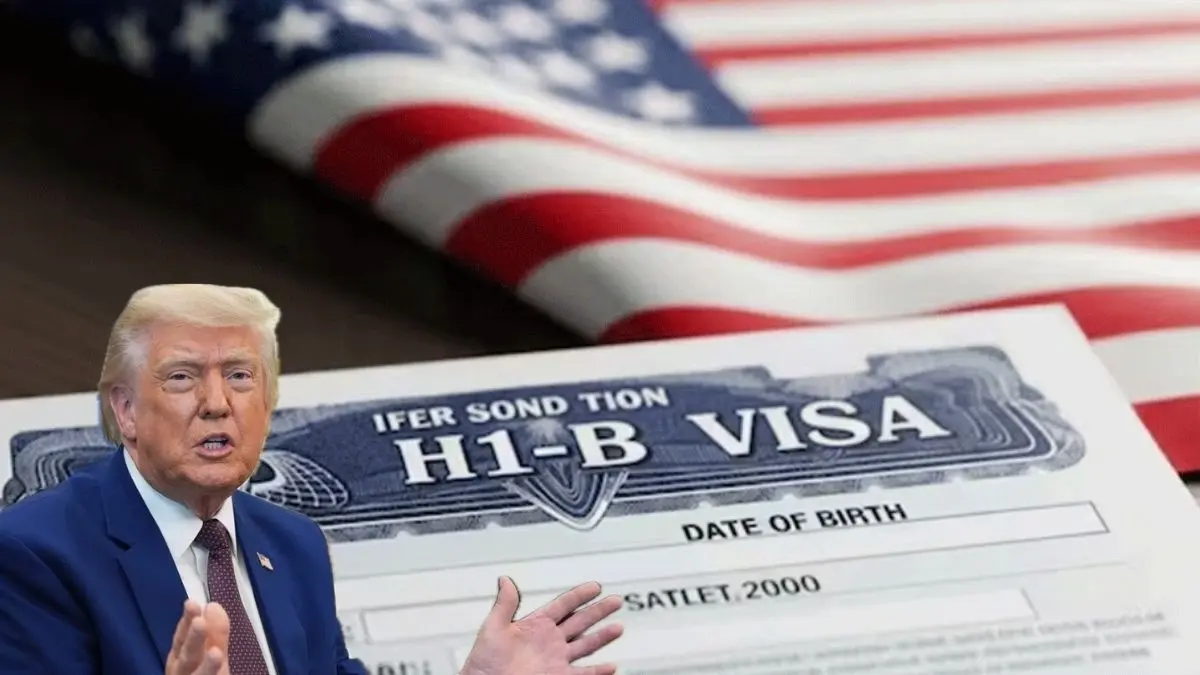
United States: A federal court has ruled down US President Donald Trump's administration's intention to charge a huge $100,000 fee on new H-1B visas for highly educated foreign workers, dealing a significant setback to his immigration policy. According to reports, US District Judge Leo Sorokin in Boston decided that the fee was illegal because it constituted a tax that Congress had never authorised.
The decision comes as a relief to thousands of international professionals, including many Indians, who were expecting to be affected by the high cost increase.
Why Was the Fee Introduced?
The legal challenge was initiated by 20 Democratic state attorneys general who filed a lawsuit against Trump's fee announcement in September. Every year, the United States grants 65,000 visas to talented foreign workers through the H-1B programme. An additional 20,000 visas are designated for those with advanced degrees. These visas are normally valid for three to six years.
Previously, firms who sponsored foreign workers paid visa-related costs ranging from $2,000 to $5,000. The Trump administration's decision to raise the sum to $100,000 indicated a significant increase. The administration contended that the fee was not a tax, but rather a monetary penalty that the President might apply under federal immigration law to prohibit foreign nationals' entry.
Advertisement
Fee Hike Led to Sharp Decline in Applications
The administration's court pleadings showed that the substantial increase in fees discouraged H-1B visa petitions. According to the government, on February 15, US Citizenship and Immigration Services (USCIS) had received only 85 payments for the new $100,000 cost. The figure was disclosed in March.
Recent USCIS data also showed a fall in interest. Last month, the USCIS stated that properly submitted H-1B registrations had decreased by 38.5 percent compared to the previous year. Registrations declined from 343,981 in fiscal year 2026 to 211,600 in fiscal year 2027.
Advertisement
Administration Claimed Programme Was Being Misused
In its proclamation announcing the higher fee, the Trump administration argued that the H-1B programme had moved away from its original purpose. The proclamation stated that the programme "has been deliberately exploited to replace, rather than supplement, American workers with lower-paid, lower-skilled labor," which has subsequently "undermined both our economic and national security".
It further said: “Some employers, using practices now widely adopted by entire sectors, have abused the H-1B statute and its regulations to artificially suppress wages, resulting in a disadvantageous labor market for American citizens, while at the same time making it more difficult to attract and retain the highest skilled subset of temporary workers, with the largest impact seen in critical science, technology, engineering, and math (STEM) fields.”
The administration has also ordered enhanced vetting of H-1B applicants and proposed a new visa selection process that would favour higher-skilled and better-paid workers.
India Raised Concerns Over Immigration Changes
The visa price hike and larger immigration measures implemented by the Trump administration have raised concerns in India due to the high number of Indian professionals working in the United States on H-1B visas. In May, S. Jaishankar, India's External Affairs Minister, highlighted the subject with US Secretary of State Marco Rubio.
In response to the worries, Rubio recognized that there may be "some bumps" and "friction points" during the transition phase as the United States works to modernize its immigration system. However, he insisted that a "efficient" system would eventually benefit all parties.
Rubio further emphasized that the immigration policies were not targeted only at India. "This is not because of India, but broadly, we have had over 20 million people illegally enter the United States over the last few years, and we have had to address that challenge," he had said.