
US Launches New Strikes On Iran Hours After Trump Announces 20% Cargo Fee For Strait Of Hormuz Passage
The US launched fresh strikes on Iran as Trump reinstated a blockade of the Strait of Hormuz and said that Washington would charge ships 20% of cargo value for protection, drawing condemnation from Iran and market volatility.
- World News
- 5 min read

;'%3e%3cpath%20d='m8,15.99c4.41,0,7.99-3.58,7.99-7.99S12.41,0,8,0,0,3.59,0,8s3.58,7.99,7.99,7.99Z'%20style='stroke:%23fff;%20stroke-miterlimit:10;%20stroke-width:.02px;'/%3e%3cpath%20d='m3.08,3.37l3.82,5.11-3.84,4.15h.87l3.37-3.64,2.72,3.64h2.94l-4.04-5.39,3.58-3.87h-.86l-3.1,3.35-2.5-3.35h-2.94Zm1.27.64h1.35l5.97,7.99h-1.35l-5.97-7.99Z'%20style='fill:%23fff;'/%3e%3c/g%3e%3c/svg%3e)


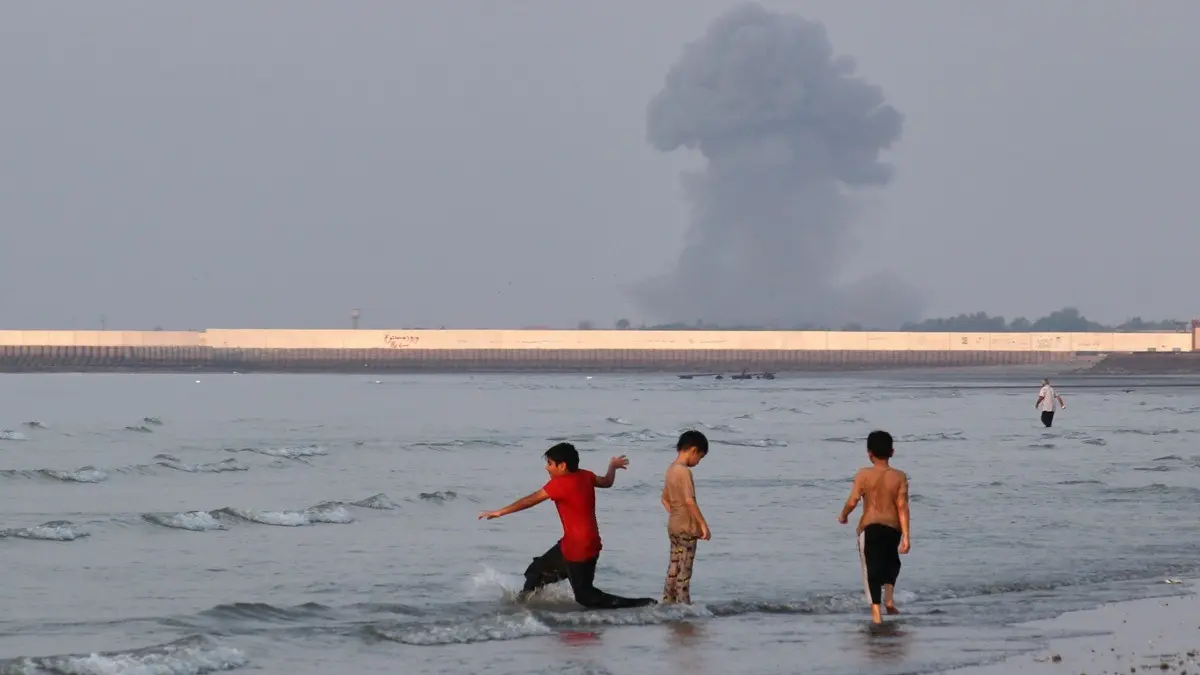
Tehran: Washington has announced a new wave of military strikes on Iran, just hours after US President Donald Trump declared that the United States was “reinstating” a blockade of Iran in the Strait of Hormuz and would begin charging other vessels for safe passage through the waterway. The announcement further escalated the tensions in the Strait, marking a sharp change in US policy, heightening fears of a return to full-scale conflict in the region.
According to US Central Command (CENTCOM), the latest strikes began on Monday and were aimed at degrading Iran’s capacity to target civilian and commercial shipping. The fresh escalation followed days of tit-for-tat attacks after Tehran was accused of targeting vessels, and comes as both Washington and Tehran claim authority over the vital shipping lane.
Meanwhile, the latest developments have already rattled global markets, with Brent crude jumping 7.8% to $81.92 a barrel on Monday, though it remained below the nearly $120 peak seen during the height of the war earlier this year.
New US Strikes And Trump’s Blockade Declaration
The US CENTCOM declared on social media that it had commenced another round of strikes against Iran. “These strikes will continue imposing a heavy cost on Iranian forces and degrade their ability to attack innocent civilians and commercial shipping in the Strait of Hormuz,” the military said.
Advertisement
Shortly afterwards, Donald Trump addressed reporters in the Oval Office and called the operation “another major attack". He said, “We’re hitting them very hard. And it’ll continue, and we’ll see what happens……We’re knocking out all of their offensive capability and we’re controlling the straits. We’re putting the blockade back.”
The president also disclosed that the US would seek reimbursement from other countries for protecting passage through the strait. “We’re protecting a very rich portion of the world…….We’re spending money. And so, what we’ve done is, we are going to be reimbursed for protection,” Trump added.
Advertisement
Policy Reversal On Shipping Fees
It is pertinent to mention that until now, the US had maintained that the Strait of Hormuz should remain open to all shipping without tolls, a position reiterated by Secretary of State Marco Rubio during meetings with Gulf leaders in Bahrain on June 25. “That’s an international waterway. There isn’t a nation on Earth that supports having to pay money to go through the straits…….zero support among the Gulf countries for any sort of toll or fees or anything that charges for the use of international waters. The president’s made it clear that’s not going to happen,” Rubio said, while talking to media personnel.
However, Trump has now reversed the stance, announcing in a social media post, saying, “We are reinstating THE IRANIAN BLOCKADE. All other countries will have fair and open use of the Strait.” He asserted that the US would be reimbursed by 20% of the value of cargo to cover “any and all costs necessary to do the job of providing safety and security".
The US CENTCOM declared that the blockade of Iranian ports would resume on Tuesday at 4 pm local time. Meanwhile, the International Maritime Organization (IMO) stated that it was seeking clarity but reiterated that “there is no legal basis through which to introduce mandatory tolls simply to transit through a strait".
Iran Responds And Regional Fallout
Amidst the US President's declaration of toll in the Strait of Hormuz, Tehran rejected the US move and vowed to resist any interference, with Foreign Minister Abbas Araghchi responding directly to Donald Trump on X. “POTUS is absolutely right. Whoever provides secure and safe passage of commercial vessels through the Strait of Hormuz should be compensated for this service…….Iran has always been the GUARDIAN of the Strait and will remain so FOREVER. 20% is of course too much. We will be fair,” Araghchi said.
Iran also reported strikes in Hormozgan, Khuzestan and Markazi provinces, with state media agency IRNA saying that at least two people were killed. The Semiofficial outlets reported further attacks in Sistan and Baluchestan province on the Gulf of Oman coast, as the Iranian officials blamed Washington for the wider instability.
Earlier, Foreign Ministry spokesperson Esmail Baghaei asserted that Iran would not permit visits by the International Atomic Energy Agency (IAEA) to nuclear sites bombed by the US, where Tehran’s stockpile of highly enriched uranium is believed to be located.
Attacks Across The Gulf
The US military has claimed that Monday’s strikes targeted dozens of sites, including air defence systems, radar installations, missile and drone equipment, and small boats, in retaliation for an Iranian attack on a container ship a day earlier. Washington also said that it used unmanned surface vessels for the first time on Sunday to hit an Iranian ship maintenance facility and a submarine.
In the meantime, the regional states reported their own incidents. Sirens sounded 3 times in Bahrain, home to the US Navy’s 5th Fleet, though no damage was immediately reported. Kuwait’s Foreign Ministry said that its consulate in Iraq had been attacked and condemned, calling the assaults by “factions and militias loyal to” Iran on border points and a maritime oil platform belonging to the Kuwait Petroleum Corporation.
Jordan’s military also claimed that it intercepted four Iranian missiles with “zero casualties or material damage.” Both Jordan and Kuwait host US forces.
Fragile Truce Hangs In Balance
Earlier, Trump stated to conservative host Hugh Hewitt that last month’s interim agreement had been built to test Iran, adding “when you’re dealing with sleazebags don’t mean much". He questioned why Washington had entered a ceasefire rather than pursue a comprehensive deal, and last week declared the truce over. “They didn’t honor the test,” Trump said.
Notably, a 5th of the world’s oil and gas transited the strait before Iran effectively closed it at the start of the war, pushing up energy and fertiliser prices globally. The traffic had improved after last month’s deal but remained below prewar levels. The mediators, including Qatar and Egypt, continue efforts toward a final agreement. Iran and the US are nearly halfway through a 60-day window intended to negotiate that deal and address Tehran’s nuclear programme.