
Drug Cartels, Oil Tanker Seizures, and Immigration | US-Venezuela Conflict Explained
The unrest in the South American nation comes as US President Donald Trump ups his pressure tactic against Venezuela's Nicolas Maduro. Here's a list of reasons which escalated the US-Venezuela conflict.
- World News
- 6 min read

;'%3e%3cpath%20d='m8,15.99c4.41,0,7.99-3.58,7.99-7.99S12.41,0,8,0,0,3.59,0,8s3.58,7.99,7.99,7.99Z'%20style='stroke:%23fff;%20stroke-miterlimit:10;%20stroke-width:.02px;'/%3e%3cpath%20d='m3.08,3.37l3.82,5.11-3.84,4.15h.87l3.37-3.64,2.72,3.64h2.94l-4.04-5.39,3.58-3.87h-.86l-3.1,3.35-2.5-3.35h-2.94Zm1.27.64h1.35l5.97,7.99h-1.35l-5.97-7.99Z'%20style='fill:%23fff;'/%3e%3c/g%3e%3c/svg%3e)


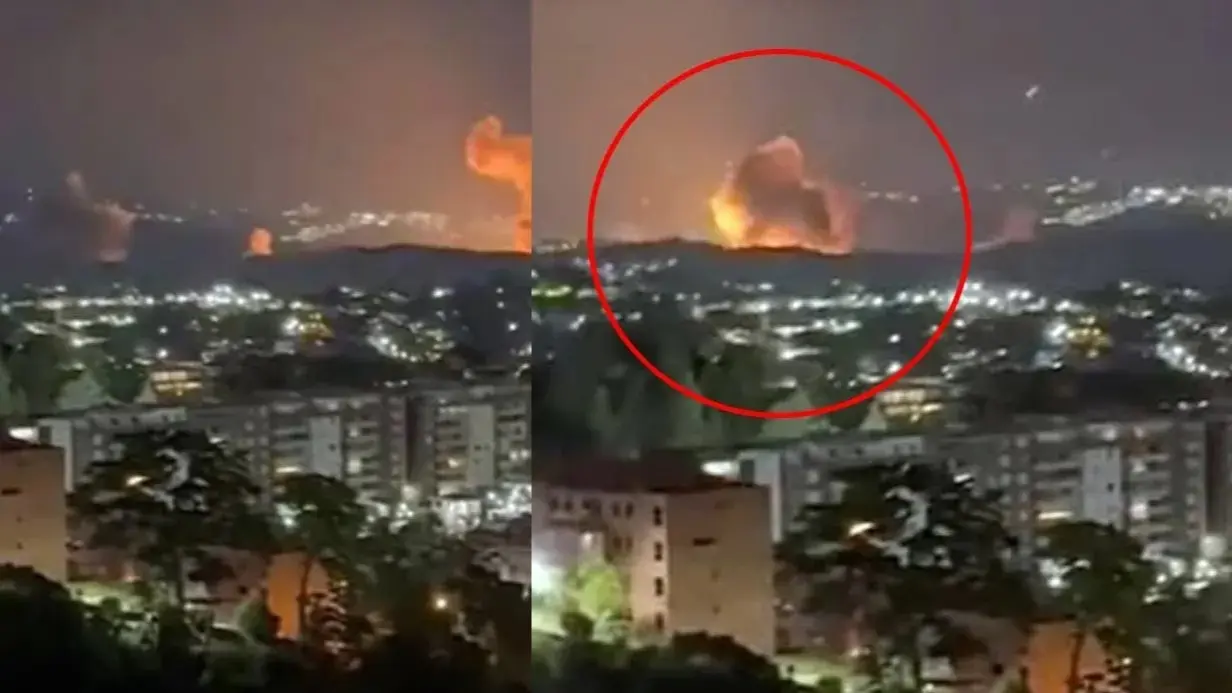
New Delhi: The United States conducted airstrikes on Venezuela’s capital, Caracas, on Saturday, provoking President Nicolas' Maduro to declare a state of emergency and call on social and political forces to "activate mobilisation plans.".
The unrest in the South American nation comes as US President Donald Trump ups his pressure tactic against Maduro.
A series of loud explosions were reported across Venezuela's capital Caracas, triggering power outages in several neighbourhoods, as per reports. Multiple blasts were heard in different parts of the city, with the first explosion occurring at around 1:50 am local time.
Following the explosions, electricity was cut in several areas of the capital, leaving parts of the city in darkness.
Advertisement
Ground strikes against Venezuela
Trump has recently deployed a navy task force to the Caribbean, which raised the possibility of ground strikes against Venezuela. The Venezuelan President called on people to mobilise against US to “defeat this imperialist aggression.”
The explosions occurred amid sharply heightened tensions between the United States and Venezuela, as President Donald Trump has repeatedly accused Venezuelan President Nicolas Maduro of presiding over what he has described as a "narco-terrorist" government. The US has also imposed sanctions on vessels it claims are involved in transporting Venezuelan oil. Here's all we need to know about the conflict.
Advertisement
Drug cartels
The Trump administration informed Congress in October that the US is in "armed conflict" with drug cartels, saying Venezuelan President Nicolas Maduro plays a major role in supplying illegal drugs that kill Americans, which Maduro denies.
The administration also has designated as foreign terrorist organizations Tren de Aragua, a Venezuelan gang with prison origins, and Cartel de los Soles, a loosely defined term that emerged in the 1990s as a reference to any Venezuelan official with alleged drug links, as per Reuters report.
The tensions escalated in September when President Donald Trump accused Venezuela President Nicolas Maduro of heading up the Cartel de los Soles (without providing evidence).
In a significant escalation of anti-cartel efforts, the U.S. launched a military strike against a vessel in the southern Caribbean that President Trump identified as a drug-smuggling boat. The operation resulted in eleven fatalities and is reportedly the first time the US military has conducted such a strike in that specific region to combat drug trafficking.
The US Justice Department indicted Maduro himself on narcoterrorism charges in 2020, during Trump's first term as president.
Venezuela is a transit country for cocaine bound for Europe and the US and a haven for criminal groups that traffic drugs, but it is not a source for fentanyl, the drug linked to most US overdoses, as per data.
Seizure of oil tanker
Venezuela has the world's largest proven oil reserves and analysts say access to oil could be a valuable bargaining chip for Maduro in his dealings with Trump, an advocate for the fossil-fuel industry.
Maduro has said Washington wants Venezuela's oil, which it currently sells mostly to China. Analysts said Venezuela's oil reserves would be of interest to Trump, but the larger issue is a country in the hemisphere with oil and other resources that is closely allied to U.S. rivals like China and Russia.
On 11 December, the US seized an oil tanker off the coast of Venezuela.
Attorney General Pam Bondi sharing a video of the operation said US forces "executed a seizure warrant for a crude oil tanker used to transport sanctioned oil from Venezuela and Iran", as per news reports.
The Venezuelan government accused the US of "blatant theft" and described the seizure as "an act of international piracy".
US warships
The docking of the USS Gravely guided missile destroyer in the capital of Trinidad and Tobago - just 25 miles from the coast of Venezuela - escalated tensions in November last year. Calling it a provocation by Trinidad and Tobago and the US, Venezuela govt condemned the arrival.
Immigration Issue
The Trump administration has begun the formal process of stripping legal protections from hundreds of thousands of Venezuelan nationals residing in the United States, pursuing the policy of "mass deportations now" that helped propel him to victory in his successful run for reelection last year.
The Venezuelan population in the United States grew by nearly 600% from 2000 to 2021, from 95,000 to 640,000, according to a Pew Research Center analysis of U.S. Census Bureau data, as the South American country faced political and economic turmoil, as per news agency reports.
Cuba's Communist government
Many close political allies of Trump, including his Cuban-American secretary of state, Rubio, have long advocated for tough measures against Cuba's Communist government. They see Maduro's government and its oil as an essential support to Cuban President Miguel Díaz-Canel and other leaders in Havana, and hope that change in Venezuela's government will weaken Cuba's.
Venezuela Airspace
Trump's post on Truth Social which read, "To all Airlines, Pilots, Drug Dealers, and Human Traffickers, please consider THE AIRSPACE ABOVE AND SURROUNDING VENEZUELA TO BE CLOSED IN ITS ENTIRETY," was labelled a "colonial threat" and "illegal, and unjustified aggression," by Venezuela's foreign affairs office, which accused the president of threatening "the sovereignty of the national airspace... and the full sovereignty of the Venezuelan state".
Explosions rock Venezuela
In an official statement, Venezuela condemned the “extremely serious military aggression” by the US against its territory and population in the civilian and military locations of Caracas and the states of Miranda, Aragua, and La Guaira.
Calling the objective behind the attack as nothing more than seizing the country's strategic resources - its oil and minerals - by thwarting its independence by force, Venezuela said that its attempt to impose a colonial war to force a "regime change," will ultimately fail.
The President ordered the immediate deployment of the Command for the Comprehensive Defense of the Nation and of the Direction Organs for Comprehensive Defense in all states and municipalities of the country.
Meanwhile, US officials told CBS News that President Donald Trump personally authorised the strikes, targeting military facilities linked to the Maduro regime. While the White House and Pentagon have not issued formal statements, Trump administration officials acknowledged they were aware of reports of explosions and aircraft activity over Caracas.