
Canada heat wave 'cooked' over a billion marine species alive, experts say
The devastating heatwave that smashed temperature records in British Columbia last week is being blamed for a massive die-off of marine animals.
- World News
- 3 min read

;'%3e%3cpath%20d='m8,15.99c4.41,0,7.99-3.58,7.99-7.99S12.41,0,8,0,0,3.59,0,8s3.58,7.99,7.99,7.99Z'%20style='stroke:%23fff;%20stroke-miterlimit:10;%20stroke-width:.02px;'/%3e%3cpath%20d='m3.08,3.37l3.82,5.11-3.84,4.15h.87l3.37-3.64,2.72,3.64h2.94l-4.04-5.39,3.58-3.87h-.86l-3.1,3.35-2.5-3.35h-2.94Zm1.27.64h1.35l5.97,7.99h-1.35l-5.97-7.99Z'%20style='fill:%23fff;'/%3e%3c/g%3e%3c/svg%3e)


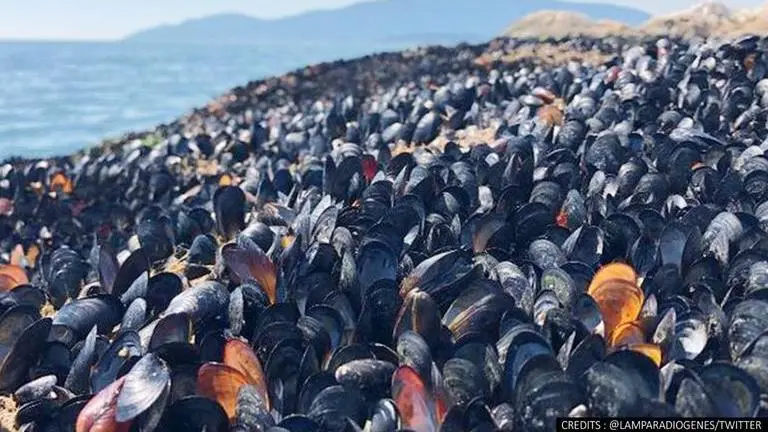
The devastating heatwave that smashed temperature records in British Columbia last week is being blamed for a massive die-off of marine animals that live on the beaches of Western Canada. The five-day "heat dome" that also settled over the northwestern US raised temperatures along the coast to 40 degrees Celsius, shattering long-standing records and providing little relief for days. The scorching heat is believed to have killed hundreds of people and also contributed to the hundreds of wildfires that are presently raging across the province and it even had a negative impact on marine life.
According to CNN, Christopher Harley, a professor in the zoology department at The University of British Columbia, found countless dead mussels popped open and rotting in their shells at Kitsilano Beach. Harley believes that the unprecedented heat may have killed over a billion marine species. To study the effects of climate change on the ecology of rocky shores, he claimed a walk down a beach in the Vancouver region and explained that he could smell the beach because of the dead animals from the previous day.
Harley even said that when we walk on the beach, it normally doesn't crunch. But there were so many empty mussel shells strewn about that we couldn't help but trip on dead animals as we walked around. He explained that mussels attach themselves to rocks and other surfaces and are used to being exposed to the air and sunlight during low tide, however, he added that they generally can’t survive temperatures over 100 degrees for very long.
'Overwhelming and visceral'
Harley further revealed that in the shallow water, snails, sea stars, and clams were rotting. He described the encounter as "overwhelming and visceral”. It is worth mentioning that while the temperature in Vancouver was more than 30 degrees, Harley and a student used infrared cameras to capture temperatures above 50 degrees Celsius along the rocky shore. According to Harley, the mass extinction of shellfish would have a temporary impact on water quality because mussels and clams filter the sea, keeping it pure enough for sunlight to reach the eelgrass beds while also providing habitat for other species.
Advertisement
Meanwhile, a new analysis by an international team of 27 scientists said that the deadly heatwave was a one-in-a-1,000-year event. The temperature records were so extreme - 116 degrees Fahrenheit in Portland, Oregon, and 121 degrees Fahrenheit in Canada’s British Columbia - that researchers said it was difficult to quantify just how rare the heatwave was. Scientists warned that Earthlings can expect extreme events such as this to become more common as the world heats up due to climate change. They also said that the chances of heatwaves occurring without human-induced warming were virtually impossible.