
Uzbekistan Reaffirms UNSC Support for India; Both Nations Agree on FM Mechanism, Trade Pact Steps
To strengthen institutional coordination, the two countries decided to establish a Foreign Ministers-led mechanism. This body will provide high-level oversight of agreements already reached, ensure timely progress on priority initiatives and projects, and facilitate closer political coordination.
- World News
- 3 min read

;'%3e%3cpath%20d='m8,15.99c4.41,0,7.99-3.58,7.99-7.99S12.41,0,8,0,0,3.59,0,8s3.58,7.99,7.99,7.99Z'%20style='stroke:%23fff;%20stroke-miterlimit:10;%20stroke-width:.02px;'/%3e%3cpath%20d='m3.08,3.37l3.82,5.11-3.84,4.15h.87l3.37-3.64,2.72,3.64h2.94l-4.04-5.39,3.58-3.87h-.86l-3.1,3.35-2.5-3.35h-2.94Zm1.27.64h1.35l5.97,7.99h-1.35l-5.97-7.99Z'%20style='fill:%23fff;'/%3e%3c/g%3e%3c/svg%3e)


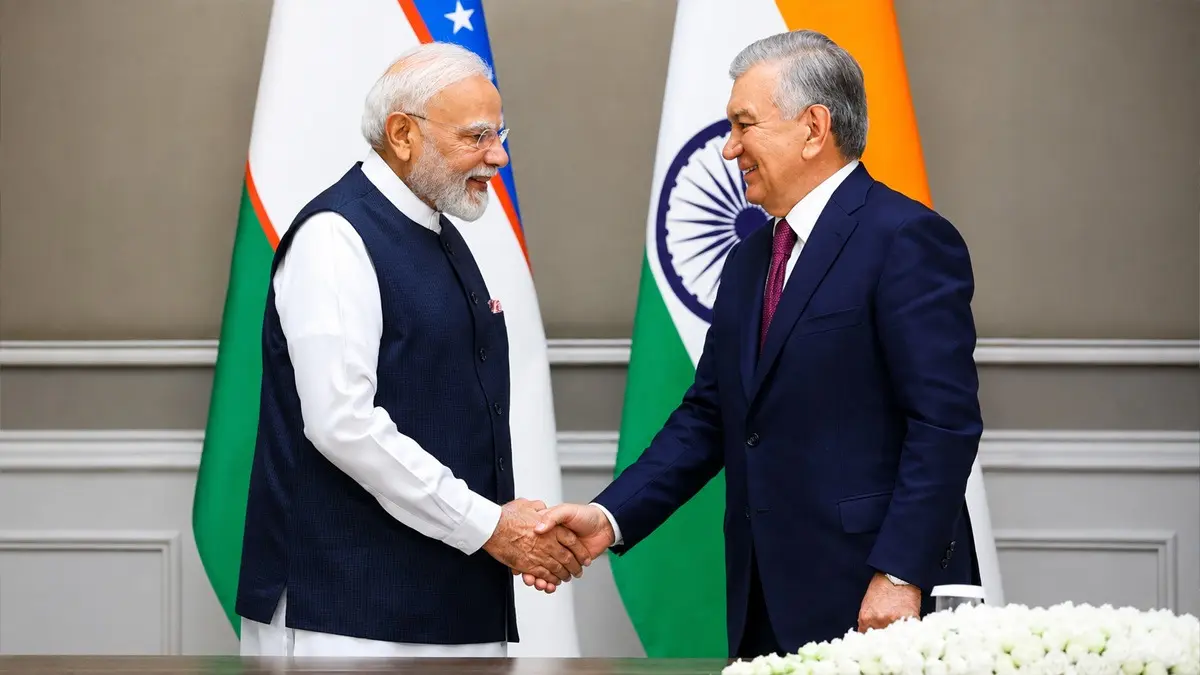
Tashkent: Uzbekistan has reaffirmed its backing for India’s bid for permanent membership of the United Nations Security Council, even as the two countries agreed to set up a Foreign Ministers-led mechanism to monitor the implementation of bilateral agreements and advanced concrete steps toward a Preferential Trade Agreement.
The decisions formed part of a Joint Statement issued after talks between Prime Minister Narendra Modi and Uzbek President Shavkat Mirziyoyev during Modi’s state visit to Uzbekistan on August 29-30. The leaders also elevated bilateral ties to a Comprehensive Strategic Partnership, marking 15 years of the existing strategic partnership.
Both sides called for comprehensive reform of the United Nations, including the Security Council, to better reflect current global realities and enhance its representativeness, effectiveness and efficiency in maintaining international peace and security. Uzbekistan specifically reiterated its support for India’s permanent UNSC membership.
To strengthen institutional coordination, the two countries decided to establish a Foreign Ministers-led mechanism. This body will provide high-level oversight of agreements already reached, ensure timely progress on priority initiatives and projects, and facilitate closer political coordination.
Advertisement
On the economic front, India and Uzbekistan agreed to work toward a Preferential Trade Agreement following the completion of a Joint Feasibility Study. They directed relevant ministries to take the next steps on a time-bound basis. A Joint Working Group will also be created to tackle non-tariff barriers and investment hurdles in key sectors.
Bilateral trade, which has already crossed USD 1 billion, is targeted to reach USD 5 billion by 2030. The leaders emphasised expanding market access, improving connectivity, strengthening banking and payment linkages, broadening the range of traded goods, promoting industrial cooperation and supporting manufacturing and export capacities. Sectors identified for greater potential include electrical items, engineering products, automobiles and pharmaceuticals.
Advertisement
Further measures include exploring mutual recognition arrangements for faster market access, enhancing cooperation in e-commerce and digital trade procedures, and promoting links between small and medium enterprises. On investment, the two sides plan an institutional mechanism to address investor concerns and facilitate ease of doing business, along with closer collaboration between Uzbekistan’s Investment Promotion Agency and Invest India through forums, roadshows and seminars.
The leaders also reaffirmed zero tolerance for terrorism in all its forms, including cross-border terrorism, and called for concerted action against terrorist entities, financing networks, safe havens and infrastructure. They stressed accountability for perpetrators and supporters, and agreed to deepen cooperation under the existing Joint Working Group on Counter Terrorism, alongside enhanced law-enforcement, intelligence-sharing and defence ties. The successful conduct of the joint military exercise “Dustlik” was welcomed.
In the multilateral sphere, the two countries pledged to strengthen coordination in forums representing the Global South, deepen engagement within the Shanghai Cooperation Organisation, and continue the Central Asia-India format. Uzbekistan appreciated India’s support for its WTO accession, while both sides committed to upholding the multilateral trading system.
Prime Minister Modi described the elevation of ties and the ambitious economic roadmap as steps to move the partnership forward with greater speed, placing trade expansion at the centre of the bilateral agenda. The visit builds on earlier meetings of the Intergovernmental Commission and business forums held in 2026, which have already contributed to expanding economic cooperation.
The agreements signal a determined push to convert the upgraded Comprehensive Strategic Partnership into tangible gains in trade, investment, security coordination and multilateral alignment.
(With inputs from ANI)