
What Is 'Donroe Doctrine', Trump's Aggressive Foreign Policy To Dominate The Western Hemisphere | Explained
Explained: What Is The Donroe Doctrine And What It Stands For After US Raided Venezuela
- World News
- 3 min read

;'%3e%3cpath%20d='m8,15.99c4.41,0,7.99-3.58,7.99-7.99S12.41,0,8,0,0,3.59,0,8s3.58,7.99,7.99,7.99Z'%20style='stroke:%23fff;%20stroke-miterlimit:10;%20stroke-width:.02px;'/%3e%3cpath%20d='m3.08,3.37l3.82,5.11-3.84,4.15h.87l3.37-3.64,2.72,3.64h2.94l-4.04-5.39,3.58-3.87h-.86l-3.1,3.35-2.5-3.35h-2.94Zm1.27.64h1.35l5.97,7.99h-1.35l-5.97-7.99Z'%20style='fill:%23fff;'/%3e%3c/g%3e%3c/svg%3e)


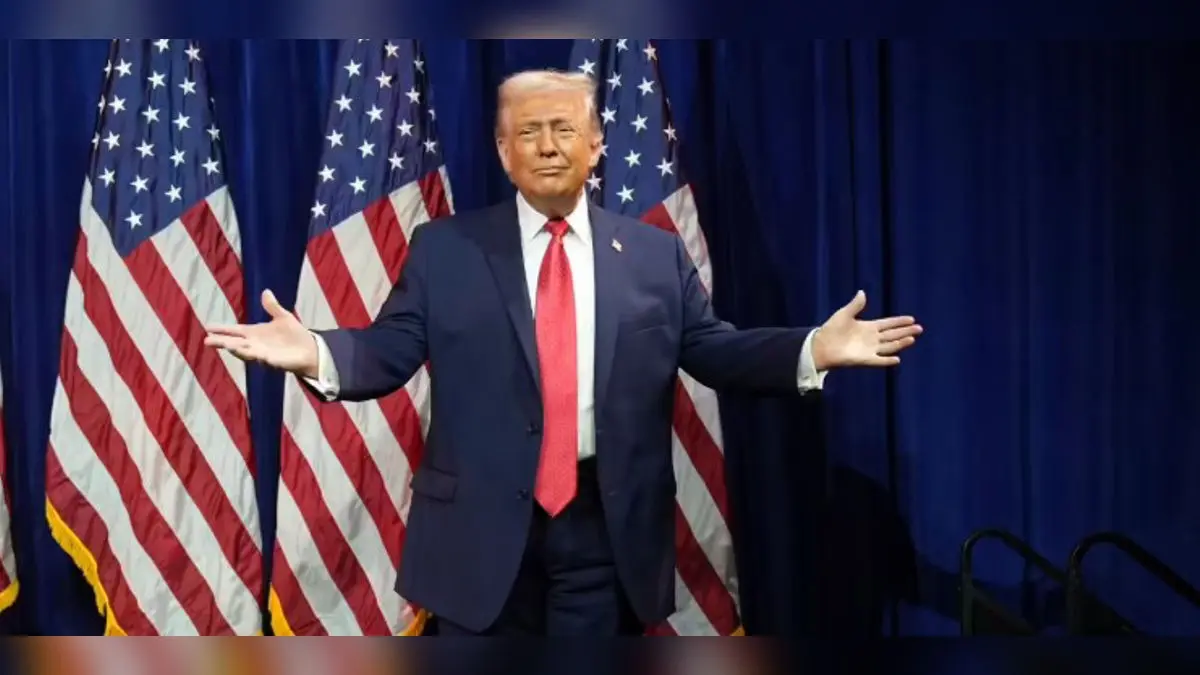
Washington: Donald Trump has recently expressed his interest in acquiring Greenland, barely a week after ousting Venezuelan President Nicolas Maduro. However, this is not the first time that the US President has tried to intervene in determining the political outcomes of other nation-states. In light of the US national interests being actively defined and redefined by Trump, the 'Donroe Doctrine' has emerged as a term popular among geopolitical experts, which seeks to describe what forms the crux of Trump's foreign policy.
It is pertinent to mention that shortly after capturing Nicolas Maduro, Trump asserted that the US will 'run' Venezuela. Hours after seizing control of Maduro, Trump threatened military action against the Colombian government. Referring to Colombia's President Gustavo Petro, Trump allegedly told reporters, "Colombia is very sick, too, run by a sick man, who likes making cocaine and selling it to the United States, and he's not going to be doing it very long." Threats to Cuba, Mexico, and Greenland followed soon after.
All of the above are now being construed as instances of the ‘Donroe doctrine’, a corollary of the 1823 Monroe Doctrine, named after Trump, which seeks US control over the western hemisphere.
How The US Under Trump Rebranded The 1823 Monroe Doctrine
Speaking to reporters after capturing the Venezuelan President, Trump said that Venezuela had hosted foreign adversaries in the US region. “All of these actions were in gross violation of the core principles of American foreign policy, dating back more than two centuries. All the way back, it dated to the Monroe Doctrine. And the Monroe Doctrine is a big deal, but we’ve superseded it by a lot, by a real lot. They now call it the ‘Donroe Doctrine," Trump reportedly said after the Venezuela raid.
Advertisement
Back in 1823, James Monroe, the then US President, established the ‘Monroe Doctrine’ as one of the most crucial parts of US foreign policy, which opposed European intervention in all of the Americas, including the Latin Americas. It warned Europe against further interference in the Western hemisphere.
Trump aide and the United States Homeland Security Advisor Stephen Miller's statements in a recent television interview further pointed towards the ‘Donroe doctrine’.
Advertisement
"The United States is using its military to secure our interests unapologetically in our hemisphere. We are a superpower, and under President Trump, we are going to conduct ourselves as a superpower," Miller reportedly said. A social media post by the State Department on Monday, stating “This is Our Hemisphere," followed Miller's statements.
While the Latin Americas and Greenland seem to be the most threatened countries amidst this situation, the alleged 'Donroe Doctrine' also implies a stern, but clear stance towards America's rivals, including China and Russia. The US capturing the Venezuelan President must have been a particularly notable instance for Taiwan, given its implications for the latter amid the undercurrents of its tensions with China.
China’s Ministry of Foreign Affairs has criticised the US for its military action against Venezuela, calling it “brazen use of force against a sovereign state.” The Donroe Doctrine, in a world post-Maduro's capture by the US, is no longer an isolated instance, but more of a signal as a threat to the sovereignty of nation-states globally.