
What Is KC-135 Stratotanker? US Air Force’s Iconic Aerial Refuelling Tanker Aircraft That Crashed In Iraq
The KC-135 Stratotanker is a crucial aircraft in the U.S. Air Force, vital for aerial refueling for over 60 years. Recently, it crashed in western Iraq related to operations against Iran, with no hostile fire involved. Developed by Boeing, it serves as the main refueling platform since 1956, supporting long-distance missions.
- World News
- 4 min read

;'%3e%3cpath%20d='m8,15.99c4.41,0,7.99-3.58,7.99-7.99S12.41,0,8,0,0,3.59,0,8s3.58,7.99,7.99,7.99Z'%20style='stroke:%23fff;%20stroke-miterlimit:10;%20stroke-width:.02px;'/%3e%3cpath%20d='m3.08,3.37l3.82,5.11-3.84,4.15h.87l3.37-3.64,2.72,3.64h2.94l-4.04-5.39,3.58-3.87h-.86l-3.1,3.35-2.5-3.35h-2.94Zm1.27.64h1.35l5.97,7.99h-1.35l-5.97-7.99Z'%20style='fill:%23fff;'/%3e%3c/g%3e%3c/svg%3e)


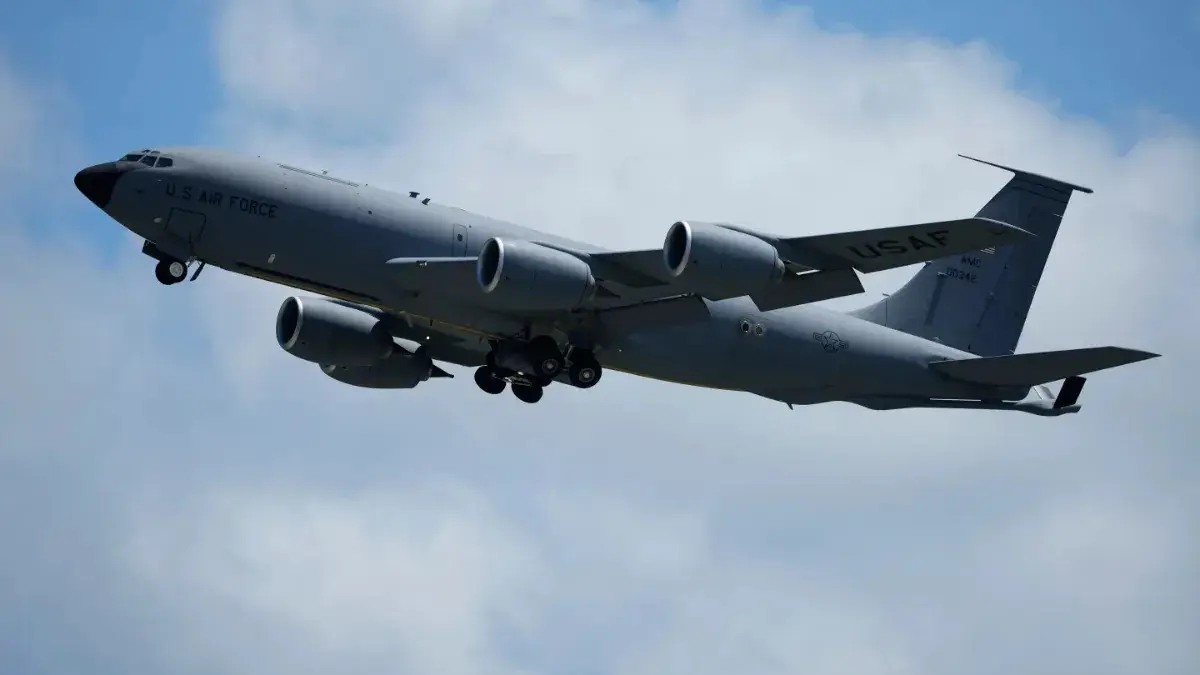
New Delhi: The KC-135 Stratotanker is one of the most important aircraft in the arsenal of the United States Air Force, serving as the backbone of its aerial refuelling capability for more than six decades. Designed to extend the range and endurance of combat aircraft, the tanker enables US and allied forces to conduct long-distance missions without landing for fuel.
The KC-135 Stratotanker recently crashed in western Iraq during operations linked to the ongoing conflict with Iran, prompting rescue operations by US Central Command.
The U.S. Central Command did not elaborate on the circumstances of the crash, but said it “was not due to hostile fire or friendly fire”. The U.S. Central Command, which oversees the Middle East, said the crash followed an unspecified incident involving two aircraft in “friendly airspace,” and that the other plane landed safely.
Backbone of US Air Power
Developed by Boeing and derived from the Boeing 707 airframe, the KC-135 entered service in August 1956 and has remained the primary aerial refuelling platform for the US Air Force. Over the decades, it has been modernised with upgraded engines, avionics, navigation and communication systems to maintain operational relevance.
Advertisement
The tanker’s core mission is mid-air refuelling, a capability that allows fighter jets, bombers and surveillance aircraft to stay airborne for extended periods, dramatically increasing the global reach of US air operations. The aircraft also supports Navy, Marine Corps and allied aircraft, making it a critical asset in multinational missions.
Key Features and Capabilities
The KC-135 is powered by four turbofan engines mounted beneath its wings, enabling the aircraft to take off with a maximum weight of around 1,50,000 kilograms. The aircraft can fly at speeds of up to 850 km per hour at 30,000 feet and operate at altitudes reaching 50,000 feet.
Advertisement
Its internal configuration allows it to carry a mix of fuel, cargo and passengers. Depending on the fuel configuration, the aircraft can transport up to 83,000 pounds of cargo along with personnel on a cargo deck located above the refuelling system.
The tanker is capable of transferring up to 91,000 kilogram of fuel to other aircraft in flight, making it essential for long-range missions and sustained air campaigns.
Unique Refuelling System
The KC-135 primarily uses a “flying boom” refuelling system, a rigid telescopic tube extending from the rear of the aircraft. A specialised crew member known as the boom operator controls this system from the back of the plane and guides the boom into the receiving aircraft’s refuelling receptacle.
In addition to the boom, the aircraft can use a drogue system, which involves a shuttlecock-shaped basket trailing behind the tanker to refuel aircraft equipped with probes. Some KC-135 variants also feature multipoint refuelling pods, allowing them to refuel two aircraft simultaneously.
Crew and Operational Roles
A standard KC-135 mission typically requires a three-member crew consisting of:
- Pilot
- Co-pilot
- Boom operator
Beyond Refuelling
Although aerial refuelling is its primary role, the KC-135 has been adapted for several other missions over the years. These include:
- Strategic airlift and cargo transport
- Medical evacuation missions
- Reconnaissance and surveillance variants
Past accidents
KC-135s have been involved in several fatal accidents. The most recent happened on May 3, 2013, when a KC-135R crashed after takeoff south of Chaldovar, Kyrgyzstan while taking part in the war in Afghanistan.
In that crash, the crew experienced problems with the plane’s rudder, according to a U.S. Air Force investigation. While they struggled to stabilize the plane, the tail section broke away and the plane exploded midair, killing all three crewmembers onboard.
The most serious mid-air collision involving the plane happened in 1966, when a B-52 bomber carrying nuclear bombs struck a tanker near Palomares, Spain.
The accident caused the tanker to crash, killing four onboard. The disaster led to an extensive decontamination effort to clean up nuclear material dispersed when conventional explosives in the hydrogen bombs detonated after hitting the ground.
Despite being more than 60 years old, the KC-135 remains widely used due to continuous upgrades and its proven reliability. The US Air Force still operates hundreds of Stratotankers, though it is gradually replacing them with the newer KC-46 Pegasus tanker fleet.