
'When India Sends Aid, It Does Not Look at Colour of Passport': PM Modi Says Stronger India Benefits All Humanity
Highlighting India's role as a first responder during humanitarian crises in the world, the Prime Minister said the country's increasing strength has enabled it to support nations affected by natural disasters and other emergencies across the world.
- World News
- 4 min read

;'%3e%3cpath%20d='m8,15.99c4.41,0,7.99-3.58,7.99-7.99S12.41,0,8,0,0,3.59,0,8s3.58,7.99,7.99,7.99Z'%20style='stroke:%23fff;%20stroke-miterlimit:10;%20stroke-width:.02px;'/%3e%3cpath%20d='m3.08,3.37l3.82,5.11-3.84,4.15h.87l3.37-3.64,2.72,3.64h2.94l-4.04-5.39,3.58-3.87h-.86l-3.1,3.35-2.5-3.35h-2.94Zm1.27.64h1.35l5.97,7.99h-1.35l-5.97-7.99Z'%20style='fill:%23fff;'/%3e%3c/g%3e%3c/svg%3e)


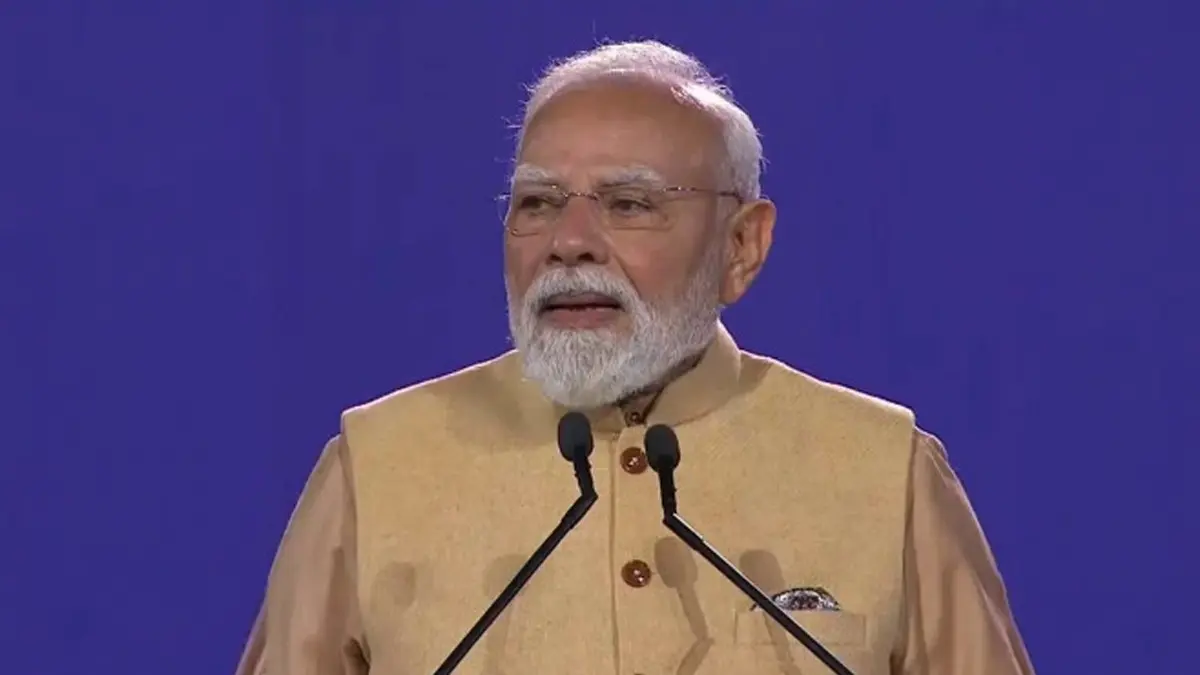
Melbourne, Australia: Prime Minister Narendra Modi on Thursday said India's humanitarian assistance is guided by compassion rather than nationality, race or geography, asserting that the country does not differentiate on the basis of passports or the "colour of the passport" while extending help to those in need on the global stage.
Addressing the Indian diaspora at the 'Melbourne Meets Modi' event as part of his three-day official visit to Australia, the Prime Minister said India's growing capabilities are being used for the benefit of humanity, adding that this approach has strengthened the world's trust in the country.
"When India extends a helping hand, it does not look at passports; when India sends aid, it does not look at the colour of the passport. That is why the world places such great trust in India," PM Modi said.
Highlighting India's role as a first responder during humanitarian crises in the world, the Prime Minister said the country's increasing strength has enabled it to support nations affected by natural disasters and other emergencies across the world.
Advertisement
"As India's strength grows, all of humanity benefits," he said.
Citing recent examples, PM Modi said India responded swiftly to the massive humanitarian crisis following the devastating twin earthquakes of over 7 magnitude in Venezuela by deploying relief material, rescue personnel and medical teams. at least 3,535 lives, left over 16,700 injured, and triggered a massive humanitarian crisis.
Advertisement
"Just last month, Venezuela faced a massive earthquake tragedy. We did not look at the distance; instead, we viewed Venezuela's suffering as our own. India launched relief and rescue operations, sending aid and experts as swiftly as possible. Our medical teams swung into action immediately. It gives me great satisfaction that many lives were saved," he said.
India, last month, launched 'Operation Amistad' as a Humanitarian Assistance and Disaster Relief (HADR) mission in a gesture of solidarity with the people of Venezuela following the devastating twin earthquakes that resulted in significant loss of life, injuries and widespread destruction.
As part of the mission, a 41-member Indian contingent comprising experienced rescue personnel and medical professionals has been deployed to work alongside Venezuelan authorities in search and rescue operations, emergency medical care and humanitarian relief efforts in the affected regions.
The contingent also carried approximately six tonnes of medical stores and humanitarian relief supplies provided by the MEA and, in addition, transported a BHISHM Cube (Bharat Health Initiative for Sahyog, Hita & Maitri) under India's Aarogya Maitri Project.
The BHISHM Cube is an indigenous, rapidly deployable, modular medical facility designed for disaster and humanitarian response. The system comprises compact, self-contained medical modules that can be quickly assembled into a fully functional field hospital, capable of treating up to 200 patients.
The Prime Minister also referred to India's humanitarian assistance following the devastating earthquakes in Turkiye and Syria, saying New Delhi acted promptly by dispatching relief and rescue teams to the affected regions.
He further highlighted India's disaster relief operations in neighbouring countries, noting that New Delhi carried out "Operation Brahma" in Myanmar last year following a devastating earthquake and launched "Operation Sagar Bandhu" after a cyclone struck Sri Lanka.
"When earthquakes struck Turkiye and Syria, India rapidly dispatched relief and rescue assistance. There are many such examples. Last year, we conducted 'Operation Brahma' in Myanmar, and when a cyclone devastated Sri Lanka, we launched 'Operation Sagar Bandhu'," the Prime Minister stated.
PM Modi said these initiatives reflect India's commitment to standing with the global community during times of crisis, reinforcing the country's image as a trusted and responsible humanitarian partner.
The Prime Minister's remarks come as he addresses around 30,000 people at the event, which is perhaps the largest such event to ever happen in Australia by any leader.
Ahead of his address, Prime Minister Narendra Modi concluded a high-level summit with Australian Prime Minister Anthony Albanese in Melbourne, marking a significant expansion of the Comprehensive Strategic Partnership (CSP).
The visit from July 8 to July 10 culminated in 18 major outcomes spanning defence, maritime security, energy, critical technologies, education, mining, research and cultural cooperation, significantly expanding the India-Australia Comprehensive Strategic Partnership.
(This story is from a syndicated feed. Except the headline, nothing has been changed)