
Why Iran Has Pulled 'Ghost Ship' Nasha Out Of Retirement To Store Crude On Water
Kharg Island produces over 90% of Iran's oil and stores around 30 million barrels of crude. However, it is almost full now as Iran cannot export crude owing to US' naval blockade. Hence, Iran has now chosen to revive the age-old oil tanker to store its excess oil.
- World News
- 3 min read

;'%3e%3cpath%20d='m8,15.99c4.41,0,7.99-3.58,7.99-7.99S12.41,0,8,0,0,3.59,0,8s3.58,7.99,7.99,7.99Z'%20style='stroke:%23fff;%20stroke-miterlimit:10;%20stroke-width:.02px;'/%3e%3cpath%20d='m3.08,3.37l3.82,5.11-3.84,4.15h.87l3.37-3.64,2.72,3.64h2.94l-4.04-5.39,3.58-3.87h-.86l-3.1,3.35-2.5-3.35h-2.94Zm1.27.64h1.35l5.97,7.99h-1.35l-5.97-7.99Z'%20style='fill:%23fff;'/%3e%3c/g%3e%3c/svg%3e)


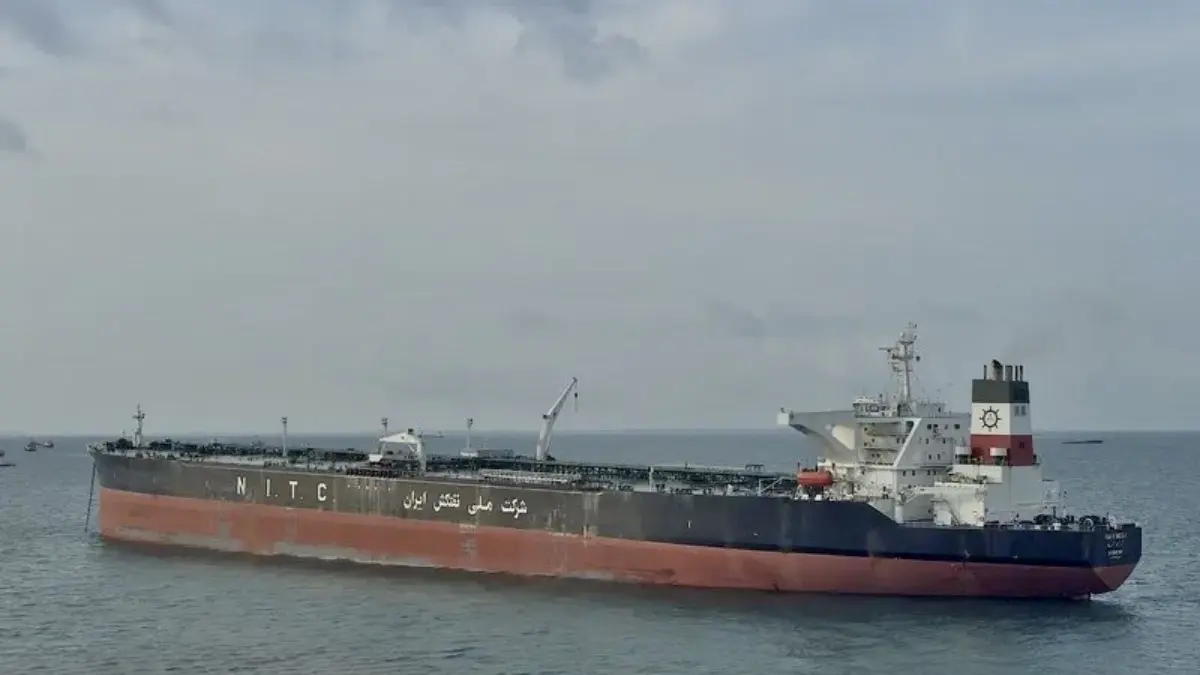
Tehran: Facing an oil storage crunch, Iran has revived its 30-year-old tanker Nasha to store crude at sea. The vessel, idle for years, is now being used to store excess oil that cannot be exported due to sanctions and the US blockade.
What Is Tehran's Oil Storage Problem?
Tehran cannot halt its oil production without damaging its wells. The US sanctions and the naval blockade at the Strait of Hormuz have prevented it from export its crude. This has kept crude piling up within its border.
Kharg Island produces over 90% of Iran's oil and stores around 30 million barrels of crude. However, it is almost full now as Iran cannot export crude owing to the naval blockade. Hence, Iran has now chosen to revive the age-old oil tanker to store its excess oil, in a bid to expand its storage at the Kharg Island.
While the move is only temporary, Iran, considering to revive this old ship, shows how the US naval blockade has tightened its oil economy.
Advertisement
What Is The Current Storage Status
Reports indicate that there is space for 13 million barrels of oil, and the net inflows are running at about 1 million to 1.1 million barrels per day. At this rate, it can be estimated that Iran's crude storage will get filled up in 12 to 13 days. Recently, satellite imagery showed three tankers loading at Iran’s Kharg Island export terminal.
Does Iran Need To Shut Its Oil Wells?
If Iran is not able to export its oil, it has to depend on its storage facilities. On top of that, if those facilities are exhausted, Iran will have no option but to shut down production, which would be a massive blow to its economy, mostly dependent on its energy exports. Hence, the US naval blockade is acting like an economic chokehold, rather than a military one. US Treasury Secretary Scott Bessent had earlier indicated that Iran might soon exhaust its crude storage facilities.
Advertisement
This would leave Iran no option but to shut down its oil wells, especially the water-injection fields that need to stay in continuous operation to avoid damage.
Why Iran Can't Just Turn Off Its Oil Production
Oil production is a delicate process, and one cannot just switch it off like a tap. Crude sits inside porous rock formations, held in place by a natural balance of pressure from gas, water, and surrounding geological forces. Extracting it requires carefully maintaining that balance so the oil can flow to the surface. Shutting wells abruptly upsets this equilibrium.
In mature fields, like many of those in Iran, stopping production can trigger water from underlying layers to seep into the reservoir. Once water seeps into the oil-bearing rock, some of the crude can become permanently trapped, reducing the amount that can be recovered. Over time, this not only lowers output but can also cause lasting damage to the reservoir’s overall productivity.
Why Nasha Is Offering A Stop-Gap Solution
Iran has little choice but to keep production running at Kharg Island despite being unable to export its crude. The redeployment of the tanker Nasha signals that Tehran has to keep oil flowing while easing pressure on vulnerable onshore storage.
However, bringing Nasha back into service offers only a short-term workaround. If the blockade continues, Iran will have to either opt for deeper production cuts or risk long-term damage to its upstream fields. For now, the move signals that Tehran is buying time.