
Xi At White House: ‘Steady Course’ For US-China Ties As Trump, Beijing Extend Trade Truce
Xi Jinping called for stable US-China ties, healthy competition and AI cooperation during his White House address as Washington and Beijing extended their trade truce until January 10, 2027.
- World News
- 6 min read

;'%3e%3cpath%20d='m8,15.99c4.41,0,7.99-3.58,7.99-7.99S12.41,0,8,0,0,3.59,0,8s3.58,7.99,7.99,7.99Z'%20style='stroke:%23fff;%20stroke-miterlimit:10;%20stroke-width:.02px;'/%3e%3cpath%20d='m3.08,3.37l3.82,5.11-3.84,4.15h.87l3.37-3.64,2.72,3.64h2.94l-4.04-5.39,3.58-3.87h-.86l-3.1,3.35-2.5-3.35h-2.94Zm1.27.64h1.35l5.97,7.99h-1.35l-5.97-7.99Z'%20style='fill:%23fff;'/%3e%3c/g%3e%3c/svg%3e)


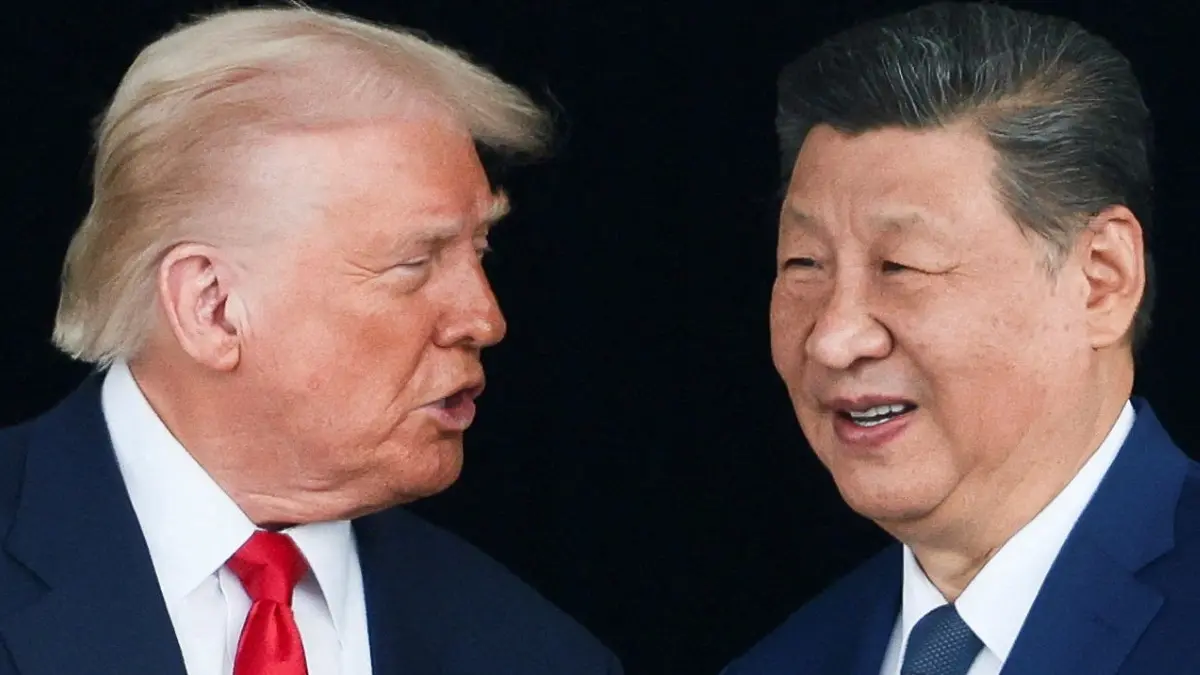
Washington: Calling on Washington and Beijing to "steer the giant ship of China–US relationship on a steady course," Chinese President Xi Jinping on Thursday (local time) delivered a broad address at the White House, urging healthy competition, mutual trust, and joint management of artificial intelligence alongside US President Donald Trump.
Against the backdrop of complex geopolitical tensions spanning technological controls, trade tariffs, and regional security, Xi framed the bilateral partnership not merely as a matter of national interest, but as an indispensable pillar of international stability.
Moreover, Washington and Beijing have consented to prolong their bilateral trade truce by an additional two months, moving the final expiration date from November 10, 2026, to January 10, 2027.
He opened his remarks by extending congratulations on the upcoming 250th anniversary of US independence on behalf of the Chinese citizens, emphasising that the historical choices made by Washington and Beijing will shape global development for decades to come.
Advertisement
"Both China and the United States are great countries, and both the Chinese and American peoples are great peoples. I am visiting the United States at President Trump's invitation to carry on our friendship, expand cooperation, and promote the well-being of both our peoples," he said.
"We should strengthen communication. China and the United States are different in national conditions, but through candid, in-depth, and continued dialogue, our two countries can understand each other better, seek common ground while shelving differences, and build up mutual trust. President Trump and I have respect for each other. We have built personal rapport and stayed in touch. We encourage our government departments to catch up on strengthening contact. And we support our legislative bodies in increasing exchanges," he added.
Advertisement
Addressing complex geopolitical tensions across trade, technology, and regional security, Xi argued that Washington and Beijing carry a historic duty to prevent zero-sum rivalry. President Xi pointed to the constructive momentum established during President Trump’s visit to Beijing earlier in the year.
"Mr. President, during your visit to China this year, we agreed to build a constructive China–U.S. relationship of strategic stability, and this is widely welcomed by the people of our two countries and the international community. I am ready to work with you to steer the giant ship of China–U.S. relationship on a steady course toward the future," Xi said.
President Xi pushed back against the notion that an established power and an emerging power are bound for inevitable conflict. To ensure long-term peace, Xi called for healthy, bounded competition, strong military-to-military crisis prevention mechanisms, and open diplomatic channels.
"As I have said many times, China and the United States, as two major countries, stand to gain from cooperation and will both lose in confrontation. We do not need to avoid mentioning competition, but our competition should be a healthy one and should be kept within bounds. It should be a race of catching up with one another, not a wrestle in which one either wins or loses," Xi stated.
"China and the United States must hold the line of no conflict and no confrontation between us. And we can certainly find the right path for two great countries to get along on this planet we both call home. Our two militaries should maintain regular dialogue and improve mechanisms for crisis communication and prevention. The Thucydides Trap can be overcome," he added.
On core policy issues, Xi highlighted artificial intelligence as a critical frontier where both Washington and Beijing must exercise responsible leadership. Recognising that both nations lead the world in advanced computing, he argued that AI development must remain strictly under human supervision and be directed toward public benefit.
He also emphasised that Beijing remains open to American capital, while advocating for fair treatment for Chinese firms operating in the United States.
"Both China and the United States are leading nations in artificial intelligence. We have both the capability and responsibility to develop and manage AI for good, and ensure that the development of AI is always under human control and serves the well-being of the people. China keeps its door wide open, welcoming American companies wanting to invest and do business there. We hope Chinese companies are treated fairly here in the United States. Working together, we can lengthen the list of cooperation and shorten the list of issues," Xi said.
Looking beyond government-to-government diplomacy, Xi underscored that long-term stability relies on strong interpersonal and cultural ties. To bridge societal divides and cultivate the next generation of leadership, he unveiled a major educational initiative aimed at expanding opportunities for American students to study in China.
"The hope of China–U.S. relationship lies in our people, and its future lies with the young. I am glad to announce an invitation for 100,000 young Americans to visit China for exchanges and study in the coming five years," Xi announced.
In a symbolic gesture of goodwill, Xi also announced the resumption of panda diplomacy, confirming that "in a few days, two pandas, Ping Ping and Fu Shuang, will come to their new home in Zoo Atlanta and meet with the American people."
Concluding his address, Xi sought to reconcile the defining domestic agendas of both leaders, China’s national rejuvenation and America’s economic revival, framing them as complementary rather than contradictory ambitions.
"Achieving the great rejuvenation of the Chinese nation and making America great again can go hand in hand. Let us meet the people's expectation and show our historical initiative. Let us keep advancing the cause of friendship between our two peoples and work together to build a better world," Xi concluded.
Earlier, while addressing the Chinese delegation at the White House, Trump praised the "truly great friendship" built between the two leaders while signalling a heavy focus on trade, technology, and advanced computing.
Looking ahead to the formal summit talks, the President framed the agenda around long-term global stability and technological governance.
"During this visit, we will also discuss pressing issues concerning security, technology, and Super Intelligence (SI). The decisions we make in these areas today can promote peace and prosperity for decades and decades to come. If we focus on our common interests, I am confident there is much we can achieve," Trump added.
Xi Jinping’s state visit to the United States will include a series of engagements with Trump at the White House, including bilateral and expanded bilateral meetings, remarks and a state dinner, according to the White House schedule. Talks with Trump are expected to cover trade, technology, critical minerals, and broader US-China relations.