
Year-Ender: From US Capitol attack to Taliban takeover, most significant news of 2021
From US Capitol attack in January to the Taliban’s Afghan takeover in August after nearly two decades, the world witnessed several significant moments in 2021
- World News
- 6 min read

;'%3e%3cpath%20d='m8,15.99c4.41,0,7.99-3.58,7.99-7.99S12.41,0,8,0,0,3.59,0,8s3.58,7.99,7.99,7.99Z'%20style='stroke:%23fff;%20stroke-miterlimit:10;%20stroke-width:.02px;'/%3e%3cpath%20d='m3.08,3.37l3.82,5.11-3.84,4.15h.87l3.37-3.64,2.72,3.64h2.94l-4.04-5.39,3.58-3.87h-.86l-3.1,3.35-2.5-3.35h-2.94Zm1.27.64h1.35l5.97,7.99h-1.35l-5.97-7.99Z'%20style='fill:%23fff;'/%3e%3c/g%3e%3c/svg%3e)


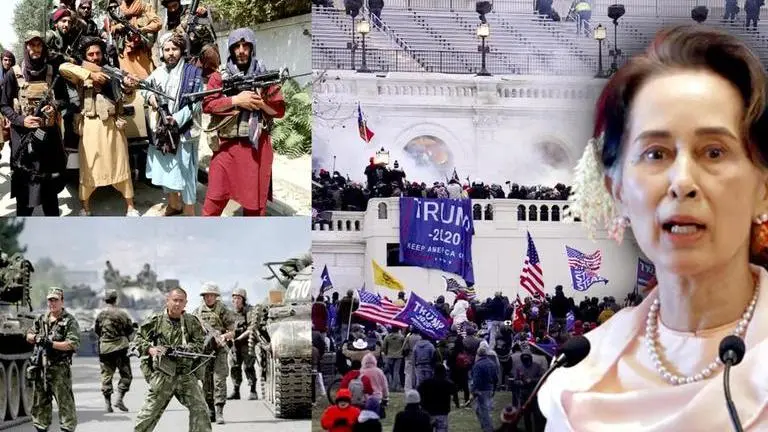
From protesters forcefully entering one of the most secure federal buildings in the US to the Taliban reconquering Afghanistan after nearly two decades, the world witnessed several significant moments in 2021, which was also the second year of the COVID-19 pandemic.
On one hand, the main focus remained on fully vaccinating the entire population against Coronavirus, but on the other, the political turmoil in the nations barred the process of immunisation as the focus shifted on tackling the humanitarian crisis such as in Myanmar. It is to note that the hope of ‘new normal’ with COVID-19 at the beginning of 2021 is now again shaken with the emergence of the Omicron variant with governments scrambling efforts to roll out COVID-19 booster shots.
Most significant world events of 2021:
US Capitol attack
At the beginning of 2021, when the world was only appearing to emerge from the COVID-19 pandemic, shocking scenes were recorded in the United States on January 6. In order to hinder Congress from certifying the victory of now US President Joe Biden, the supporters of former US President Donald Trump stormed through the US Capitol, destroyed the federal property and even chanted death threats to US lawmakers including then-Vice President Mike Pence. The pro-Trump protesters were fuelled by baseless claims of election fraud that the ex-US President reiterated in his speech on that same day. Several demonstrators have now been charged or fined for their role in the riot that claimed at least one life due to a gunshot.
Myanmar coup
In Myanmar, the decades-long struggle for democracy suffered a blow as the military seized power and put the civilian leaders of the country under house arrest including Nobel laureate Aung San Suu Kyi. On February 1, Myanmar’s military seized power February 1 in a ‘coup’ against the democratically elected government of Suu Kyi, who is now sentenced to two years and was recently spotted in a prison uniform. Military-owned Myuawaddy TV had announced the takeover while citing a section of the military-drafted constitution that allows the armed forces to take control at the time of national emergency. It budded from the military’s claims of voter fraud in November 2020’s election. Myanmar has now endured 10 months of junta rule.
Advertisement
Taliban takeover
In another shocking world event, the Taliban reconquered Afghanistan after two decades in August 2021 as the US and other western troops left the foreign soil. The extremists not only changed the name of the country but their takeover pushed thousands of Afghan citizens into uncertainty. The US and other nations scrambled efforts to take out their troops, officials and other people who worked with the former government under Ashraf Ghani. Now, the Taliban has assembled its own administration and fighting for international recognition. The leadership of the country has no women, and girls and females in Afghanistan continue to dread their safety considering the previous iron-fist rule of the extremists.
Ukraine-Russia tensions
Russia’s armed aggression against Ukraine in 2014 resulted in Moscow’s annexation of Crimea - a part of Ukrainian territory. The tensions between both countries witnessed a fresh escalation this year triggering fears of Moscow invading Kyiv. Even though Dmitry Peskov, a spokesman for Russian President Vladimir Putin, told reporters, “Russia is not going to attack anyone”. After that reports have continued to emerge stating military buildup near its borders with Ukraine.
Advertisement
While Moscow made the development in the recent weeks, it stoked fears among the Western nations and in Kyiv that Russia might start a new war with its neighbour. Ukraine is Russia’s former province that chose to break away from the Kremlin's political orbit. Earlier this month, Russia revealed its security proposals to the West precluding the eastward expansion of NATO.
Recently, on 17 December, Russia’s Foreign Ministry published two draft agreements regarding the security guarantees between Moscow, the United States and the alliance. Amid tensions over its border with Ukraine, the Kremlin suggested that NATO would not expand further into Eastern Europe and stop Washington and Moscow from deploying medium to short-range missiles within striking distance of each other’s territory. The proposal also limits the troop, warship and aircraft deployment for both sides.
Belarus-Poland migration crisis
Thousands of migrants were stranded between 398 km long border between Poland and Belarus. The migrant crisis escalated this year and people found themselves stuck at the centre of an escalating geopolitical dispute pitying the European Union, the US and NATO against the Belarusian government.
The West accused Belarusian President Alexander Lukashenko of manufacturing a migrant crisis on the EU’s eastern border in a bid to destabilise the bloc as a retaliation to the sanctions over human rights abuses. However, his government has denied all the allegations and blamed the West for dangerous, fatal, border crossings and even poor treatment of migrants.
According to the media reports, the Polish border guard said in November that it recorded more than 1,000 crossing attempts in just two days. These attempts reportedly included some of the “large-scale” efforts with around 100 people trying to breach the fence. Migrants who have flocked the Belarus border with Poland, are hoping to get to Western Europe but since many of them are left stranded, they have started building makeshift camps in the area.
Iran nuclear program advanced
As tensions continue to escalate between the United States and Iran over Islamic Republic’s nuclear program and Washington’s sanctions, Tehran continued to develop its facilities this year. The Iran nuclear deal of 2015 had granted Tehran relief from sanctions by the rest of the world to limit Islamic Republic’s nuclear program. However, Iran was pushed into a fresh crisis after the United States under then-President Donald Trump withdrew from the accord and reimposed the crippling sanctions on Iran. In retaliation, Tehran geared up its nuclear program and is now spinning a stock of uranium enriched to 60% purity, the AP report stated. Iran now remains a short technical step away from weapons-grade levels.
AUKUS deal signed
Signalling a major paradigm shift in the strategy and policy across the region, the new security partnership in the Asia-Pacific called AUKUS was unveiled this month between the US, UK and Australia. One of the most significant features of this alliance is that it will witness the UK and the US provide Australia with both the technology and capability to deploy nuclear-powered submarines.
It is pertinent to note that once the plan is carried out, it would be the first time when a non-nuclear weapons state would acquire nuclear-powered submarines.
Under the defence strategic deal, Australia would get eight nuclear-powered submarines that are capable of stealthy, long-range missions. The trilateral defence alliance also provides for sharing of cyber, artificial intelligence, quantum and unspecified undersea capabilities. However, AUKUS drew criticism from France and anger from China. Beijing described the pack as an “extremely irresponsible” threat to stability in the region.