
White Paper: Third-largest auto maker, aviation & IT hub, youthfulness drive India's growth story
India aims net-zero emission goal, creating 19-20 million jobs each year, sustained growth, and inclusivity.
- Republic Business
- 6 min read

Accelerating growth engine: Several sector-wise independent reports and studies, issued during the last two years, have revealed that India is well-poised to become a developed economy. The country's Rs 12.5 lakh crore worth auto industry, with over Rs 3 core to Rs 4 crore exports has surpassed Japan to become the third-largest auto manufacturer, according to Society of Indian Automobile Manufacturers (SIAM) data.
Center for Asia Pacific Aviation (CAPA), which provides market intelligence for the aviation and travel industry, has underlined the confirmed orders from airlines in India have touched 1,500 aircraft, and India will have a strong fleet of 3,500 aircraft by 2047. The International Monetary Fund (IMF) has projected India's demographic advantage to continue till 2050 and sees the country create 19-20 million skilled workforce every year. Besides, India is fast attracting global Information Technology (IT) giants to set up Global Capability Centers (GCC) in its booming IT hubs such as Bengaluru, Pune, Hyderabad, and Delhi NCR.
For the country to achieve the cherished goal of becoming the world's third-largest economy, improved socio-economic parameters and continued optimism remain the key. The growing focus on manufacturing, employment, sustainability, tech-driven healthcare, and education, will be pivotal to letting the country make its presence felt in the league of economic superpowers.
Sharing a Whitepaper in Parliament on Thursday, that compares the state of India’s economic performance with that of the UPA-led decade, the Government highlighted the high inflation that people of the country had to face due to poor policies and high expenditure of the Government. This comparison reveals India’s journey from grappling with inflation concerns to achieving stability and resilience. Republic Business takes a deep dive.
Private Investments
Most industry forums, including umbrella bodies, Confederation of Indian Industry (CII) and Federation of Indian Chamber of Commerce and Industry (FICCI), and sector-specific ones such as Society of Indian Automobile Manufacturers (SIAM) and National Association of Software and Service Companies (NASSCOM), through regularly issued reports have reaffirmed that apart from an IT services hub, India is globally perceived as technologically oriented and innovative in almost all sector.
Image Credit: Unsplash
Given that all sectors are seeing 75-95 per cent capacity utilisation currently on the back of a growing economy, India is set to see a significant private investment coming into both manufacturing and services sectors, Confederation of Indian Industry President R Dinesh has said. A strategic partnership that can get the best of both private and public sector can help bridge the divide in job creation, infrastructure development and economic growth. Industry has reiterated that with manufacturing sentiment being high in the country, more private investments will flow. There are several sectors whose potential is well identified. One such sector is mining and metal industries, he said. Although India has the raw material like iron ore for steel making, the country is not a major exporter of steel and its related downstream products. China, Japan and South Korea are top exporters. There is no reason why India cannot do likewise, most industry leaders have said.
Sustainable Growth
If India is to become a developed nation by 2047, the country will have to gear up in education, science and technology, and sustainability, reveals a report ‘Gainful Employment Growth’ prepared by Maharashtra-based Technology Transfer Association. The National Education Policy, 2020 highlighted the reforms to be carried out into the educational sector, says the report, adding that to build a startup-centric and equitable ecosystem to attract foreign investments, and virtual elements to enhance learning are at the forefront of the country's growth, the report said.
Image Credit: Unsplash
Micro-credentials and interdisciplinary establishments could be of great help. Research-oriented higher education with a collaborative partnership with industry and all other stakeholders, says TTA research. For India to emerge as a developed country by 2047, not only upgradation of the existing technologies but also manufacture of new products with newly developed globally competitive cutting edge technologies being used for the manufacture of products in competition with other developed countries. This will mean shifting the focus from labour-oriented manufacturing to the use of automated machines and systems including the massive use of robots.
Skilled Workforce
Image Credit: Unsplash
Projections from both industry observers as well as government data has revealed that over the next 10 to 15 years, millions of youth will become a part of country's workforce. India can utilise this demographic dividend, provided the country is able to create educated workforce with skills relevant to the industry. There are many pathways that can be followed. The best pathway is to go by Public Private Partnership. To envisage that the government alone can address the issues concerning the industry. Adequate funds must be allocated to create more research opportunities. Transparent process for faculty recruitment duly supported by training and equipment. International partnership for leveraging technology to improve students experience is must to build the required skills in both the faculty and students.
Universal Health Services

Image Credit: Unsplash
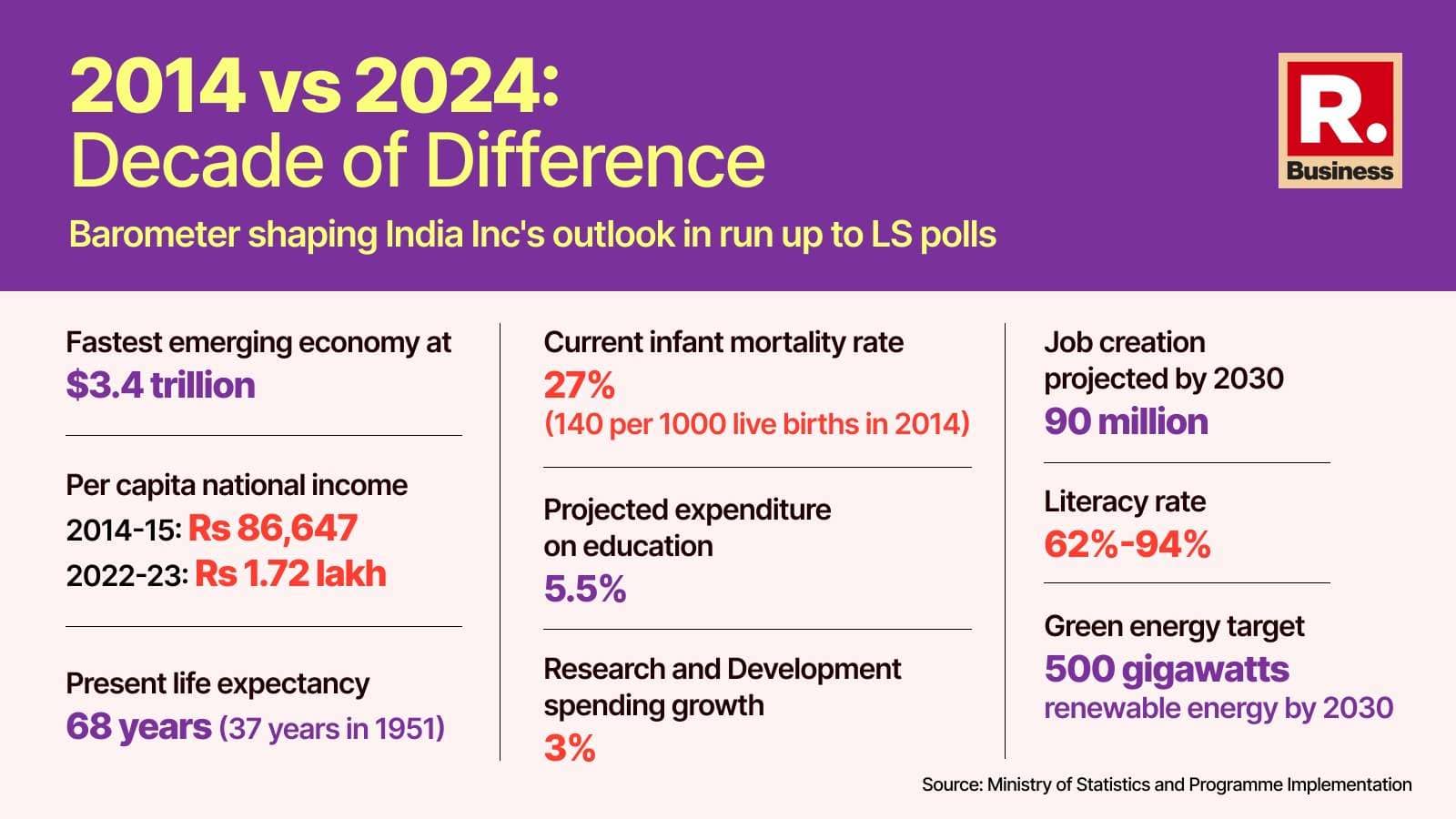
Over the last one decade, India has several achievements to its credit. These include food self-sufficiency, increase in life expectancy and reducing maternal, infant mortality rates (Refer to infographics). A strong economic base has been created. While there is potential to increase the per capita income to Rs 2 lakhs, as envisaged by the government, such a push is possible if India can play to its demographic dividend edge. The median age of India population is projected to be 31-years by 2030 as compared to 42-years in China and 40-years in US. As a result, India will have 90 million additional households headed by millennials. But to gainfully employ its young population , India will need to unlock following key focus areas such as universal health services, gender equality, logistic improvements, and hi-tech manufacturing.
Tech influenced policies
Image Credit: Unsplash
Technological interventions to boost the country's industrial and agricultural productivity have started influencing policymakers. If there has to be dramatic productivity improvement, not only to meet the requirements of increased population but also for export purposes, India will have to have an agri and industrial revolution with automation, use of drones, and remote sensors, says a report by Data Bridge Market Research. Currently, India uses four robots as against 10,000 used by South Korea. Automation of such magnitude will also require an educated and skilled labour force.
Published By : Saqib Malik
Published On: 1 January 2024 at 20:23 IST