
Volvo EX90 Review: The Electric SUV That Makes Luxury Feel Effortless
The EX90 does not feel like Volvo trying to build the most outrageous electric SUV on the road. It feels like Volvo trying to build the electric SUV that people could actually live with every day.
- Automobile News
- 12 min read

;'%3e%3cpath%20d='m8,15.99c4.41,0,7.99-3.58,7.99-7.99S12.41,0,8,0,0,3.59,0,8s3.58,7.99,7.99,7.99Z'%20style='stroke:%23fff;%20stroke-miterlimit:10;%20stroke-width:.02px;'/%3e%3cpath%20d='m3.08,3.37l3.82,5.11-3.84,4.15h.87l3.37-3.64,2.72,3.64h2.94l-4.04-5.39,3.58-3.87h-.86l-3.1,3.35-2.5-3.35h-2.94Zm1.27.64h1.35l5.97,7.99h-1.35l-5.97-7.99Z'%20style='fill:%23fff;'/%3e%3c/g%3e%3c/svg%3e)


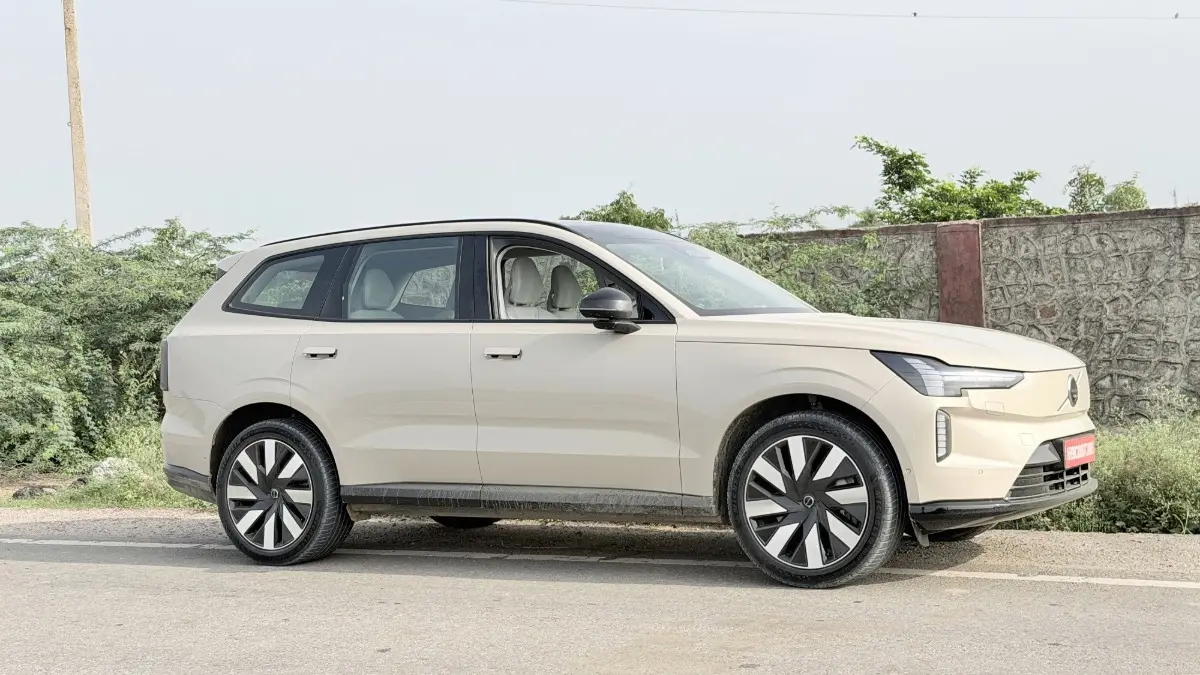
Volvo has never really been interested in making cars that scream for attention. The EX90 is a good example of that philosophy. At a time when electric SUVs are increasingly becoming exercises in aggressive styling, dramatic lighting and unnecessary bits of chrome, the EX90 takes a much calmer approach. It looks premium, but it does not constantly remind you that it is expensive.
The design borrows heavily from Volvo's Scandinavian design philosophy, and there are similarities with the newer ES90 as well. But the EX90 is a much larger proposition. It is more than five metres long, has a 2,985mm wheelbase and, in India, comes with six seats.
That makes it a huge SUV, but interestingly, I never felt that Volvo was trying too hard to make it look huge. It has a certain presence without the visual drama that has become almost mandatory in the luxury EV segment.
I spent time with the EX90 to understand whether this restrained approach actually works in the real world. For the most part, it does.
Advertisement
What's Good
The design is understated, but far from boring
The first thing I noticed about the EX90 was how different it felt from many of the electric SUVs I have driven recently.
There are no exaggerated grilles, unnecessary creases or excessive chrome elements. Volvo has kept the surfaces clean and the overall design quite simple. Yet the EX90 does not disappear into traffic. The Thor's Hammer LED daytime running lights are probably my favourite part of the front design. They give the otherwise restrained face a playful character, while the new rear light signature gives the SUV a distinctive identity from behind.
Advertisement
The 21-inch aerodynamic alloy wheels also help. They are probably one of the few elements of the EX90 that immediately feel familiar to someone coming from a conventional luxury SUV.-1789751868921.webp)
The EX90 is also huge. It measures 5,037mm in length and has a 2,985mm wheelbase, while the India-spec version weighs around 2.7 tonnes in running order.
Yet it does not look like Volvo simply stretched an existing SUV until it became enormous. That is a difficult balance to achieve.
The cabin is exactly what I expect from a modern Volvo
The interior is where the Scandinavian philosophy really comes through.
There is a sense of space everywhere. The seats are comfortable, electrically adjustable, and the front seats also get ventilation and massage functions. The second row gets individual captain seats, which is one of the reasons the EX90 feels different from a conventional three-row SUV.
The six-seat configuration gives the second row considerably more room than a bench would. There is enough space between the seats for passengers to move around, and children can easily stand there when getting into or out of the third row.-1789751879527.webp)
The third row is better suited to children than adults, but that is not unusual for a three-row SUV. What I like is that Volvo has not treated the third row as something that exists only on a brochure.
With all the seats in place, boot space is 324 litres. Fold the third row and that increases to 690 litres, while folding the rear seats completely opens up substantially more room. There is also a 46-litre front luggage compartment, which is useful for storing charging equipment or smaller bags.
For a family, that flexibility matters more than simply having a gigantic boot figure.
Volvo has gone all-in on the touchscreen
The 14.5-inch touchscreen sits prominently in the centre of the dashboard, and almost everything happens through it.
You can control the climate, operate the air vents, access apps, adjust vehicle settings and even open the glovebox from the screen. Volvo has also made the interface relatively intuitive, with contextual controls appearing when they are relevant.
I did not find myself constantly hunting through menus. Navigation can sit alongside other information, and Google Maps, Google Play and Google Assistant are built into the car, meaning you do not necessarily need your phone for every basic function.-1789751907869.webp)
The integration with smartphones is also impressive. The EX90 supports wireless Apple CarPlay and Android Auto, and I had no trouble using Siri through CarPlay for navigation while also using the built-in Google ecosystem for other functions.
I could even talk to Gemini to perform certain tasks, including changing settings such as the air-conditioning temperature. The catch is that you have to be fairly precise with the command. Natural-language assistants are getting better, but apparently they still appreciate being spoken to like slightly confused interns.
Is the digital approach a little too far?
This is also one of the areas where I think the EX90 could frustrate some owners.
I am fine with having a large touchscreen in a modern EV. What I am less convinced about is putting functions that I would normally expect to operate physically behind that screen.
Even adjusting the exterior mirrors involves the digital interface. It looks futuristic, but I found myself wondering whether it is actually better than simply pressing a physical control. The same applies to climate controls and the air vents. It is not difficult once you understand the system, but it introduces another layer between you and something you may want to adjust immediately.
The digital key can also be a source of frustration. The key needs to be positioned correctly for the car to recognise it, and the authorisation process can feel unnecessarily slow when you are simply trying to get into the car and leave.-1789751917403.webp)
The key is also involved in authorising the car to start, with the required placement on the charging pad adding another step.
Volvo's official Digital Key Plus system is designed to allow a compatible iPhone, Apple Watch or UWB-equipped Android device to unlock and drive the car without taking the device out of your pocket.
That sounds excellent on paper. In practice, though, small inconsistencies in digital access are exactly the kind of things that can become disproportionately annoying when you are already running late. But you can't blame Volvo here, because the EV industry is increasingly going all-digital despite genuine pain points.
The sound system can turn this into a very expensive party
The Bowers & Wilkins system is one of the features that makes the EX90 feel properly premium.
The optional system uses 25 speakers and a 1,610-watt amplifier, and supports Dolby Atmos. Volvo has also introduced an Abbey Road Studios sound mode through an over-the-air update. I could push the volume considerably without the system sounding like it was struggling.
In fact, it gets loud enough that the EX90 can start attracting attention for reasons unrelated to its design. The quiet cabin helps here too. Volvo has put considerable effort into insulation, while laminated windows further reduce outside noise.
The result is exactly what you want from a luxury EV. The cabin becomes a quiet space when you want it to be, and a fairly serious entertainment system when you don't.
The driving experience is the real surprise
The EX90 is a very large SUV. That is something you notice when you look at it. But you do not necessarily notice it when you drive it.
The India-spec EX90 gets a 106kWh battery and a twin-motor all-wheel-drive system producing 456hp and 670Nm. Volvo claims 0-100kmph in 5.5 seconds and a top speed of 180kmph.
I found it took slightly more than six seconds to reach 100kmph in my testing, rather than the claimed 5.5 seconds. That is a minor gripe rather than a serious problem.
The acceleration is still remarkably quick for something this large.-1789751927240.webp)
More importantly, the power delivery is smooth. There is no dramatic surge that makes the car feel nervous. The EX90 simply gathers speed very quickly, and because the power delivery is so linear, the size of the vehicle almost disappears once you are moving.
That is one of the things I liked most about it.
You can actually customise the way it drives
The EX90 offers Range, Standard, Performance and Off-road driving modes. You can also adjust steering feel, suspension feel and regenerative braking.
The Performance mode makes the car feel more responsive, while Range mode makes more sense when efficiency matters.
The suspension is particularly interesting because the EX90 can adjust its ride characteristics electronically, while the Off-road mode raises the suspension to increase ground clearance and adds hill-descent control.
Volvo's India specifications list a maximum ground clearance of 250mm with the suspension raised, giving the EX90 some useful flexibility when dealing with bad roads, steep ramps or rougher terrain.
I would not mistake this for a hardcore off-roader, but that is not what the EX90 is trying to be. It is an SUV first, and the additional capability makes it more useful.
The EX90 has more range and charging technology than the numbers suggest
Volvo quotes up to 625km of range under the NEDC testing cycle for the India-spec model. It also uses an 800V electrical architecture and supports 10-80 percent DC charging in a claimed 22 minutes when using a 350kW charger.
The 800V architecture is important because it is not simply about producing a bigger range number. It allows the car to handle higher charging power more efficiently and reduces heat generated during charging.
Volvo says the newer 800V EX90 can add up to 250km of range in 10 minutes under its test conditions, although actual charging performance will depend on the charger, battery temperature, state of charge and other conditions.
During my drive, however, I also noticed how quickly consumption can rise when I kept driving at higher speeds and using the performance available from the twin motors. I lost roughly 20 percent battery in about half an hour while driving at speeds above 80kmph.
That does not mean the EX90 has poor efficiency. It simply demonstrates the obvious truth about large, heavy EVs: 456hp is fun, but physics continues to invoice everyone.
For normal city driving and steady cruising, the car is much more sensible about how it uses its battery. And with 670Nm available almost instantly, you do not need to constantly floor the accelerator to access the performance.
The safety technology feels appropriate for a Volvo
Safety is obviously a major part of the EX90's identity, but I found the approach more interesting than simply counting airbags and sensors.
The EX90 uses a combination of cameras, radar and driver-monitoring technology to understand what is happening around the car and, to an extent, what is happening with the driver. Volvo calls this Driver Understanding. It can monitor eye and head movements, as well as driving behaviour, and can escalate warnings if it detects that the driver is not responding.
There is also occupant sensing, which can detect movement inside the cabin and warn if someone or an animal has been left behind.-1789752033493.webp)
Pilot Assist can help with steering, braking and acceleration, while Park Pilot Assist can take over steering, acceleration, braking and gear selection when parking, with the driver still required to supervise.
The EX90 also gets a 360-degree camera system and high-definition Pixel headlights that use 1.3 million pixels to adjust the light pattern around other road users.
These features are not replacements for paying attention, but they do make sense in a large family SUV where visibility and situational awareness matter.
What's Bad
The biggest issue with the EX90 is that Volvo's obsession with creating a software-defined car sometimes gets in the way of simple interactions.
The touchscreen itself is good. The problem is that Volvo has placed so many functions inside it.
Mirror adjustment, climate controls and other everyday functions do not always need a screen. There are situations where a physical button is simply faster.
The digital key can also be temperamental enough to become irritating. The idea is excellent, but when a key needs to be positioned in a particular way before the car recognises it, the experience can feel less seamless than it should.-1789752051155.webp)
The third row is another limitation. With the seats up, 324 litres of boot space is not particularly generous for a vehicle of this size.
It is perfectly usable for everyday family duties, but if six people are going away for several days with luggage, you will need to plan carefully. The frunk helps, but it cannot completely compensate for the compromise created by the third row.
The other thing worth remembering is the sheer size of this SUV. At 5,037mm long and more than two metres wide with the mirrors folded, the EX90 is not a small vehicle.
The cameras, parking assistance and driver-support technology help, but there is no getting around the fact that this is a large luxury SUV. Indian parking spaces were not designed by people who have apparently ever met a vehicle like this.
Verdict
The Volvo EX90 is one of those cars that becomes more impressive the longer I spend with it.
It does not have the instantly dramatic design of some electric SUVs. It does not throw futuristic elements at you simply because it can. Instead, it focuses on making the cabin comfortable, the technology useful, the driving experience effortless and the overall environment premium.
That is very Volvo.
The six-seat layout is particularly interesting because it gives the second row a level of comfort that many three-row SUVs simply cannot match. The third row remains more appropriate for children, but the flexibility of the cabin, the 690-litre boot with the third row folded and the 46-litre frunk make the EX90 practical enough for family use.
Then there is the performance. A 456hp, 670Nm all-wheel-drive SUV that can get to 100kmph in around six seconds is more than quick enough. What impressed me more was how easy it was to access that performance without making the car feel intimidating.
The technology is both its strength and its weakness. The 14.5-inch display, Google built-in, wireless smartphone connectivity, OTA updates, driver assistance and digital key make the EX90 feel like a computer on wheels. But sometimes I wished Volvo had remembered that a button is also a perfectly respectable piece of technology.
The biggest question now is the price.
Volvo has not announced the India price yet, with the pricing announcement expected in October. That figure will ultimately determine where the EX90 sits in India's luxury EV market.
For now, though, the EX90 makes a strong case for Volvo's idea of what a modern luxury SUV should be. It is huge without being intimidating, luxurious without being ostentatious, and technologically advanced without completely losing sight of the fact that people still have to live inside it.
And that may be its biggest strength. The EX90 does not feel like Volvo trying to build the most outrageous electric SUV on the road. It feels like Volvo trying to build the electric SUV that people could actually live with every day.