
New IIP Series Debuts: India's Industrial Output Grows 4.9% In April On Strong Manufacturing
India’s industrial output expanded by 4.9% in April 2026 compared to the same month last year. The growth was powered by a 6.2% surge in the manufacturing sector. This release marks the historic debut of the revised Index of Industrial Production (IIP) series, which updates the base year to 2022-23 to better reflect modern economic structures.
- Republic Business
- 3 min read

;'%3e%3cpath%20d='m8,15.99c4.41,0,7.99-3.58,7.99-7.99S12.41,0,8,0,0,3.59,0,8s3.58,7.99,7.99,7.99Z'%20style='stroke:%23fff;%20stroke-miterlimit:10;%20stroke-width:.02px;'/%3e%3cpath%20d='m3.08,3.37l3.82,5.11-3.84,4.15h.87l3.37-3.64,2.72,3.64h2.94l-4.04-5.39,3.58-3.87h-.86l-3.1,3.35-2.5-3.35h-2.94Zm1.27.64h1.35l5.97,7.99h-1.35l-5.97-7.99Z'%20style='fill:%23fff;'/%3e%3c/g%3e%3c/svg%3e)


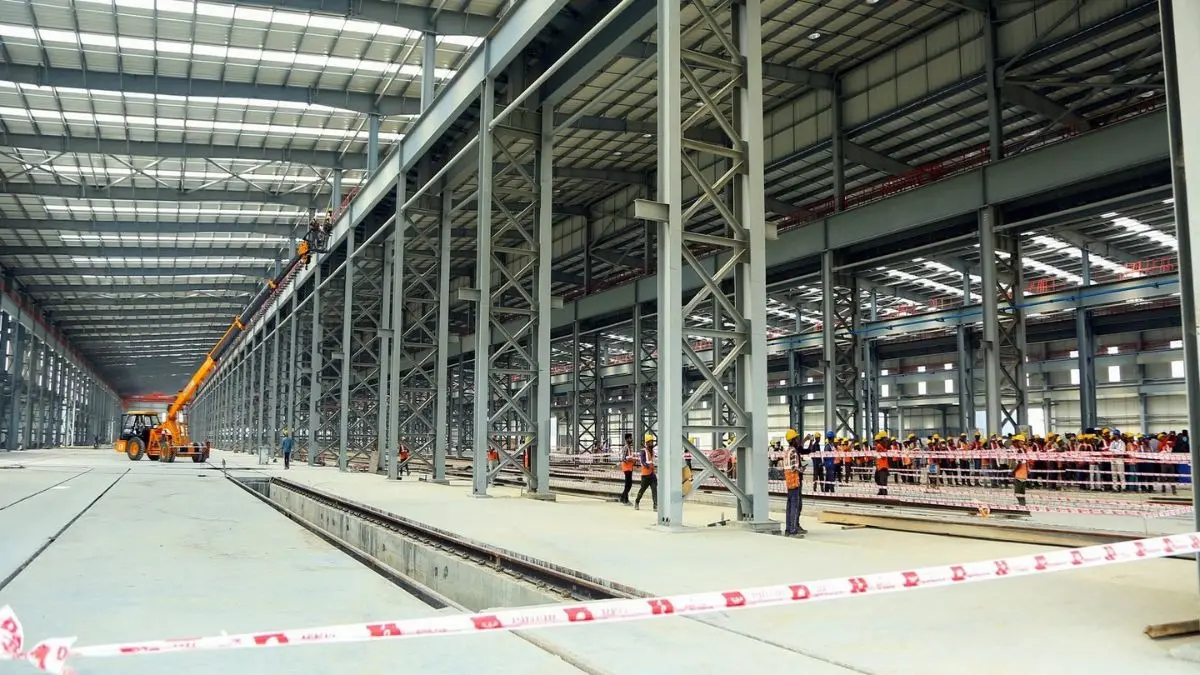
India’s industrial production grew by 4.9% in April 2026, supported heavily by a strong performance in domestic manufacturing.
The data represents the very first press release compiled under the newly revised Index of Industrial Production (IIP) series. The Ministry of Statistics and Programme Implementation (MoSPI) officially shifted the macroeconomic benchmark's base year from 2011-12 to 2022-23. The institutional overhaul aims to make the index far more representative of India's current industrial dynamics.
The quick estimate for the General IIP index stood at 118.9 for April 2026, rising from 113.1 in April 2025. The structural changes follow a detailed report submitted on May 25, 2026, by the Technical Advisory Committee for Base Year Revision.
Manufacturing
The manufacturing sector, which holds the largest chunk of the IIP weighting at over 76%, expanded by 6.2% during the month. Out of 23 distinct industry groups within manufacturing, 17 recorded positive expansions.
Advertisement
The primary growth drivers included motor vehicle manufacturing, which jumped 12.7%, and electrical equipment production, which soared by 19.2%. Significant growth contributions within these segments came from auto components, switchgears, and small transformers.
In sharp contrast, the mining and quarrying sector contracted by 5.1% during April. Meanwhile, electricity and gas supply grew by 4.9%, and the newly integrated water supply, sewerage, and waste management sector posted a 6.6% increase.
Advertisement
Capital Goods Surge
An analysis of the data using use-based classification shows an impressive 16.0% surge in the capital goods segment. Capital goods serve as a critical gauge for factory equipment demand and corporate investment across the Indian economy.
Other segments also tracked steady upward trajectories. Intermediate goods registered a 7.7% growth rate, while infrastructure and construction goods climbed by 7.1%.
Consumer-facing segments showed more moderate momentum. Consumer durables, which track high-value items like electronics and appliances, grew by 4.3%. Consumer non-durables, reflecting everyday fast-moving consumer goods, logged a quieter 2.8% expansion.
The revamped 2022-23 series significantly alters what MoSPI tracks to measure India’s industrial health. The updated item basket now spans 463 distinct item groups, up from 407 in the old series.
The government expanded sectoral coverage by adding modern high-tech commodities. New additions to the tracking list include CCTV cameras, magnetic stripe cards, non-woven textiles, spacecraft parts, medical stents, and human vaccines.
Conversely, outdated or declining products were completely scrubbed from the collection panel. Deleted items include traditional kerosene, fluorescent tubes, compact fluorescent lamps (CFLs), printing machinery, and sewing machines. MoSPI also introduced state-level data collection for minor minerals and expanded its data source panel to 16 agencies to maintain long-term reporting accuracy.