
DRDO Successfully Conducts Maiden-Test Flight of Long Range Kusha Air Defence Missile Off Odisha Coast
DRDO successfully conducts the maiden flight test of India's long-range surface-to-air missile Kusha off the Odisha coast, boosting indigenous air defence.
- Defence News
- 3 min read

;'%3e%3cpath%20d='m8,15.99c4.41,0,7.99-3.58,7.99-7.99S12.41,0,8,0,0,3.59,0,8s3.58,7.99,7.99,7.99Z'%20style='stroke:%23fff;%20stroke-miterlimit:10;%20stroke-width:.02px;'/%3e%3cpath%20d='m3.08,3.37l3.82,5.11-3.84,4.15h.87l3.37-3.64,2.72,3.64h2.94l-4.04-5.39,3.58-3.87h-.86l-3.1,3.35-2.5-3.35h-2.94Zm1.27.64h1.35l5.97,7.99h-1.35l-5.97-7.99Z'%20style='fill:%23fff;'/%3e%3c/g%3e%3c/svg%3e)


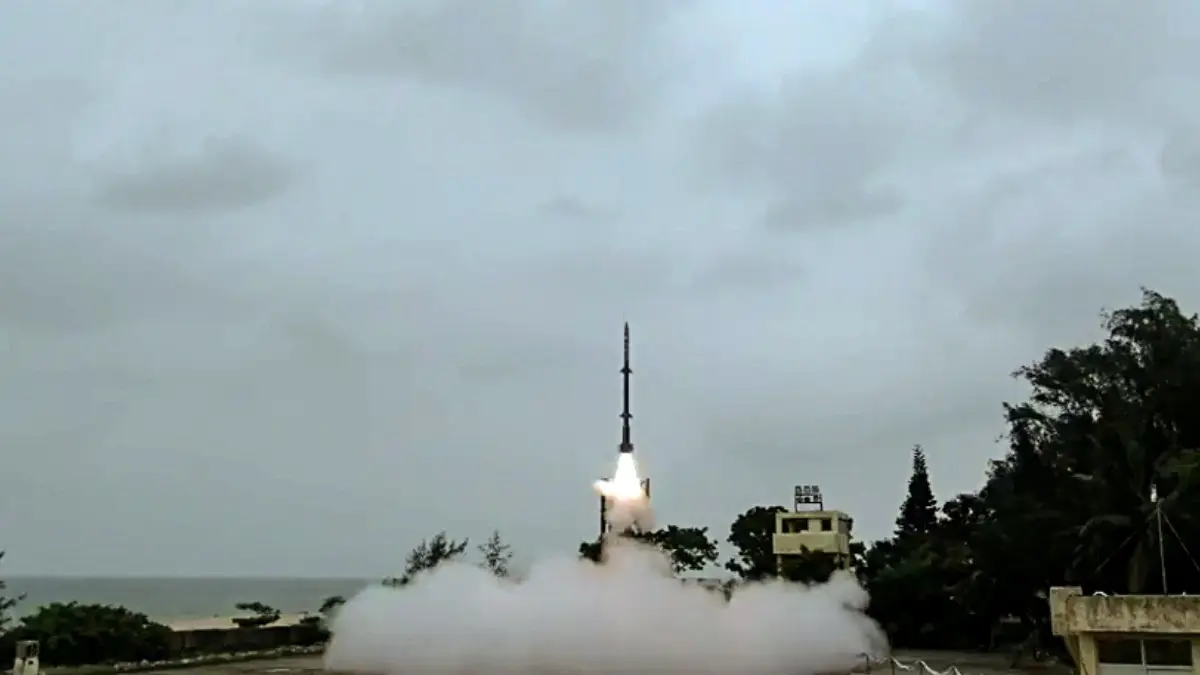
In a major boost to the nation’s strategic self-reliance, the Defence Research and Development Organisation (DRDO) on Thursday successfully conducted the maiden flight test of the indigenous long-range surface-to-air missile (LRSAM) Kusha. The successful launch took place from APJ Abdul Kalam Island off the coast of Odisha, marking a monumental milestone in India’s efforts to build a robust, home-grown air defence network.
A Major Milestone for Indian Defence R&D
Announcing the breakthrough, Defence Minister Rajnath Singh highlighted the versatility of the Kusha missile system. He noted that it is engineered to neutralise a wide array of aerial threats, including enemy fighter jets, cruise missiles, unmanned aerial vehicles (UAVs), and large strategic aircraft across broad ranges and altitudes.
Taking to X to congratulate the DRDO team, Singh praised the accomplishment as a crucial leap forward for the nation’s defence capabilities. "The DRDO has successfully conducted the maiden flight test of Long-Range Surface-to-Air Missile Kusha today from the APJ Abdul Kalam Island off the coast of Odisha," the Defence Minister said.
He emphasized that only a small group of nations currently possesses the technology to independently design and deploy long-range surface-to-air missile platforms. According to the minister, developing the Kusha system will dramatically cut India's reliance on foreign weapon imports while enhancing its indigenous military power.
Advertisement
Designed as a Three-Tiered Air Defence Shield
Project Kusha serves as the foundation of India’s future long-range air defence network, aiming to rival global systems like Russia’s S-400 Triumf and the US MIM-104 Patriot. Designed to offer a multi-layered shield, the system features a three-tier architecture with M1, M2, and M3 interceptors designed for ranges of approximately 150 km, 250 km, and up to 350–400 km, respectively.
Capable of reaching speeds around Mach 5.5, these interceptors will rely on sophisticated radars, fire-control systems, and a network-centric command structure. Once operational, Kusha will intercept incoming fighter jets, stealth aircraft, drones, cruise missiles, precision-guided munitions, and select ballistic missile threats.
Advertisement
Strategic Integration and Mission Sudarshan Chakra
The Defence Acquisition Council granted Acceptance of Necessity (AoN) in September 2023 to procure five squadrons of Project Kusha for the Indian Air Force. Bharat Electronics Limited (BEL) is serving as the primary industry partner for radar systems and system integration. The missile shield will seamlessly connect with the Indian Air Force's Integrated Air Command and Control System (IACCS), allowing real-time tracking and simultaneous engagement of multiple incoming threats.
This successful test sets the stage for further developmental trials before deployment. Ultimately, Project Kusha plays a central role in Mission Sudarshan Chakra—India’s initiative to establish a comprehensive, multi-layered national missile defence umbrella by 2035 by pairing long-range interceptors with short-range missiles, directed energy weapons, and ballistic missile defence capabilities.