
Indian Air Force Outranks China For 5th Time Since 2022 to Claim Third Spot in Global Airpower, But Fighter Squadron Gap Persists
The Indian Air Force beats China to claim the 3rd spot in the 2026 WDMMA global rankings. Discover the fleet breakdown, modernization plans, and the structural challenges ahead.
- Defence News
- 4 min read

;'%3e%3cpath%20d='m8,15.99c4.41,0,7.99-3.58,7.99-7.99S12.41,0,8,0,0,3.59,0,8s3.58,7.99,7.99,7.99Z'%20style='stroke:%23fff;%20stroke-miterlimit:10;%20stroke-width:.02px;'/%3e%3cpath%20d='m3.08,3.37l3.82,5.11-3.84,4.15h.87l3.37-3.64,2.72,3.64h2.94l-4.04-5.39,3.58-3.87h-.86l-3.1,3.35-2.5-3.35h-2.94Zm1.27.64h1.35l5.97,7.99h-1.35l-5.97-7.99Z'%20style='fill:%23fff;'/%3e%3c/g%3e%3c/svg%3e)


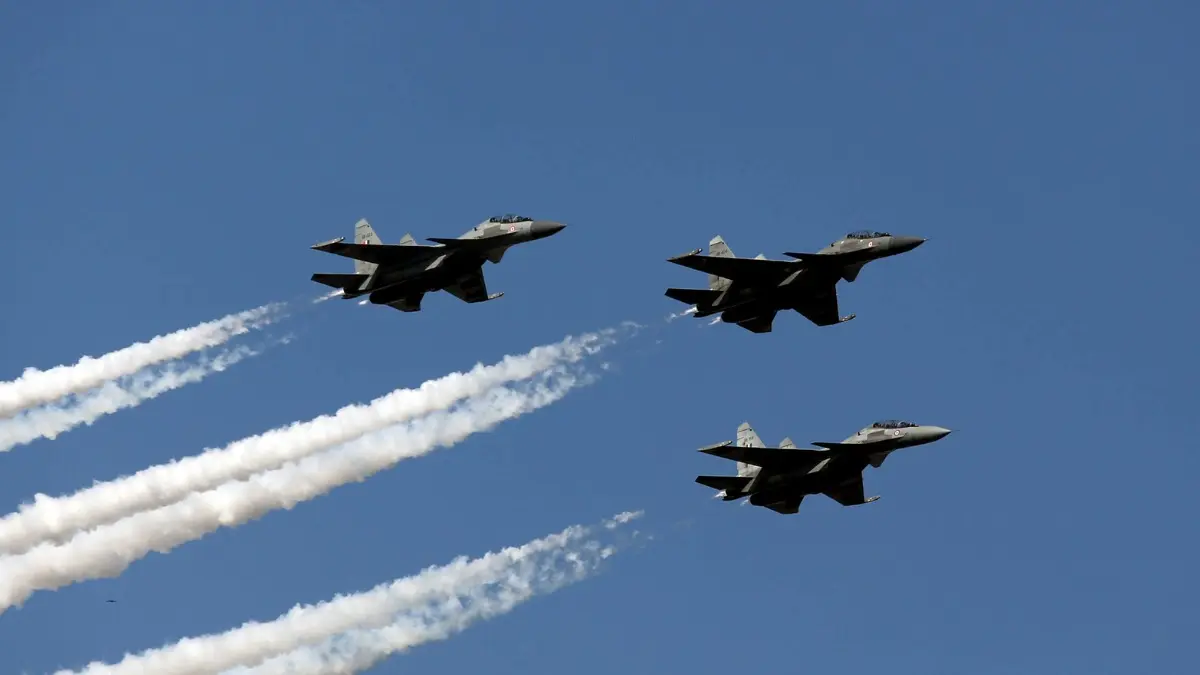
The Indian Air Force (IAF) has once again secured the third spot globally in the 2026 rankings released by the World Directory of Modern Military Aircraft (WDMMA). Sitting right behind the United States and Russia, India’s air arm has remarkably outpaced China’s People's Liberation Army Air Force (PLAAF), which takes the fourth position.
This marks the fifth time since 2022 that the IAF has ranked ahead of the PLAAF. On a broader scale, it is the sixth time the IAF has held a dominant position just behind the collective might of the US Air Force, the US Navy, the Russian Air Force, the US Army, and the US Marine Corps.
How the Global Rankings Work
Rather than simply counting raw aircraft numbers, the WDMMA evaluates 129 air services across 103 countries using a unique formula called the True Value Rating (TVR). Tracking a massive global database of over 48,000 aircraft, the system caps its highest attainable score at 242.9, a peak currently held by the United States Air Force.
The TVR algorithm weighs multiple critical pillars:
Advertisement
- Total fleet size and composition
- Modernization levels and logistical support
- Overall operational capability
Crucially, the system favors a well-balanced fleet mix over sheer fighter count. It places heavy emphasis on specialized assets like mid-air refuelers, special-mission aircraft, transports, trainers, and close-air-support platforms. Additionally, an air service's upcoming order book and local aerospace manufacturing capabilities heavily influence the final score.
Inside India's Fleet: What Drives the High Ranking?
According to WDMMA data, the Indian Air Force commands an active fleet of 1,716 aircraft. Fighters form the backbone of the force, accounting for 542 airframes spread across seven distinct types. Interestingly, this tally still includes the MiG-21, which was officially retired in September 2025.
Advertisement
A breakdown of the IAF's diverse fleet reveals:
- Helicopters: Making up nearly 30% of the entire inventory, the rotary-wing fleet stands at 498 aircraft. This is led by 222 Mi-17 units alongside 111 indigenous HAL Dhruv and Rudra helicopters.
- Transports: Logistics assets comprise about 16% of the fleet with 282 aircraft.
- Trainers: Tasked with preparing the next generation of pilots, 374 training aircraft make up roughly 22% of the force. This includes 325 pure trainers and additional type-conversion twin-seat variants.
- Special Aircraft: Making up just over 1% of the fleet, 20 specialized platforms handle vital tasks like mid-air refueling, airborne early-warning, and intelligence.
Comparing the IAF with the Top-Ranked US Air Force
How does India's fleet distribution compare to the world's leading air power? The number-one ranked United States Air Force dedicates 32% of its fleet strictly to fighters. When adding bombers and close-air-support platforms, that combat share rises to 41%.
However, their operational philosophies diverge sharply when it comes to support assets. While helicopters and transports make up a massive 46% of India's fleet, they account for just 4% and 14% of the USAF inventory, respectively. Instead, the US heavily prioritizes special-mission aircraft, which make up about 14%, nearly one in every seven planes, of its entire force.
The Squadron Gap: Critical Shortages Facing the IAF
Despite its impressive global standing, the IAF faces pressing structural challenges, most notably a severe deficit in fighter squadron strength. While the force has a sanctioned strength of 42 fighter squadrons, it currently operates with just 29. With an ideal metric of 18 aircraft per squadron, the IAF’s target combat fleet sits at around 750 fighters, leaving a noticeable operational gap.
The service is also grappling with a shortage of critical force multipliers. There is an urgent need for more mid-air refuelers, airborne early-warning and control (AEW&C) systems, electronic-warfare assets, and Intelligence, Surveillance, Target Acquisition, and Reconnaissance (ISTAR) platforms.
Procurements and the Path to Modernization
To bridge these gaps, New Delhi is executing several aggressive modernization programs. The IAF has secured orders for 180 indigenous Tejas Mk-1A fighters across two distinct tranches of 83 and 97 aircraft. The initial units have already rolled off the production lines and are undergoing final systems integration ahead of their official induction.
Furthermore, a massive planned procurement of up to 114 Rafale fighters could potentially inject another 294 airframes into the combat inventory. This influx of modern technology is vital, as the IAF prepares to phase out more than 200 aging Jaguars, Mirage 2000s, and MiG-29s through the 2030s.
Parallel programs are also in motion to acquire next-generation tanker aircraft and additional airborne warning systems to extend India's strategic reach. Following the Defence Ministry's approval of new ISTAR platform acquisitions last year, the steady induction of these advanced assets is set to significantly reinforce the IAF's overall capabilities, ensuring effective power projection during peacetime and conflict alike.