
Indonesia To Buy Elite Astra Missiles: Here's Why DRDO’s Crown Jewel Air-to-Air Weapon With 'Buddy Launch' Mode Is A Game Changer
India's indigenous Astra Beyond-Visual-Range Air-to-Air Missile (BVRAAM), developed by DRDO, is set to gain a major international boost as Indonesia has shown interest in importing the missile, according to sources. The move is expected to be among the key defence outcomes during PM Modi's Indonesia visit, alongside the expansion of the BrahMos partnership.
- Defence News
- 5 min read

;'%3e%3cpath%20d='m8,15.99c4.41,0,7.99-3.58,7.99-7.99S12.41,0,8,0,0,3.59,0,8s3.58,7.99,7.99,7.99Z'%20style='stroke:%23fff;%20stroke-miterlimit:10;%20stroke-width:.02px;'/%3e%3cpath%20d='m3.08,3.37l3.82,5.11-3.84,4.15h.87l3.37-3.64,2.72,3.64h2.94l-4.04-5.39,3.58-3.87h-.86l-3.1,3.35-2.5-3.35h-2.94Zm1.27.64h1.35l5.97,7.99h-1.35l-5.97-7.99Z'%20style='fill:%23fff;'/%3e%3c/g%3e%3c/svg%3e)


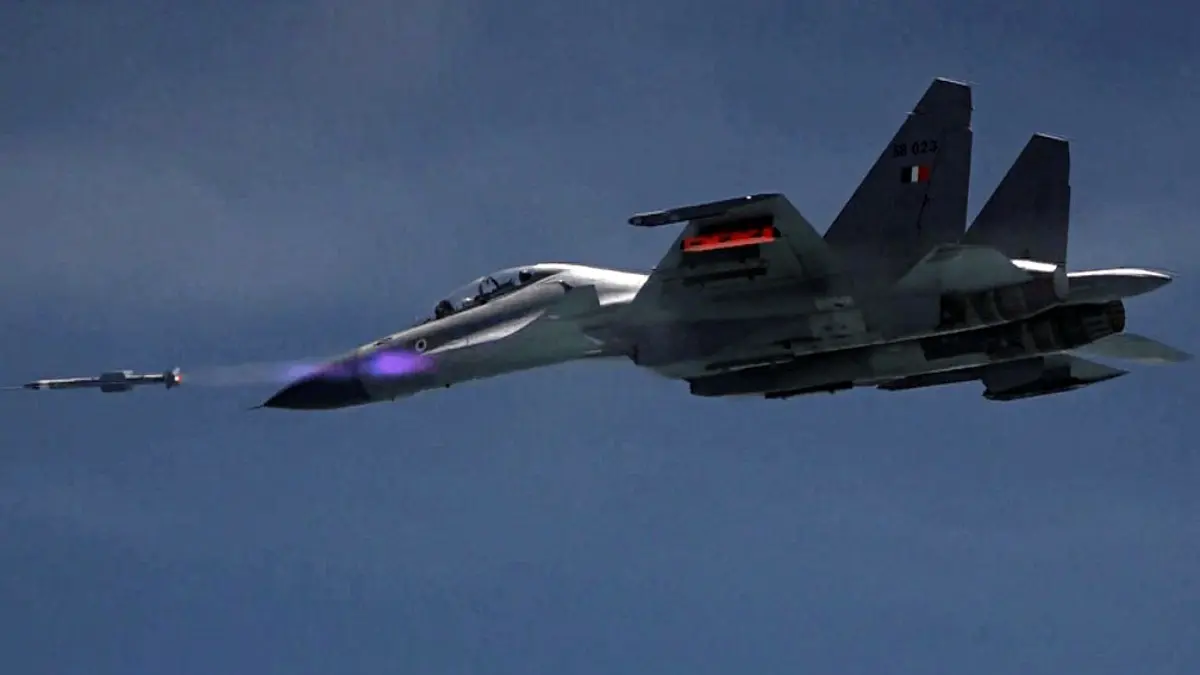
India's indigenous Astra Beyond-Visual-Range Air-to-Air Missile (BVRAAM), developed by the Defence Research and Development Organisation (DRDO), is set to receive a major international endorsement, with Indonesia deciding to import the missile, according to sources.
The proposed deal is expected to be one of the biggest defence outcomes during Prime Minister Narendra Modi's visit to Indonesia, reflecting the growing strategic partnership between the two countries.
Massive Boost To India-Indonesia Ties
This game-changing export deal follows the highly decorated, proven combat success of Astra air-to-air missile power in Operation Sindoor. Driven by DRDO, the Astra weapon system represents the absolute pinnacle of indigenous aerospace engineering, earning global praise for its pinpoint accuracy, state-of-the-art radar tracking, and reliable execution.
The Southeast Asian nation is also expected to expand its BrahMos missile inventory by importing more batteries from India.
Advertisement
In another significant development, India will support Indonesia in developing Indonesia-specific Electronic Voting Machines (EVMs), showcasing confidence in India's election management model.
Both countries are also expected to jointly develop Sabang Port, which overlooks the strategically important Strait of Malacca and is located about 100 miles from India's Great Nicobar Port project, making it a key maritime project in the Indo-Pacific.
Advertisement
India is set to invest heavily in the Indonesian manufacturing sectors for steel, nickel, and rare earth permanent magnets, securing critical components for modern technology.
Following his engagement in Jakarta, PM Modi will continue his historic multi-nation tour, traveling to Melbourne, Australia (July 8-10) for the India-Australia CEOs Forum, and concluding with a historic state visit to Auckland, New Zealand (July 10-11) - the first by an Indian Prime Minister in four decades - strengthening India's formidable security and economic imprint across the Indo-Pacific region.
What is the Astra Missile? India’s Elite Sky Hunter
Astra is India's first indigenously developed Beyond-Visual-Range Air-to-Air Missile (BVRAAM), designed by DRDO for the Indian Air Force (IAF) and the Indian Navy. The Astra is a family of premier indigenously designed BVRAAMs intended to track, lock onto, and destroy highly maneuverable, supersonic enemy aircraft completely beyond the line-of-sight.
The missile is capable of destroying enemy aircraft well beyond the pilot's visual range, giving Indian fighter aircraft a decisive advantage in aerial combat.
The operational Astra Mk-1 can travel at speeds of up to Mach 4.5 and can engage highly manoeuvrable supersonic targets at ranges beyond 100 km and at altitudes of up to 20 km using an advanced indigenous Radio Frequency (RF) seeker developed by DRDO.
It has already been integrated with the Indian Air Force's Su-30 MKI fighter aircraft and the Light Combat Aircraft (LCA) Tejas. It is also set to equip the Tejas Mk1A, Rafale and MiG-29 fighter jets. The missile measures 3.6 metres in length, has a diameter of 178 mm and weighs around 154 kg.
Operating on a smokeless solid-fuel engine for enhanced stealth, Astra supports advanced inertial navigation, mid-course data link updates, and electronic counter-countermeasures (ECCM) manufactured by Bharat Electronics Limited (BEL) to completely resist enemy jamming and electronic warfare. Crucially, it features a "buddy launch mode," allowing one fighter jet to fire the missile while a secondary aircraft guides it safely to the target.
The missile can engage highly manoeuvrable supersonic targets at ranges beyond 100 km and at altitudes of up to 20 km.
The Astra Family Power
Astra Mk-2: Longer Reach, Greater Capability
The DRDO is currently developing the Astra Mk-2, an extended-range variant that will further improve India's air combat capability. Unlike the Mk-1's single-pulse smokeless solid-fuel motor, the Astra Mk-2 uses a dual-pulse solid rocket motor, giving it greater reach and improved performance during the terminal phase of engagement.
The missile is expected to achieve ranges of 200-240 km under high-altitude conditions, with some estimates placing its maximum engagement envelope between 160 km and 240 km depending on launch conditions.
Astra Mk-2 will feature an indigenous seeker manufactured by Bharat Electronics Limited (BEL), equipped with Electronic Counter-Countermeasures (ECCM) to resist enemy jamming and electronic warfare. It will also include a two-way data link, allowing real-time guidance updates from the launch aircraft or other friendly assets.
The larger missile will have a diameter of 190 mm and weigh close to 175 kg.
Astra Mk-3 (Gandiva): The Next Generation
The Astra Mk-3, also known as Gandiva, represents the next generation of India's indigenous air-to-air missile programme. It will use Solid Fuel Ducted Ramjet (SFDR) technology, enabling engagement ranges of up to 340 km, making it one of India's most advanced air-to-air missile projects.
Astra Missile Flight Tests In 2025
On July 11, 2025, DRDO and the Indian Air Force successfully conducted flight tests of the Astra BVRAAM equipped with the indigenous Radio Frequency seeker from a Su-30 MK-I fighter aircraft off the coast of Odisha.
During the trials, two missiles were launched against high-speed unmanned aerial targets at different ranges and engagement conditions. Both missiles destroyed their targets with pinpoint accuracy. According to DRDO, all subsystems, including the indigenous RF seeker, performed exactly as expected. Flight data collected by the Integrated Test Range at Chandipur validated the missile's accuracy and reliability.