
Learning From ‘Op Sindoor’: Is the New CDS Ready to Reshape the Armed Forces Into Theatre Commands?
With lessons from 'Op Sindoor', New CDS Gen NS Raja Subramani prepares to submit India's historic integrated theatre commands blueprint to Rajnath Singh.
- Defence News
- 6 min read

;'%3e%3cpath%20d='m8,15.99c4.41,0,7.99-3.58,7.99-7.99S12.41,0,8,0,0,3.59,0,8s3.58,7.99,7.99,7.99Z'%20style='stroke:%23fff;%20stroke-miterlimit:10;%20stroke-width:.02px;'/%3e%3cpath%20d='m3.08,3.37l3.82,5.11-3.84,4.15h.87l3.37-3.64,2.72,3.64h2.94l-4.04-5.39,3.58-3.87h-.86l-3.1,3.35-2.5-3.35h-2.94Zm1.27.64h1.35l5.97,7.99h-1.35l-5.97-7.99Z'%20style='fill:%23fff;'/%3e%3c/g%3e%3c/svg%3e)


For nearly twenty years, the grand plan to reorganize India’s armed forces into unified theatre commands remained confined to academic papers, committee recommendations, and occasional speeches by military leaders. That era of hesitation is ending.
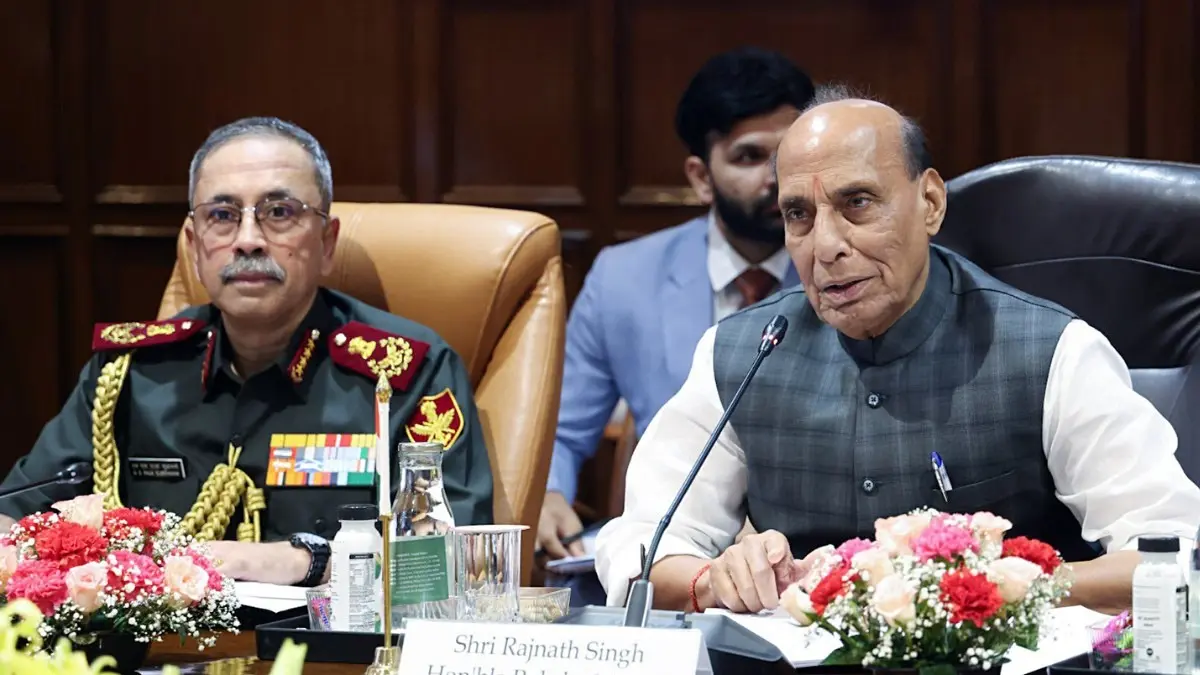
Following the conclusion of General Anil Chauhan’s tenure as Chief of Defence Staff (CDS), the final blueprint, which he completed before stepping down on May 31, is ready. The responsibility now rests with the new CDS, General NS Raja Subramani, who assumed office at the end of May. General Subramani is expected to present this definitive theaterisation strategy to Defence Minister Rajnath Singh shortly, setting the stage for the most profound restructuring of India’s military since Independence.
Why India is Moving Away from 17 Separate Commands
Under the existing framework, India’s Army, Navy, and Air Force operate largely in independent silos. The military is currently fragmented into 17 separate operational commands: seven managed by the Army, seven by the Air Force, and three by the Navy. Each branch maintains its own distinct planning processes, operational responsibilities, and chains of command.
During a crisis, these forces coordinate reactively rather than operating as a singular, cohesive machine. The limitations of this institutional gap were vividly demonstrated during a brief four-day clash with Pakistan last year. To manage the situation, the three service chiefs had to coordinate operations from an improvised joint setup inside the Army's war room—a temporary fix that highlighted the urgent need for permanent structural integration.
Advertisement
Theatreisation will fundamentally invert this model. The proposed system replaces service-specific structures with integrated commands. A single commander will exercise operational control over all Army, Navy, and Air Force assets assigned to a specific geographic zone or operational domain, streamlining decision-making when speed is vital.
The Blueprint: Three New Theatre Commands and Four-Star Leaders
The evolving structural framework focuses on establishing three primary geographic and functional formations:
Advertisement
- Northern Theatre Command: Headed out of Lucknow, this command will focus entirely on the China border.
- Western Theatre Command: Based in Jaipur, it will manage the Pakistan front.
- Maritime Theatre Command: Headed from Thiruvananthapuram, this command will safeguard India’s vast coastlines and the broader Indian Ocean Region, integrating the existing Andaman and Nicobar Command.
To lead these sprawling commands, the plan introduces a new tier of top-level military leadership. The restructuring proposes four new four-star appointments, including the post of Vice Chief of Defence Staff (VCDS). Each of the three theatre commands will be led by a four-star officer, placing them on equal footing with the traditional service chiefs—a detail that required intense internal consensus-building.
Dividing 'Force Application' and 'Force Generation'
The operational philosophy driving this transformation relies on a clear division of responsibilities, a model successfully utilized by several advanced global militaries.
Former CDS General Anil Chauhan described this principle as separating "force application" from "force generation".
Under this architecture, the individual service chiefs of the Army, Navy, and Air Force will shed their operational responsibilities. Instead, they will focus exclusively on "force generation," which entails raising, training, and equipping their respective branches. The actual employment of these troops and assets in battle, or "force application," will fall entirely under the purview of the theatre commanders.
General Subramani has aligned this institutional push with Prime Minister Narendra Modi’s overarching defense mandate of "Jointness, Atmanirbharta and Innovation." By linking theaterisation to technological modernization and self-reliance, the leadership views this reform as a vital step toward preparing India for modern, multi-domain warfare.
The Sticking Points: Why the Reform Took Two Decades
Overcoming decades of institutional inertia has proven incredibly difficult, which explains why the project has been under intense deliberation since 2022, with roots stretching back to the aftermath of the 1999 Kargil conflict. Even after the creation of the CDS post in 2019 provided an institutional champion for the reform, several complex friction points remained:
Air Force Fleet Concerns: The Indian Air Force (IAF) raised significant concerns regarding its relatively limited fleet of fighter aircraft. The IAF argued that air power is inherently flexible and should remain centrally controlled, allowing assets to be rapidly deployed across the country as needed, rather than being permanently carved up and tied to specific geographic theatres.
Control of Strategic Assets: Extensive consultations were required to determine who commands critical, high-value assets like transport aircraft, mid-air refueling tankers, airborne early warning systems (AWACS), and long-range missiles.
Cultural and Administrative Realignment: Merging three services with distinct organizational cultures, independent promotion tracks, and separate procurement systems requires a massive overhaul of command hierarchies, staffing, and communication networks without disrupting active operations.
Aligning with Global Military Giants
If implemented, India will join a select group of major global military powers that operate via integrated commands. The United States utilizes unified combatant commands divided by global regions, while China completely reorganized its military into five distinct theatre commands in 2016 under President Xi Jinping to enhance joint operational readiness.
The urgency of this transition has been underscored by recent global conflicts, including the Russia-Ukraine war and the Israel-Hamas conflict. These battlefields have proven that modern warfare no longer respects traditional boundaries between land, sea, and air; instead, success depends on the real-time integration of drones, missiles, cyber capabilities, and electronic warfare. While India currently operates two tri-service formations—the Andaman and Nicobar Command and the Strategic Forces Command—this reform will expand that integration across all conventional operations.
What Happens Next?
The groundwork for this historic shift is largely complete. The Defence Minister has granted an in-principle approval, the National Security Adviser (NSA) has rigorously examined the framework, and the three service chiefs alongside the CDS have officially endorsed it. As a sign of gradual transition, uniform joint instructions applicable to all three services have already begun replacing legacy, service-specific directives.
The immediate next step rests with the political leadership. Once General Subramani briefs Defence Minister Rajnath Singh on the final execution roadmap, the file will move to the Cabinet Committee on Security (CCS), chaired by Prime Minister Narendra Modi, for ultimate clearance. Approval will mark the beginning of a complex, multi-year rollout. Transitioning to full integration will take time as new headquarters are physically established, personnel are reassigned, and unified doctrines are written. All eyes are now on the defense minister’s desk to see how quickly the final file moves.