
US Accelerates F-47 Sixth-Generation Fighter Program as China Pushes Ahead With J-36 and J-50
The US is boosting F-47 fighter funding as China advances its J-36 and J-50 programs, intensifying the race for sixth-generation air superiority.
- Defence News
- 8 min read

;'%3e%3cpath%20d='m8,15.99c4.41,0,7.99-3.58,7.99-7.99S12.41,0,8,0,0,3.59,0,8s3.58,7.99,7.99,7.99Z'%20style='stroke:%23fff;%20stroke-miterlimit:10;%20stroke-width:.02px;'/%3e%3cpath%20d='m3.08,3.37l3.82,5.11-3.84,4.15h.87l3.37-3.64,2.72,3.64h2.94l-4.04-5.39,3.58-3.87h-.86l-3.1,3.35-2.5-3.35h-2.94Zm1.27.64h1.35l5.97,7.99h-1.35l-5.97-7.99Z'%20style='fill:%23fff;'/%3e%3c/g%3e%3c/svg%3e)


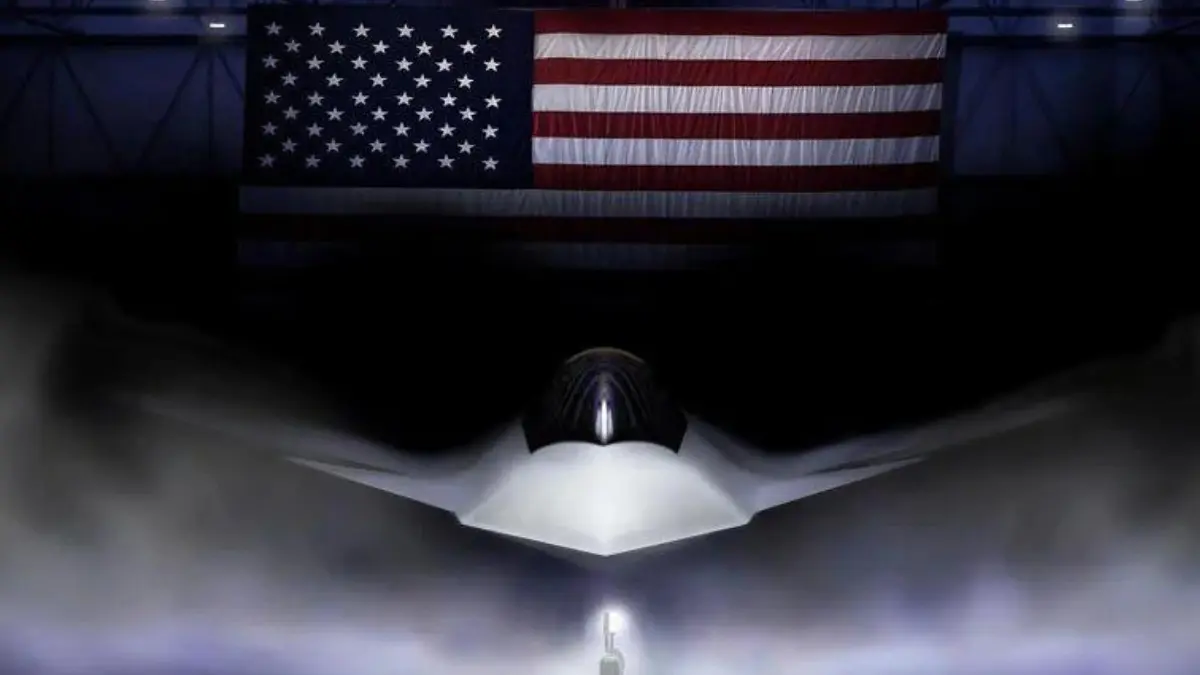
The United States Air Force has significantly accelerated development of the Boeing F-47 sixth-generation fighter, requesting US$5.03 billion for Fiscal Year 2027. The sharp increase in funding underscores growing concerns in Washington over China's rapid progress in next-generation combat aircraft programs and reflects the Pentagon’s increasing focus on maintaining air superiority in the Indo-Pacific.
The requested budget marks a 65 percent increase over the previous fiscal allocation and highlights fears that China's parallel sixth-generation fighter projects could challenge decades of American dominance in advanced combat aviation during the 2030s.
Developed under the highly classified Next Generation Air Dominance (NGAD) program, the F-47 has officially entered the Engineering and Manufacturing Development (EMD) phase. Boeing secured an EMD contract worth more than US$20 billion in March 2025, transforming the aircraft from a technology demonstrator into the centerpiece of America's future long-range airpower strategy.
The F-47 is expected to replace the ageing F-22 Raptor fleet and play a critical role in future US military operations across the vast Indo-Pacific region.
Advertisement
Pentagon Sees Sixth-Generation Fighters as an Urgent Requirement
The latest funding surge suggests that the Pentagon no longer views sixth-generation combat aviation as a distant modernization project. Instead, it is increasingly being treated as an immediate strategic necessity driven by China's rapidly expanding aerospace-industrial capabilities.
Unlike previous American fighter programs that emerged during periods of clear technological superiority, the F-47 is being developed at a time when China has already publicly flown multiple sixth-generation aircraft prototypes.
Advertisement
Chinese aerospace companies Chengdu and Shenyang have reportedly been conducting flight tests of the J-36 and J-50 since December 2024. Their progress represents one of the most serious challenges to US leadership in advanced military aviation since the Cold War era.
The visibility of China's programs has increased pressure on Washington to accelerate development timelines and demonstrate continued technological leadership in future air combat systems.
Pacific Geography Is Shaping the F-47's Design
The enormous distances of the Indo-Pacific theater are among the most important factors influencing the F-47's development.
Current US tactical fighters remain heavily dependent on aerial refuelling to sustain long-range operations. However, military planners fear that tanker aircraft could become vulnerable targets in any future conflict involving China.
To address this concern, the F-47 is expected to feature a combat radius exceeding 1,000 nautical miles. Such capability would allow the aircraft to operate much deeper inside contested areas without immediate tanker support, fundamentally changing operational planning assumptions.
Senior Air Force officials increasingly consider range, survivability, autonomous teaming and sensor integration more important than traditional fighter characteristics focused on maneuverability and short-range dogfighting.
The aircraft is also expected to exceed Mach 2 while incorporating advanced broadband stealth technology designed to reduce detection across radar, infrared and electronic surveillance spectrums. This approach reflects growing recognition that future detection systems will rely on multi-domain sensor fusion rather than radar alone.
A New Era of Software-Driven Air Combat
One of the defining features of the F-47 program is its emphasis on adaptability.
The aircraft's Modular Open Systems Architecture is designed to enable rapid software-based upgrades instead of lengthy hardware modernization programs. Military planners increasingly believe that future air superiority will depend as much on software, artificial intelligence and electronic warfare as on aerodynamic performance.
The F-47's sensor fusion capabilities are expected to transform the aircraft into more than just a fighter. It is likely to function as an airborne command-and-control platform capable of coordinating multiple assets across a battlespace.
This concept aligns with the Pentagon's broader "systems-of-systems" doctrine, where combat effectiveness depends on network resilience, distributed targeting and machine-assisted decision-making rather than the performance of a single platform.
The aircraft is also expected to support operations from dispersed and austere bases, reflecting concerns that traditional airbases could become vulnerable to missile strikes during future conflicts.
Loyal Wingman Drones Could Redefine Air Warfare
Perhaps the most transformative aspect of the F-47 program is its planned integration with more than 1,000 Collaborative Combat Aircraft (CCA) autonomous drones.
These drones are expected to operate as semi-independent "loyal wingmen" accompanying crewed aircraft on missions. Their roles could include electronic warfare, reconnaissance, missile carriage, decoy operations and distributed sensing.
The manned-unmanned teaming concept reflects Pentagon assessments that future peer-level conflicts may involve attrition rates that exceed the available supply of trained fighter pilots.
Rather than concentrating combat power in a limited number of expensive aircraft, the CCA ecosystem would distribute combat functions across multiple autonomous platforms. This could complicate enemy targeting efforts and improve overall battlefield resilience.
The architecture would also allow the F-47 to remain farther from heavily defended zones while drones conduct operations deeper inside contested airspace.
Military planners believe this approach is increasingly necessary as drone warfare, electronic warfare and advanced sensors continue to reshape modern combat environments.
China's J-36 and J-50 Are Driving Strategic Competition
China's visible sixth-generation aircraft programs have injected urgency into America's efforts.
The Chengdu J-36 reportedly features a highly unconventional tailless trijet flying-wing design optimized for long-range strike missions and substantial payload capacity. The aircraft is widely viewed as a platform designed for operations across contested Indo-Pacific environments.
Meanwhile, the Shenyang J-50 appears to be a smaller and more flexible multirole platform that could potentially support carrier-based operations as China expands its naval aviation capabilities.
The simultaneous development of two sixth-generation aircraft demonstrates China's willingness to pursue innovation through parallel competition rather than relying on a single procurement pathway.
This approach allows engineers to collect flight-test data earlier and refine technologies more rapidly. Although Western analysts continue to question China's progress in areas such as adaptive engines, software reliability and integrated sensor fusion, Beijing's manufacturing capacity and industrial coordination remain significant advantages.
Pentagon officials increasingly acknowledge that China's greatest strength may not be a single technological breakthrough, but the speed with which it can prototype, test and field advanced aerospace systems.
Pentagon Spending Highlights Long-Term Airpower Priorities
The US$5.03 billion request for FY2027 represents one of the largest annual increases for an American combat aviation development program in decades.
Approximately US$4.92 billion would support aircraft development, testing and systems integration activities, while the remaining funds would cover program management and infrastructure requirements.
Budget projections indicate annual spending above US$3.2 billion through 2030, illustrating Washington's commitment to maintaining technological superiority despite the enormous costs associated with sixth-generation aviation programs.
The F-47 was temporarily paused in 2024 because of affordability concerns. However, its resumption following a strategic review indicates that US defence officials ultimately concluded that delaying development would create unacceptable operational risks across the Indo-Pacific during the next decade.
Boeing's selection as prime contractor also carries major industrial implications. Successful execution of the program could strengthen the company's position within the US defence sector after years of production challenges and growing competition from rivals.
The aircraft's first flight is currently targeted for 2028, with operational service expected during the early 2030s.
F-47 vs China's Sixth-Generation Fighters: Comparison
Rather than acting merely as expendable escorts, CCAs will perform electronic warfare, reconnaissance, missile carriage, decoy operations, and distributed sensor functions, extending the F-47’s operational reach deep into contested airspace. This architecture heavily complicates enemy targeting calculations, forcing adversaries to face highly networked drone swarms capable of dynamically redistributing combat roles even after individual losses.
Aspect | U.S. F-47 (Boeing NGAD) | China J-36 / J-50 |
Status | EMD phase under Boeing contract exceeding US$20 billion | Multiple prototypes undergoing flight testing since December 2024 |
Timeline | First flight targeted 2028, IOC early 2030s | Estimated operational service during early-to-mid 2030s |
Design | Broadband stealth, adaptive engines, CCA integration | Tailless stealth designs emphasizing range and MUM-T |
Combat Radius | More than 1,000 nautical miles | Long-range Pacific strike emphasis |
Speed | Above Mach 2 | Supersonic capability expected |
Key Strength | Adaptive engines, sensor fusion, systems integration | Rapid prototyping and industrial iteration speed |
Key Challenge | Extremely high program cost and delayed public flight testing | Engine maturity and advanced systems integration |
Strategic Objective | Pacific air dominance against China | Western Pacific anti-access superiority |
Drone Integration | 1,000+ Collaborative Combat Aircraft planned | Strong emphasis on autonomous teaming |
Industrial Model | Structured systems-of-systems development | Parallel competitive prototype evolution |
A Race That Could Shape the Future Balance of Power
The growing competition between America's F-47 and China's J-36 and J-50 increasingly represents more than a traditional fighter-versus-fighter contest.
Both countries are pursuing similar concepts centered on long-range operations, broadband stealth, autonomous teaming, artificial intelligence, electronic warfare and distributed sensor networks tailored for Indo-Pacific warfare. China currently benefits from the visibility of publicly demonstrated prototypes, while the United States retains advantages in fifth-generation operational experience, advanced propulsion technologies and combat-proven systems integration.
Neither side has disclosed the full capabilities of its aircraft, and both programs remain highly classified. Analysts caution that prototypes often undergo major redesigns before entering operational service, making direct comparisons difficult. Ultimately, the decisive factor during the 2030s may be which nation can successfully integrate manned and unmanned combat systems into a resilient and sustainable operational network.
For Washington, the F-47 is more than a replacement for the F-22 Raptor. It represents a broader effort to preserve strategic deterrence and maintain military superiority as competition with China intensifies across the Indo-Pacific. As both powers accelerate development, the outcome of this sixth-generation race could help define the future balance of airpower in the region.