
New NCERT Class 8 Textbook Drops Hitler's Name in Reference to Netaji Subhash Chandra Bose's , Adds Content on Savarkar
These updates are part of a broader, ongoing effort by the National Council of Educational Research and Training (NCERT) to revise school textbooks.
- Education News
- 2 min read

;'%3e%3cpath%20d='m8,15.99c4.41,0,7.99-3.58,7.99-7.99S12.41,0,8,0,0,3.59,0,8s3.58,7.99,7.99,7.99Z'%20style='stroke:%23fff;%20stroke-miterlimit:10;%20stroke-width:.02px;'/%3e%3cpath%20d='m3.08,3.37l3.82,5.11-3.84,4.15h.87l3.37-3.64,2.72,3.64h2.94l-4.04-5.39,3.58-3.87h-.86l-3.1,3.35-2.5-3.35h-2.94Zm1.27.64h1.35l5.97,7.99h-1.35l-5.97-7.99Z'%20style='fill:%23fff;'/%3e%3c/g%3e%3c/svg%3e)


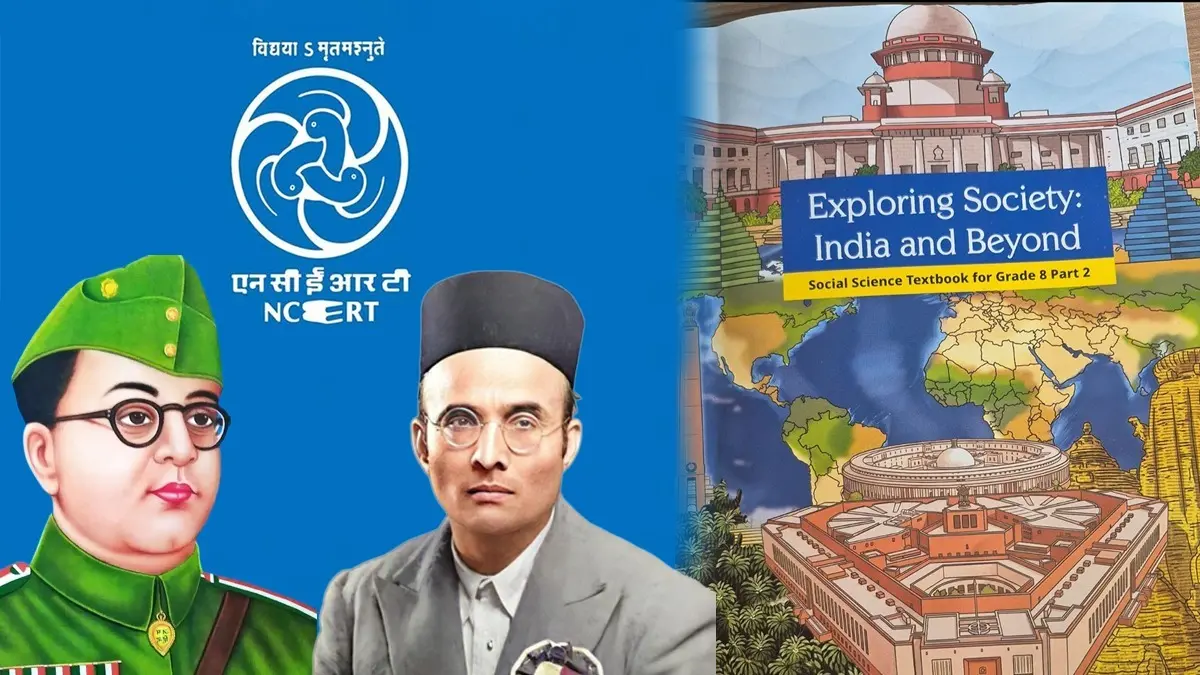
The updated NCERT Class 8 Social Science textbook that recently came out includes several major changes that go well beyond the recently debated chapter on the judiciary.

The new edition rewrites the section on the judicial system following a regular review that drew comments from the Supreme Court. In addition to these civic updates, the textbook features significant revisions to historical narratives including the account of the Indian National Congress’s stance on Partition, removes mentions of Adolf Hitler and Nazi ideology when discussing Netaji Subhas Chandra Bose, and adds a reference to Vinayak Damodar Savarkar’s early demand for Swaraj.
Key Revisions to the Curriculum
The updates modify how modern Indian history and civics are presented to eighth-grade students across the country:
- The Judiciary: The chapter has been restructured to change how the court system and legal frameworks are explained to young students.
- Congress and Partition: The text revises the historical account of the events leading up to 1947, specifically changing the narrative around how the Indian National Congress handled the political decisions regarding the partition of the country.
- Subhas Chandra Bose: The book removes previous lines that linked Bose’s wartime strategy to Hitler and Nazi Germany. The new text focuses more closely on his independent leadership and his role with the Indian National Army (INA).
- VD Savarkar: The textbook now explicitly introduces Savarkar's early call for Swaraj during the Indian freedom struggle, adding a new dimension to the chapter on nationalist movements.
Context of the Changes
These updates are part of a broader, ongoing effort by the National Council of Educational Research and Training (NCERT) to revise school textbooks. According to education officials, the revisions are meant to simplify complex history, remove unnecessary parallels, and bring the curriculum in line with current pedagogical standards.
Advertisement
However, the changes have also renewed discussions among historians, educators, and political figures regarding how India's freedom struggle and political history are taught to school children. The newly printed textbooks are already being distributed and introduced in schools for the current academic year.