
Bihar Election Results 2025: 7 Reasons Behind NDA’s Massive Mandate
Bihar Election Results 2025: With the NDA heading for a landslide win, we break down the 7 key reasons behind the coalition’s sweeping mandate.
- Election News
- 3 min read

;'%3e%3cpath%20d='m8,15.99c4.41,0,7.99-3.58,7.99-7.99S12.41,0,8,0,0,3.59,0,8s3.58,7.99,7.99,7.99Z'%20style='stroke:%23fff;%20stroke-miterlimit:10;%20stroke-width:.02px;'/%3e%3cpath%20d='m3.08,3.37l3.82,5.11-3.84,4.15h.87l3.37-3.64,2.72,3.64h2.94l-4.04-5.39,3.58-3.87h-.86l-3.1,3.35-2.5-3.35h-2.94Zm1.27.64h1.35l5.97,7.99h-1.35l-5.97-7.99Z'%20style='fill:%23fff;'/%3e%3c/g%3e%3c/svg%3e)


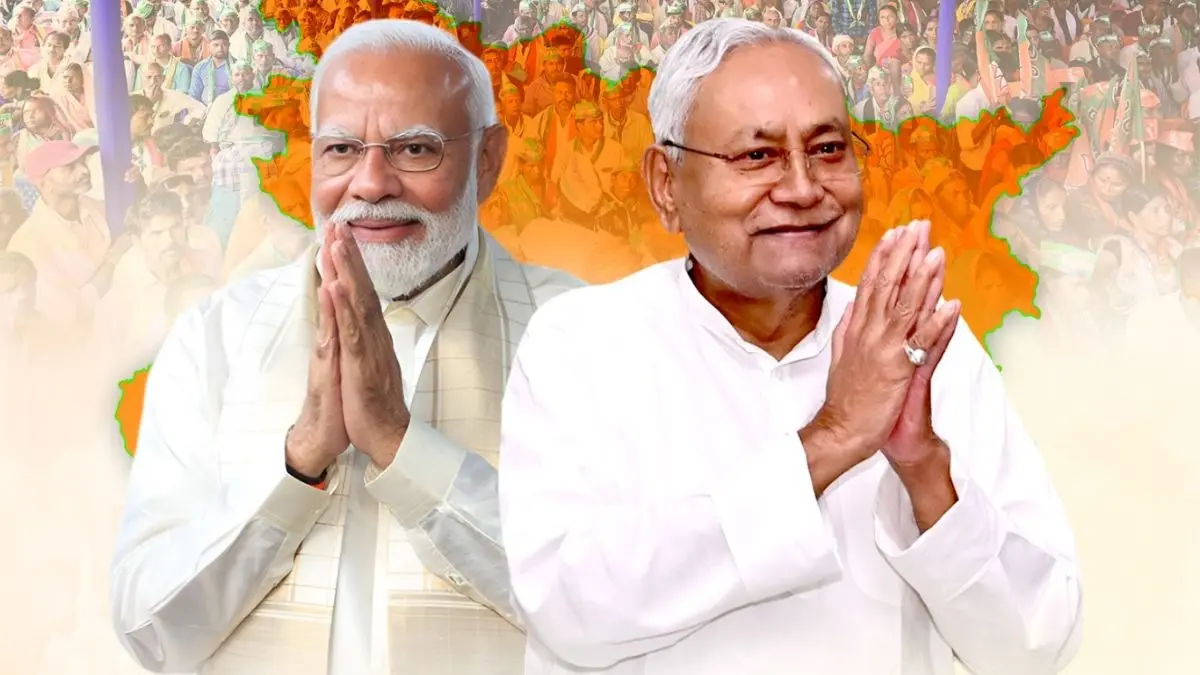
New Delhi: The Bihar Assembly Election 2025 has delivered one of the biggest victories the National Democratic Alliance has ever seen in the state. With the tally crossing the 208-seat mark, the verdict is clearly in favour of the NDA’s pitch for continuity and stability. The campaign may have been long and tightly fought, but the final numbers leave no room for doubt: voters preferred a familiar leadership and a predictable governance model over experimentation.
1. Development Narrative That Stuck With Voters
The “double-engine government” slogan was not just a catchphrase this time — it came backed with delivery on the ground. Roads, drinking water connections, welfare benefits and electricity expansion continued to show visible results. While the Opposition tried to question development in rural pockets, the NDA’s long-term work in infrastructure and welfare gave it a clear advantage, especially among middle-income and lower-income households.
2. Early and Problem-Free Seat Sharing
Advertisement
The biggest boost for the alliance came from the fact that the BJP and JD(U) settled their seat distribution well in advance, avoiding the usual friction that troubles coalitions in Bihar. Both parties contested 101 seats each, signalling balance and avoiding internal resentment. The smaller partners too — LJP (Ram Vilas), HAM(S) and RLM — went into the polls knowing exactly what they were fighting for. A united alliance helped the NDA run a smoother and far more coordinated campaign.
3. A Broader Caste Combination Than Previous Elections
Advertisement
The NDA managed to pull in support from sections that traditionally did not align with it. While the BJP held its upper-caste base, the JD(U) revived its influence among EBC and Mahadalit communities. Women across caste groups also showed clear preference for the alliance. This wide spread of support weakened the Mahagathbandhan’s earlier hold over certain vote banks.
4. Women Voters and Youth Played a Key Role
The rise in turnout among women worked heavily in the NDA’s favour. Better safety, welfare schemes targeted at women, and Nitish Kumar’s long-standing emphasis on women’s empowerment continued to pay dividends. On the other hand, young voters — especially first-timers — found the NDA’s pitch on stability and opportunity more convincing than the Opposition’s promises.
5. Nitish Kumar’s Experience Still Matters
Despite the political switches of the past few years, Nitish Kumar’s personal image remains intact among a large section of people. His reputation for improving law and order, introducing prohibition, and focusing on education and women’s welfare helped the JD(U) retain crucial segments of the electorate. His presence gave the NDA an anchor the Opposition could not counter.
6. The ‘Jungle Raj’ Memory Returned to the Debate
The NDA’s repeated reference to the pre-2005 law-and-order situation struck a chord once again. The contrast between the current policing environment and the earlier period of fear played a role in urban centres, small towns and even among migrants. Many voters, especially older families, still have memories of that era, and the NDA used this effectively to draw comparisons.
7. Opposition Disconnected and Poorly Coordinated
The Mahagathbandhan failed to project unity or clarity. Leadership confusion, poor communication, and lack of a common message weakened their campaign. Several constituencies saw split votes due to the presence of new entrants like PK’s party, indirectly benefiting the NDA in close contests. The Opposition’s inability to capitalise on anti-incumbency ultimately cost them heavily.