
'Drastic rise in severe cyclones in Indian ocean': says Earth Science Ministry in RS
Union Ministry of Earth Sciences (MoES) recorded a surge in the number of cyclones formed in the northern Indian ocean as well as Arabian Sea and Bay of Bengal
- India News
- 2 min read

;'%3e%3cpath%20d='m8,15.99c4.41,0,7.99-3.58,7.99-7.99S12.41,0,8,0,0,3.59,0,8s3.58,7.99,7.99,7.99Z'%20style='stroke:%23fff;%20stroke-miterlimit:10;%20stroke-width:.02px;'/%3e%3cpath%20d='m3.08,3.37l3.82,5.11-3.84,4.15h.87l3.37-3.64,2.72,3.64h2.94l-4.04-5.39,3.58-3.87h-.86l-3.1,3.35-2.5-3.35h-2.94Zm1.27.64h1.35l5.97,7.99h-1.35l-5.97-7.99Z'%20style='fill:%23fff;'/%3e%3c/g%3e%3c/svg%3e)


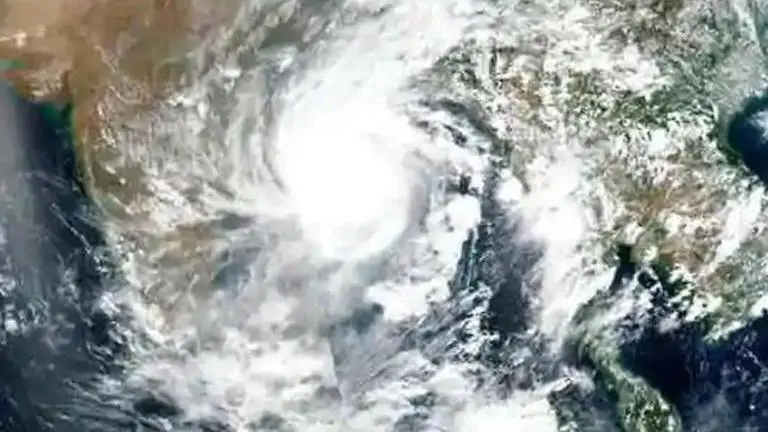
The Union Ministry of Earth Sciences (MoES) has recorded a surge in the number of cyclones that have formed in the northern Indian ocean as well as Arabian Sea and Bay of Bengal. The MoES also brought the attention to increase in the occurrence of severe rainfall measuring over 20 centimetres (20 cm), in the past three years.
The MoES has highlighted on Tuesday in Rajya Sabha while responding to a question, that there were five cyclones over the Arabian Sea in 2019 as against the average of one per year.
"Based on the statistics from 1891-2017, on an average, five cyclones develop over the north Indian Ocean in a year with four over the Bay of Bengal and one over the Arabian Sea," the ministry stated.
In the recent past, an increase in frequency has been observed in the formation of cyclones in the north Indian Ocean, the ministry said.
Advertisement
Advertisement
Five cyclones had developed over the Arabian Sea last year. The normal is one cyclone per year since 1902, the ministry said.
"The occurrence of five cyclones over Arabian Sea in 2019 against the normal of one per year equals the previous record of 1902 for the highest annual cyclone frequency over Arabian Sea," the minister told the house.
There were one, three and five cyclones over the Arabian Sea in 2017, 2018 and 2019, the ministry said, adding that the Bay of Bengal saw two, four and three cyclones in the same years.
However, the ministry also asserted that despite the increase in the number of cyclones and severe rainfalls, or other natural calamities, the loss of lives have been decreased due to preemptive abilities of the departments and timely action taken by the concerned authorities.
"IMD has demonstrated its capability to provide early warning for cyclones with high precision and has earned accolades globally and nationally for very effective, state of art early warning system for monitoring and prediction of cyclones. The cyclone forecast accuracy has significantly improved in recent years as has been demonstrated during cyclones Phailin (2013), Hudhud (2014), Vardah (2016), Titli (2018), Fani and Bulbul (2019) and Amphan & Nisarga (2020). Due to this, in recent years, the loss of life has been drastically reduced, being limited to double digit figures only,” a note from the ministry said.
(with inputs from agencies)
(Representative image, credit: AP)