
‘10x Better Than Our Generation’: Army Chief Gen Upendra Dwivedi Warns Pakistan, Praises Gen Z Innovators
Army Chief Gen Upendra Dwivedi issues a stark warning to Pakistan while praising Gen Z's digital skills and outlining the Indian Army's shift to data-centric warfare.
- India News
- 6 min read

;'%3e%3cpath%20d='m8,15.99c4.41,0,7.99-3.58,7.99-7.99S12.41,0,8,0,0,3.59,0,8s3.58,7.99,7.99,7.99Z'%20style='stroke:%23fff;%20stroke-miterlimit:10;%20stroke-width:.02px;'/%3e%3cpath%20d='m3.08,3.37l3.82,5.11-3.84,4.15h.87l3.37-3.64,2.72,3.64h2.94l-4.04-5.39,3.58-3.87h-.86l-3.1,3.35-2.5-3.35h-2.94Zm1.27.64h1.35l5.97,7.99h-1.35l-5.97-7.99Z'%20style='fill:%23fff;'/%3e%3c/g%3e%3c/svg%3e)


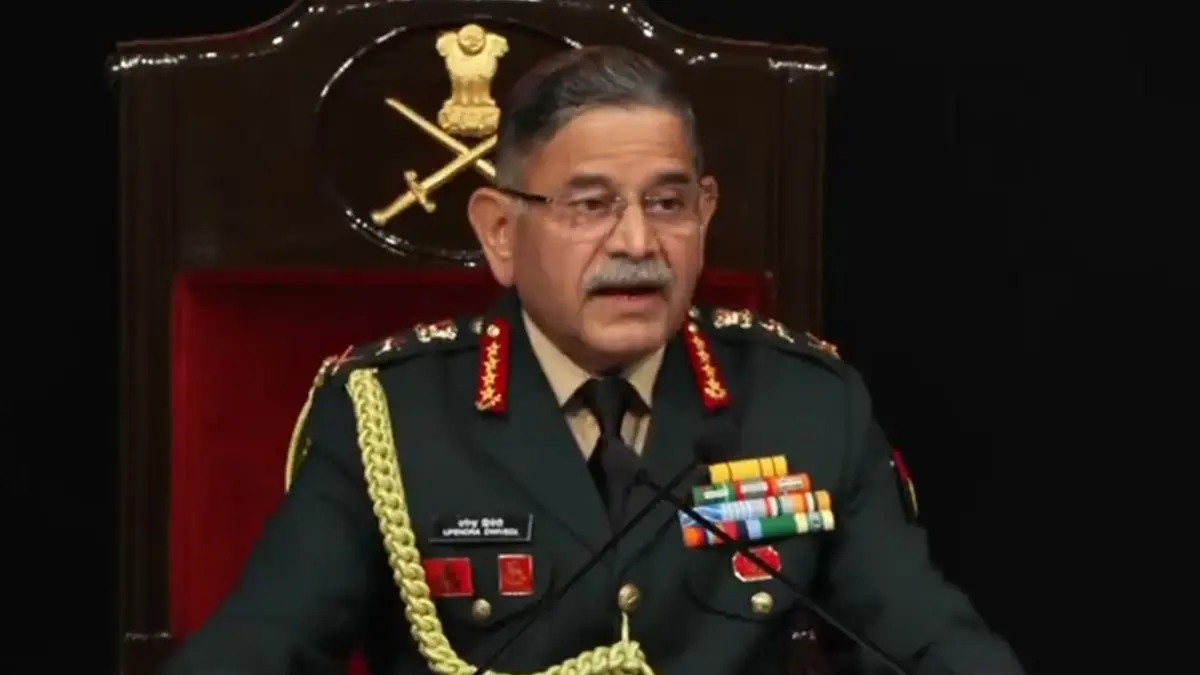
New Delhi [India], May 16 (ANI): Indian Army Chief General Upendra Dwivedi on Saturday delivered a wide-ranging address touching on national security, military modernisation and leadership development, while issuing a strong warning to Pakistan over its continued support to terrorism against India.
Speaking at the 'Sena Samvad' event at the Manekshaw Centre, he also praised Gen Z for their adaptability and digital skills, highlighted the Army's shift towards data-centric and networked operations, and stressed the need for a "whole-of-nation approach" to future warfare.
He issued a strong warning to Pakistan over its continued support for terrorism against India, asserting that it must decide its future course. He said Pakistan "has to decide whether it wants to be part of geography or history" if it continues such activities against India.
"If you have heard me earlier, what I have said is that Pakistan, if it continues to harbour terrorists and operate against India, then they have to decide whether they want to be part of the geography or history or not," General Dwivedi said.
Advertisement
Further, General Dwivedi praised Gen Z, saying they are far more adaptable, socially aware and digitally skilled compared to earlier generations. He said the Army is increasingly focusing on data-driven and technology-based operations, aiming for a more networked force in the coming years.
He also highlighted the strong response to internship opportunities in the Army, saying that nearly one lakh applications were received for just 100 vacancies.
Advertisement
"So let me firstly concede and accept that the generation is at least 10 times better than our generation. They are much more adaptable. They're socially aware, globally connected, and digitally fluent...The Indian Army is talking about 2026-27 as the year of networking and data centricity. We have started the internship, and we received one lakh applications for 100 vacancies," the Indian Army Chief said.
"Today, we have opened up all the army-based workshops, all our category A establishments, and so many headquarters for the internship of the children. Because half of the time, they come out with a simplistic solution. On the battlefield, we require a battlefield equaliser.
We don't require tank versus tank. If you give me a simple solution to a difficult problem, I think you are the ones who are going to win the battle for us," he further said. The Indian Army Chief said that self-actualisation in leadership means understanding one's true potential and working to achieve it as part of a team rather than as an individual.
He said the Army is rapidly modernising and adapting to new technologies, which are changing at a very fast pace and becoming outdated within 18 months.
"Self-actualisation is when you realise what your actual potential is and then you desire to reach out to that level, and that is what is something important because when you have to reach out to that level, it is not individual. You are heading a team, you are a leader...Today, the military is changing so fast, the modernisation is taking place so fast, and technology becomes stale within 18 months.
If you have to adapt to that kind of technology, how are you going about it? Therefore, the ripples of change have to be felt at every level, starting from a soldier to a major to a major general, till a general like me," General Dwivedi further said.
General Dwivedi also stressed the need for a "whole-of-nation approach" in future warfare, saying that coordination across institutions and clear strategic guidance are essential to strengthen national preparedness and ensure seamless integration during operations.
"When you look at the big picture, a whole-of-nation approach. How are you going to converge this complete India as a nation to fight a war? How are you going to establish the interlinkages? How are you going to provide the strategic guidance to the decision makers? Those are the big things that we are looking at while making sure that your halo effect and the reputation which you have made over a period of time comes down to a soldier or to a common citizen who is part of the whole of the nation approach whenever you go for the next operations or war," he said.
General Dwivedi said that his decision to join the Army was strongly influenced by his upbringing and the environment at home.
He said that discussions on epics like the Mahabharata and Ramayana, along with stories of major wars such as World War II and the 1962 and 1965 conflicts, played an important role in shaping his interest in the armed forces from a young age.
"Your upbringing in childhood makes a major difference. And the environment in the house of your parents, brothers, cousins, and uncles, all this makes a major difference. So in my case also, if I can say that, the two famous epics, that is, the Mahabharata and the Ramayana, were something which were always discussed in the house. The World War II stories, 62 war, 65 war, all those also got discussed," he said.
General Dwivedi said, "In case the leader dies during the combat, then who takes on the charge? So, as far as the Indian Army is concerned, there are always layers which are there. Leadership is at every level.
A rifleman is commanded by a Nayak, Nayak is commanded by a Havaldar, then a Nayab Subedar, Subedar, Captain, Major. So there's always a leadership which is there. And we always have number two or nominated number two. Even today, if something happens to me, my vice chief is always there. That is how we look at it. So there is no dearth of leadership initiative..."
On the indigenisation, he said, "It's a gradual process. Why? Because for a soldier, whatever is best will be provided. Now we have reached a very high standard of indigenisation. Because the best weaponry of a particular kind is being manufactured in India.
There are changes as far as the present-day battlefield is concerned, and the future battlefield is concerned. The present-day battlefield, if you see, is more related to the first three domains: land, maritime, and air. Now these three domains have to give space to the three different domains, cyber, space and the cognitive.
But it doesn't mean the first three domains will go away. Because in the Indian army, we look at all five generations of warfare...So the future of warfare is going to be more challenging because all this has to be put in somebody's brain.
And your generation will definitely be better off than us. Because in our case, artificial intelligence, we knew the definition, but you know the application. That's the biggest difference."
On his post-retirement plans, Indian Army Chief General Upendra Dwivedi said, "...I belong to a state called Madhya Pradesh. I am looking at working for the tribals so that I am able to ensure the reverse migration.
As PM Modi says, the border villages are your first villages, not the last villages. So if they're the first villages, why not go there and see the growth centres there instead of having somewhere in the centre. This is what we are looking at. Of course, which I have also said earlier, I'm also planning to open a cafe called 'Ahista Zindagi'..." (ANI)
Get Current Updates on India News, Entertainment News, Cricket News along with Latest News and Web Stories from India and around the world.