
20 Years of Nitish Kumar at the Helm – A Look Back at the Many Twists in His Political Journey
Nitish Kumar steps down as Bihar Chief Minister after two decades, signaling the end of an era marked by alliances, breakups, and dramatic comebacks. His move to the Rajya Sabha caps a career defined by political twists and landmark policies.
- India News
- 5 min read

;'%3e%3cpath%20d='m8,15.99c4.41,0,7.99-3.58,7.99-7.99S12.41,0,8,0,0,3.59,0,8s3.58,7.99,7.99,7.99Z'%20style='stroke:%23fff;%20stroke-miterlimit:10;%20stroke-width:.02px;'/%3e%3cpath%20d='m3.08,3.37l3.82,5.11-3.84,4.15h.87l3.37-3.64,2.72,3.64h2.94l-4.04-5.39,3.58-3.87h-.86l-3.1,3.35-2.5-3.35h-2.94Zm1.27.64h1.35l5.97,7.99h-1.35l-5.97-7.99Z'%20style='fill:%23fff;'/%3e%3c/g%3e%3c/svg%3e)


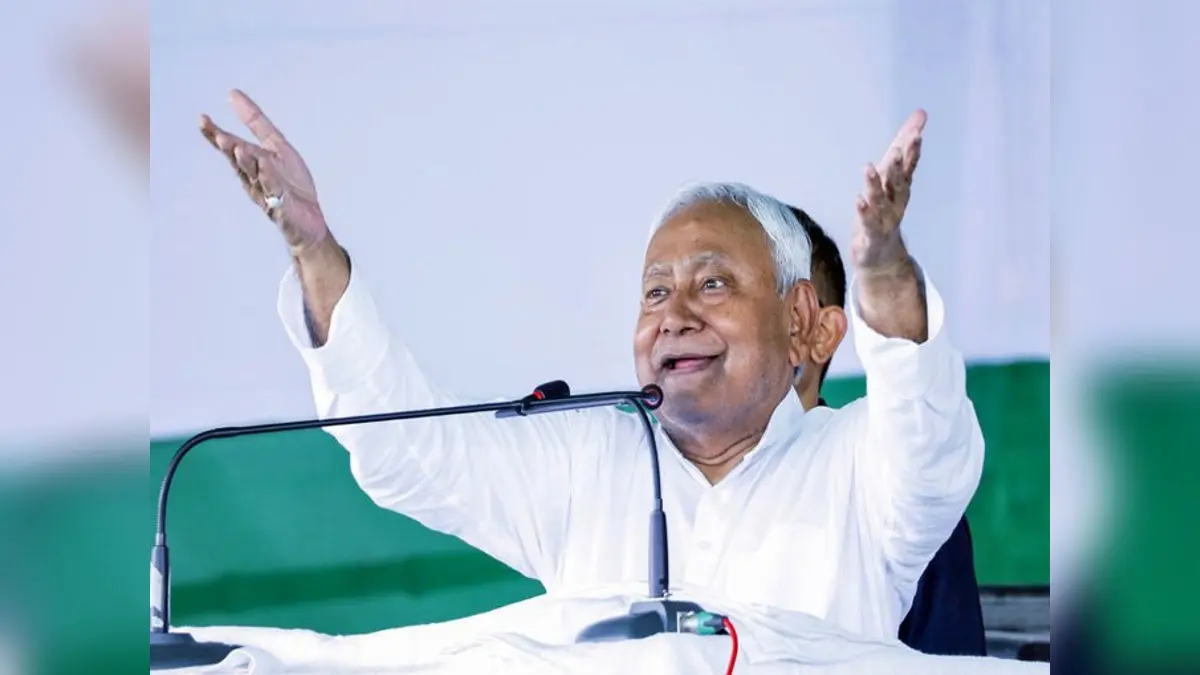
New Delhi: Nitish Kumar has always been a politician who writes his own script. And in Bihar politics, the script rarely runs straight. This week, the man who dominated the state’s politics for nearly two decades signalled the end of an era. Nitish Kumar announced that he will step down as Bihar’s Chief Minister and seek a seat in the Rajya Sabha, saying it had long been his wish to serve in all four legislative houses.
For Bihar, it feels like the closing scene of a long political drama - full of alliances, breakups, comebacks, and unexpected turns.
The man who ruled Bihar for two decades
Nitish Kumar’s story in Bihar politics really begins in 2005. That was the year when people, tired of the chaos of the 1990s, voted for change. Nitish - then allied with the Bharatiya Janata Party -promised “sushasan”, or good governance. Roads started getting built. Girls were given bicycles to go to school. Crime dropped compared to the past decade. For many people in Bihar, especially women and rural voters, Nitish became the face of stability. But his journey actually started earlier. In 2000, he briefly became Chief Minister for just seven days before resigning when he could not prove a majority.
It was a short-lived beginning. But the real Nitish era would start five years later.
Advertisement
The alliance maker… and breaker
If Bihar politics had a master of alliances, it was Nitish Kumar. He began his long run with the BJP as part of the NDA alliance. Together they won big in 2005 and again in 2010, giving Bihar one of its most stable governments in decades. But in 2013, things changed. When Narendra Modi was declared the BJP’s prime ministerial candidate, Nitish walked out of the alliance. The move shocked many. His party, Janata Dal (United), suddenly found itself alone. Then came one of the biggest twists. In 2015, Nitish joined hands with his long-time rival Lalu Prasad Yadav and the Rashtriya Janata Dal to form the Mahagathbandhan. Together with the Congress, they defeated the BJP in a landslide.
Politics in Bihar had flipped overnight.
Advertisement
The Manjhi chapter
One of the strangest episodes in Nitish’s career came in 2014. After JD(U)’s poor performance in the Lok Sabha election, Nitish resigned as Chief Minister. In his place, he installed a relatively unknown leader - Jitan Ram Manjhi. The idea seemed simple: a loyal placeholder. But Manjhi soon began asserting himself. Within months, tensions exploded between him and the JD(U) leadership. The political drama lasted weeks - speeches, rebellion, party meetings - before Nitish returned as Chief Minister in 2015.
It was a reminder that in Bihar politics, even temporary arrangements can become full-blown power struggles.
The famous “U-turn” reputation
By 2017, Nitish made another dramatic move. He broke the Mahagathbandhan with the RJD, citing corruption allegations, and walked back to the BJP-led NDA. Many critics began calling him “Paltu Ram” - the man who keeps switching sides. But Nitish had one advantage, he always managed to stay at the centre of power. In 2020, he again became Chief Minister with BJP support, though the BJP had more seats this time.
Then another twist arrived.
In 2022, Nitish left the BJP once again and revived the Mahagathbandhan with the RJD and Congress. Two years later, in 2024, he returned to the NDA yet again. Few politicians in India have shifted alliances so many times while still holding on to the top job.
The policies that defined his rule
For all the political twists, Nitish’s governments did push several policies that reshaped Bihar’s social landscape. The most visible ones included:
1. Women empowerment
• 50% reservation for women in panchayats
• Free bicycles and uniforms for schoolgirls
2. Infrastructure push
• Major expansion of roads and bridges
• Improved rural connectivity
3. Prohibition
In 2016, Nitish imposed a statewide alcohol ban - one of the most controversial decisions of his tenure. Supporters say it helped families and women. Critics say it created a black market and policing problems. Still, the ban became closely linked with his political identity.
Ten times Chief Minister
Over the years, Nitish Kumar took oath as Chief Minister ten times, an extraordinary record in Indian politics. Sometimes it was after elections. Sometimes after alliances collapsed. Sometimes after resigning and returning again. In Bihar’s unpredictable political weather, Nitish always seemed to find a way back.
The final twist: Delhi calling
Now, after nearly 20 years dominating Bihar politics, Nitish Kumar is preparing to move to the Rajya Sabha. He says the move fulfils a long-held wish to serve in every legislative forum - state assembly, legislative council, Lok Sabha and Rajya Sabha. For Bihar, this may mark the end of an era. The big question now is simple- Who fills the space Nitish leaves behind?
Because love him or criticise him, one thing is certain. For two decades, Bihar politics did not move without Nitish Kumar somewhere in the frame. And even now, as he heads to Delhi, it would be foolish to assume the story is over.
Get Current Updates on India News, Entertainment News, Cricket News along with Latest News and Web Stories from India and around the world.