
8 Indian Sailors Released From Iran After Nearly Two Months in Detention
Eight Indian sailors have been released from Iranian detention after their tanker was seized on smuggling allegations, while efforts continue to secure the remaining eight crew members.
- India News
- 4 min read

;'%3e%3cpath%20d='m8,15.99c4.41,0,7.99-3.58,7.99-7.99S12.41,0,8,0,0,3.59,0,8s3.58,7.99,7.99,7.99Z'%20style='stroke:%23fff;%20stroke-miterlimit:10;%20stroke-width:.02px;'/%3e%3cpath%20d='m3.08,3.37l3.82,5.11-3.84,4.15h.87l3.37-3.64,2.72,3.64h2.94l-4.04-5.39,3.58-3.87h-.86l-3.1,3.35-2.5-3.35h-2.94Zm1.27.64h1.35l5.97,7.99h-1.35l-5.97-7.99Z'%20style='fill:%23fff;'/%3e%3c/g%3e%3c/svg%3e)


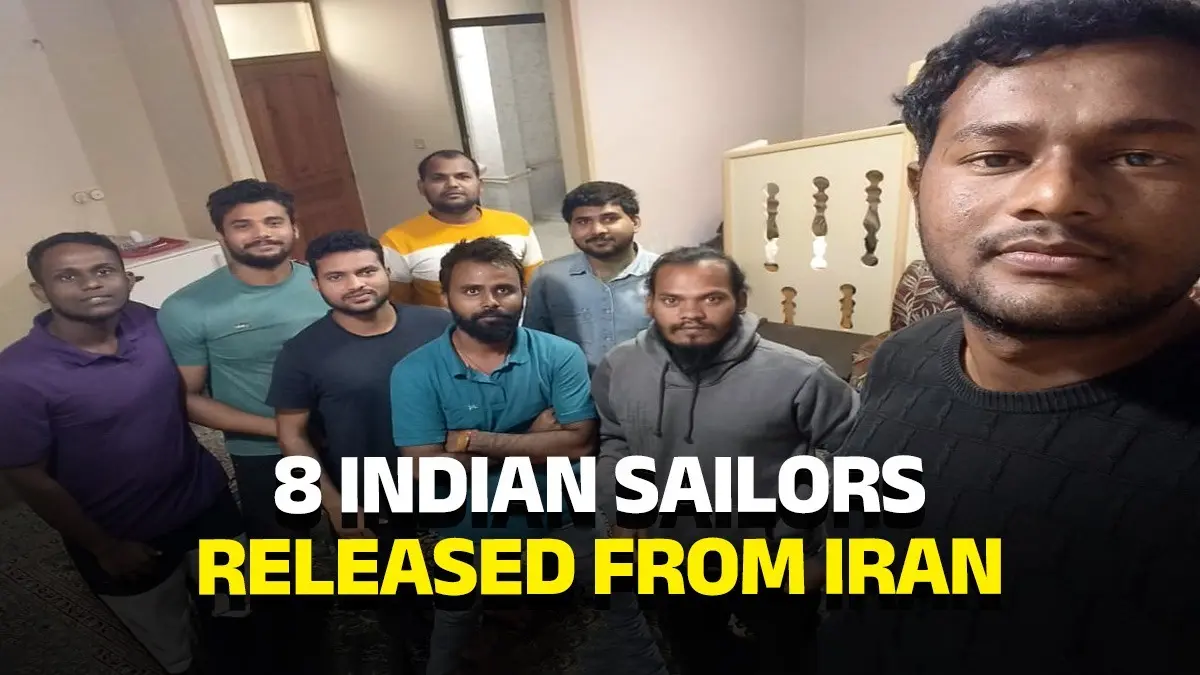
New Delhi: In a significant development, 8 Indian sailors out of sixteen who had been detained since December 2025 were released from Iran, offering relief to their distressed families.
They were cleared for release after a court order from the Iranian judiciary.
According to exclusive information and confirmation from the Ministry of External Affairs (MEA), the Iranian authorities released 8 of the sixteen Indian crew members. The released seafarers were:
- Shoeb Akhter
- Ansari Manzoor
- Akash Kumar Singh
- Ramesh Aro Derish Thasan
- Gopal Chauhan
- Divakar Puthi
- Akash Gupta
- Vishal Kumar
Why Were They Detained?
The 16 Indian crew members of the oil tanker M.T. Valiant Roar endured nearly two months of ordeal after the vessel was seized by Iran’s Islamic Revolutionary Guard Corps (IRGC) on December 8 near Dibba port in UAE waters.
Advertisement
Iranian authorities accused the ship of smuggling approximately 6,000 metric tonnes of fuel, an allegation strongly denied by the Dubai-based operator, Prime Tanker LLC.
The crew faced harsh conditions. Ten members were imprisoned in Bandar Abbas jail, while the remaining were confined aboard the crippled vessel, which had no electricity and unhygienic facilities, posing serious health risks.
Advertisement
Families of the seafarers made emotional appeals to Prime Minister Narendra Modi and External Affairs Minister Dr. S. Jaishankar, urging the government to secure their loved ones' dignified return. The Indian government intervened at the highest levels and secured consular access for the detained men.
MEA Spokesperson Randhir Jaiswal stated, "We had consular access to the 16 sailors in Iran. Our officials in Bandar Abbas met with them. Of those 16, eight people, according to the Iranian authorities, were released and would be returning home. With regard to the remaining eight sailors, we were in touch with the Iranian authorities. We would see how best to support them..."
US Military Buildup Near Iran Raised Concerns
The United States moved a large number of military assets toward Iran in recent days as more than 110 C‑17 transport aircraft arrived or were en route to the region. The USS Abraham Lincoln carrier group was operating in the Arabian Sea. Analysts stated that the scale and speed of the buildup suggested Washington was preparing options for a possible strike, even as officials insisted no final decision had been made.
Envoys and senior commanders had also visited forward‑deployed forces, adding to speculation about U.S. intentions.
However, amidst that build-up, Foreign Minister Abbas Araghchi clarified that "their military formation in the region would not scare us."
"Why have we always insisted on enrichment and continue to do so, even if war is imposed on us? Because nobody is allowed to tell us what we should possess and what we shouldn't," he said at the National Conference of Foreign Policy.
His remarks came just after negotiations with the United States over its nuclear programme and in the wake of nationwide protests.
Decades of Tense Relations Between Iran and the US
Iran was once one of the U.S.’s top allies in the Mideast under Shah Mohammad Reza Pahlavi, who purchased American military weapons and allowed CIA technicians to run secret listening posts monitoring the neighbouring Soviet Union. The CIA had fomented a 1953 coup that cemented the shah’s rule.
But in January 1979, the shah, fatally ill with cancer, fled Iran as mass demonstrations swelled against his rule. The Islamic Revolution followed, led by Grand Ayatollah Ruhollah Khomeini, and created Iran’s theocratic government.
Later that year, university students overran the U.S. Embassy in Tehran, seeking the shah’s extradition and sparking the 444-day hostage crisis that severed diplomatic relations between Iran and the U.S. The Iran-Iraq War of the 1980s saw the U.S. back Saddam Hussein. The “Tanker War” during that conflict saw the U.S. launch a one-day assault that crippled Iran at sea, while the U.S. later shot down an Iranian commercial airliner that the U.S. military said it mistook for a warplane.
Iran and the U.S. had seesawed between enmity and grudging diplomacy in the years since, with relations peaking when Tehran made the 2015 nuclear deal with world powers. But President Donald Trump unilaterally withdrew the U.S. from the accord in 2018, sparking tensions in the Mideast that persisted.
Get Current Updates on India News, Entertainment News, Cricket News along with Latest News and Web Stories from India and around the world.