
AI-Powered Surveillance Leads to Arrest of Three Suspects in Anantnag, Strengthening Amarnath Yatra Security Arrangements
AI-powered facial recognition helped Anantnag Police arrest three suspected overground workers during the Amarnath Yatra as a multi-layered security grid with over 600 AI-enabled cameras strengthens pilgrim safety.
- India News
- 3 min read

;'%3e%3cpath%20d='m8,15.99c4.41,0,7.99-3.58,7.99-7.99S12.41,0,8,0,0,3.59,0,8s3.58,7.99,7.99,7.99Z'%20style='stroke:%23fff;%20stroke-miterlimit:10;%20stroke-width:.02px;'/%3e%3cpath%20d='m3.08,3.37l3.82,5.11-3.84,4.15h.87l3.37-3.64,2.72,3.64h2.94l-4.04-5.39,3.58-3.87h-.86l-3.1,3.35-2.5-3.35h-2.94Zm1.27.64h1.35l5.97,7.99h-1.35l-5.97-7.99Z'%20style='fill:%23fff;'/%3e%3c/g%3e%3c/svg%3e)


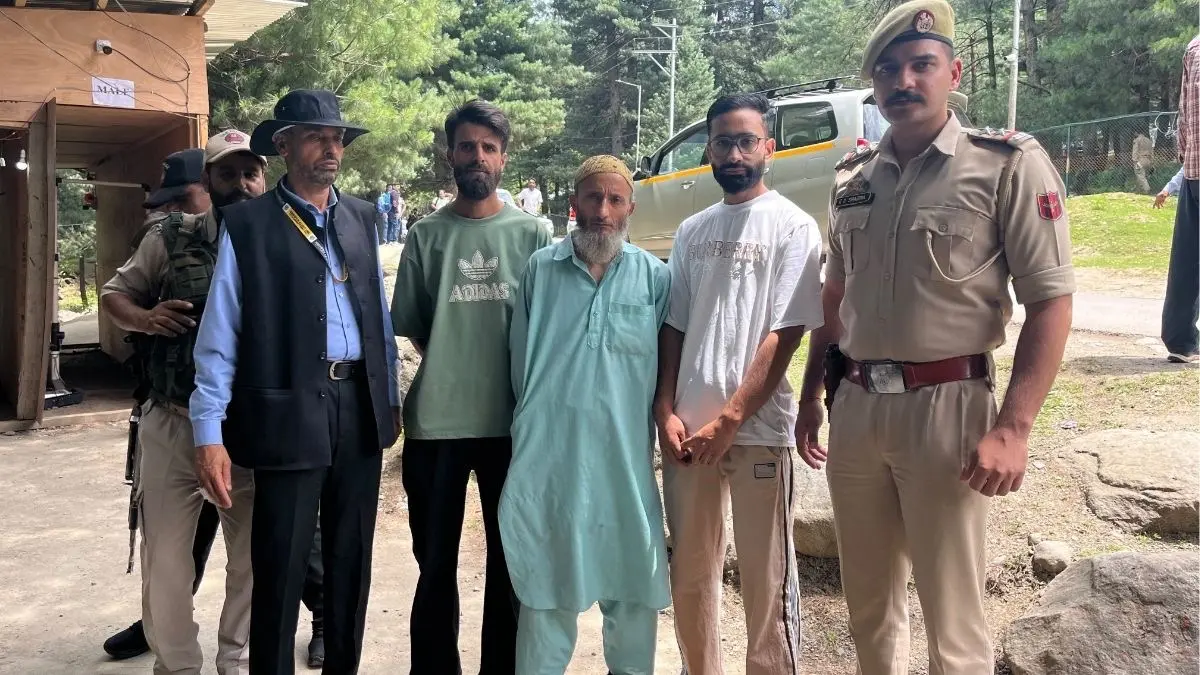
Srinagar: Artificial Intelligence is reshaping security at this year’s Amarnath Yatra, with Anantnag police on Wednesday arresting three suspected overground workers in Sarbal after a facial recognition system flagged them as suspicious.n
Officials said the arrests reveal the success of the multi-layered security grid deployed across the Yatra routes. Facial recognition systems installed at key points identified the trio, prompting police to stop and verify their identities before taking them into custody. Legal proceedings are underway.
Police described the breakthrough on X as a major success for modern surveillance technology being used to secure the annual pilgrimage.
Meanwhile, security agencies confirmed that more than 600 AI-enabled cameras have been installed this year, forming a vast surveillance network to monitor crowds, detect suspicious activity, and identify wanted individuals. Facial recognition networks are active along routes such as Pahalgam and Baltal, supplementing traditional surveillance with real-time tracking.
Advertisement
Heightened vigilance has been enforced on the pilgrimage tracks. Officials said layered checkpoints, drone patrols, and mobile quick-reaction teams have been deployed along vulnerable stretches. Integrated command centers are coordinating ground forces with AI-driven alerts, ensuring rapid response capability.
The outer perimeter security has been strengthened with Army and paramilitary forces guarding approaches and vulnerable entry points leading to the Yatra corridor. This layer ensures infiltration attempts or unauthorized movements are intercepted well before reaching the pilgrimage routes.
Advertisement
The middle layer checkpoints are manned by police and CRPF personnel, where identity verification, baggage checks, and crowd control measures are carried out. These checkpoints act as the second line of defense, filtering movement and maintaining order among the large gatherings of pilgrims.
Closer to the shrine and resting points, the inner ring surveillance has been activated. This includes AI-powered cameras, drones, and facial recognition systems that track individual movements in real time, ensuring suspicious activity is immediately flagged and acted upon.
To safeguard pilgrims against emergencies, dedicated medical and response units have been positioned along the tracks. These teams are equipped to provide rapid intervention in case of health crises, accidents, or security incidents.
At the core of the system are integrated command centers, which link ground forces with AI-generated alerts. These hubs coordinate responses across all layers, ensuring swift communication and seamless action whenever a threat or emergency is detected.
The security grid now combines human vigilance with technology, creating what officials describe as a “hybrid shield” for yatris. From crowd management to infiltration prevention, the system is designed to provide seamless protection across the pilgrimage corridor.
Anantnag Police stressed that efforts are ongoing to make the Yatra safe and peaceful, with technology now playing a frontline role in strengthening the multi-layered security grid.
Get Current Updates on India News, Entertainment News, Cricket News along with Latest News and Web Stories from India and around the world.