
Narendra Modi’s 25-Year Public Service Legacy: Key Achievements, Diplomatic Wins, Landmark Schemes, & Areas for Introspection
The core of Modi's governance model has been built on bureaucratic streamlining, digital public infrastructure, assertive diplomacy, resilient electoral support and direct-benefit welfare delivery intended to bridge India’s historical delivery gaps.
- India News
- 6 min read

;'%3e%3cpath%20d='m8,15.99c4.41,0,7.99-3.58,7.99-7.99S12.41,0,8,0,0,3.59,0,8s3.58,7.99,7.99,7.99Z'%20style='stroke:%23fff;%20stroke-miterlimit:10;%20stroke-width:.02px;'/%3e%3cpath%20d='m3.08,3.37l3.82,5.11-3.84,4.15h.87l3.37-3.64,2.72,3.64h2.94l-4.04-5.39,3.58-3.87h-.86l-3.1,3.35-2.5-3.35h-2.94Zm1.27.64h1.35l5.97,7.99h-1.35l-5.97-7.99Z'%20style='fill:%23fff;'/%3e%3c/g%3e%3c/svg%3e)


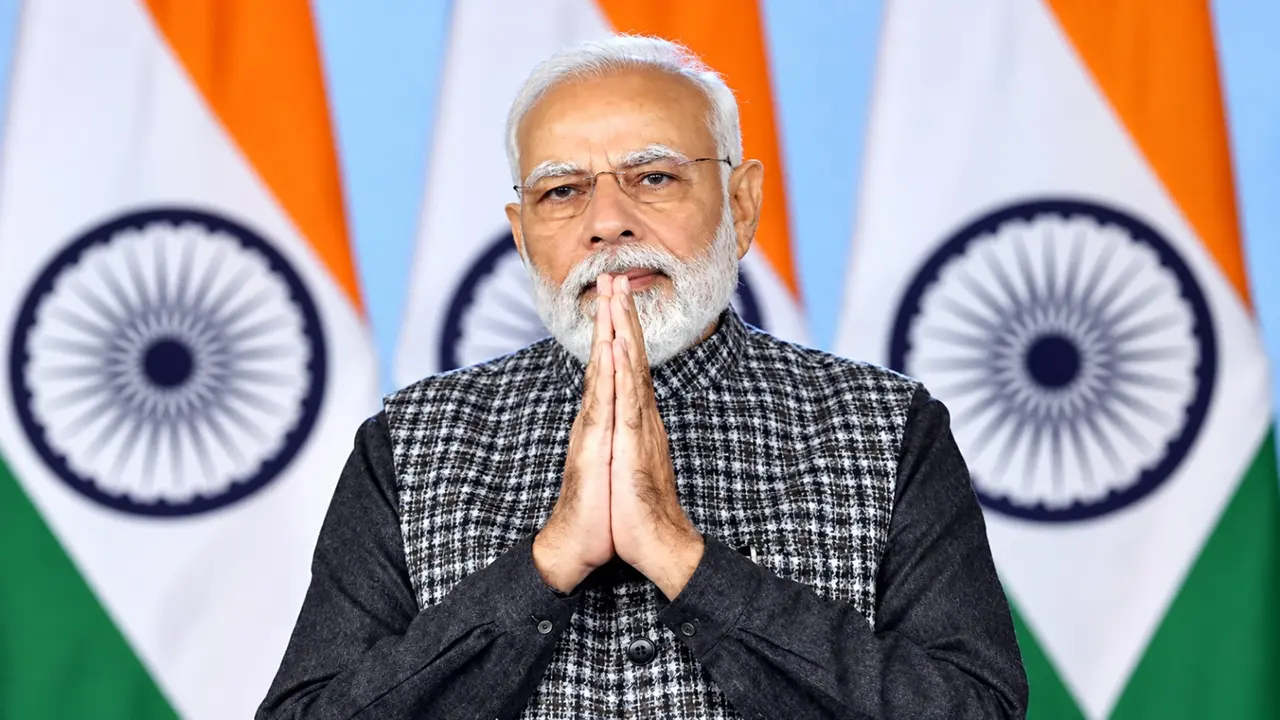
New Delhi: Prime Minister Narendra Modi on October 7, 2026, completed 25 continuous years as head of a government, a rare milestone in modern democratic politics. He assumed office as Chief Minister of Gujarat on October 7, 2001, in the aftermath of the devastating Bhuj earthquake, and moved to the national stage in 2014. He secured consecutive electoral majorities and a third consecutive term in 2024. The Bharatiya Janata Party is marking the occasion with a month-long Seva Sankalp Abhiyan. President Droupadi Murmu has credited him with setting new benchmarks in good governance and inclusive development, while the Union Cabinet has passed a resolution highlighting transformations in welfare delivery, infrastructure, and security, many of which trace roots to Gujarat-era experiments.
The core of Modi's governance model has been built on bureaucratic streamlining, digital public infrastructure, assertive diplomacy, resilient electoral support and direct-benefit welfare delivery intended to bridge India’s historical delivery gaps.
Gujarat Foundations (2001–2014)
Modi took charge months after the earthquake that killed around 20,000 people. His administration prioritised rapid reconstruction of homes, schools, and hospitals and enacted India’s first state disaster management law. The Vibrant Gujarat Summits, launched in 2003, positioned the state as an investment destination and attracted a notable share of national FDI. Jyotigram Yojana separated agricultural and domestic power feeders to deliver reliable electricity to villages. Water initiatives such as Sujalam-Sufalam and SAUNI expanded irrigation and supplied fluoride-free drinking water; World Bank estimates pointed to agricultural growth near 10 percent in that decade. The SWAGAT grievance-redressal platform earned a United Nations Public Service Award in 2010 and later inspired the national PRAGATI system. Gujarat’s economy grew at nearly 10 percent annually for periods between 2001 and 2012, outpacing the national average, with strong industrial, port, and infrastructure expansion.
Landmark Schemes and Domestic Delivery at Scale
As Prime Minister, Modi scaled several Gujarat approaches nationally, emphasising bureaucratic streamlining, digital public infrastructure, and direct-benefit transfers. Pradhan Mantri Jan Dhan Yojana drove financial inclusion: accounts rose from 14.72 crore in March 2015 to nearly 58–60 crore by early 2026, with a majority held by women and concentrated in rural and semi-urban areas. Combined with Aadhaar and mobile connectivity (the JAM trinity), this architecture underpins large-scale Direct Benefit Transfers with reduced leakages. UPI transactions surged from about 2 crore in FY2016-17 to over 24,000 crore in FY2025-26.
Advertisement
Other flagship programmes include Swachh Bharat Mission (over 12 crore toilets constructed; rural India declared open-defecation free in official data), Pradhan Mantri Ujjwala Yojana (over 10 crore LPG connections, reducing indoor pollution risks for rural women), Pradhan Mantri Awas Yojana (over 4 crore houses), Jal Jeevan Mission (rural household tap-water coverage rising from around 17 percent to over 80 percent), Ayushman Bharat–PM-JAY (health cover of up to ₹5 lakh per family for tens of crores of beneficiaries), and PM-KISAN (transfers exceeding ₹4 lakh crore). Government estimates credit multidimensional poverty reduction that lifted about 25 crore people out of poverty between 2013–14 and 2022–23.
Regulatory reforms replaced cascading indirect taxes with the Goods and Services Tax, expanding the taxpayer base and creating a single market. Over 1,500 obsolete laws were reportedly abolished, thousands of compliances removed, and self-attestation introduced. Complementary measures include the Insolvency and Bankruptcy Code, Digital India, Make in India with production-linked incentives (electronics production rising sharply), and elevated public capital expenditure that supported highway expansion and near-complete railway electrification. Defence production and exports have also expanded substantially.
Advertisement
Diplomatic Wins and Strategic Assertiveness
Modi’s foreign policy shifted emphasis toward multi-alignment, projecting India as a leading power and voice for the Global South. India’s 2023 G20 presidency secured consensus on a Leaders’ Declaration amid geopolitical differences and achieved permanent membership for the African Union. India successfully hosted the 18th BRICS Summit in September 2026 and adopted a joint declaration (the New Delhi Declaration) based on consensus among all members. This has been widely regarded as a major diplomatic win for India. Vaccine Maitri supplied hundreds of millions of COVID-19 doses to over 100 countries. Forums such as the Quad deepened security cooperation with the United States, Japan, and Australia. Strategic partnerships with the UAE, Saudi Arabia, and other partners expanded through high-level visits and investment commitments. India managed the 2017 Doklam standoff and subsequent disengagements after the 2020 Galwan clash while maintaining strategic autonomy in relations with Russia and the West.
Recent trade diplomacy includes a free-trade agreement announced with the European Union in January 2026 after nearly two decades of talks -- India’s ninth such pact in four years, following deals with the UK, Oman, and New Zealand. Analysts link the timing partly to diversification needs amid elevated US tariffs. The EU deal awaits formal entry into force, expected by year-end. Trade talks with the US is also on.
On national security, the administration moved beyond historical strategic restraint with the 2016 surgical strikes, 2019 Balakot airstrikes, the abrogation of Article 370, creation of the Chief of Defence Staff post, and One Rank One Pension.
Mass Support and Electoral Resilience
Modi’s connection with citizens, built through populist communication, and a reputation for personal incorruptibility, has sustained broad electoral appeal. By emphasising asset-building -- pucca houses, toilets, electricity, digital payments -- the leadership forged a cross-caste “beneficiary class.” The BJP secured successive strong mandates in 2014, 2019, and 2024. His personal popularity has consistently outpaced that of the government or party in multiple assessments.
Areas for Introspection
A full assessment requires attention to structural bottlenecks. While GDP growth has often ranked among the fastest for major economies, formal high-quality job creation has lagged the influx of young people into the workforce. Youth and graduate unemployment remain elevated in several datasets; the share of the workforce in agriculture has risen in recent years after earlier declines. Inequality metrics from sources such as the World Inequality Lab indicate high concentration of wealth and income at the top. Official claims that India overtook Japan as the fourth-largest economy have been tempered by the IMF’s April 2026 outlook, which ranks India sixth by nominal GDP at $4.15 trillion (reflecting rupee depreciation and a downward base-year revision). By purchasing-power parity India ranks third, yet per-capita GDP stood at $2,694 in 2024 – below levels in Japan or Germany. On the positive side, Japan’s JCR upgraded India’s sovereign rating to A- in September 2026.
Agrarian distress persists despite capital injections such as PM-KISAN; earlier agricultural-reform friction highlighted communication gaps between policy design and farming communities.
As India advances toward the centenary of independence under the Viksit Bharat 2047 vision, the next phase of governance will be judged by its ability to convert macroeconomic expansion and welfare reach into more equitable human development, sustained job creation, and robust democratic pluralism. Supporters emphasise scale and delivery; critics emphasise jobs, incomes, and institutional freedoms. Both sets of evidence and opinions/views form part of the 25-year record.
Get Current Updates on India News, Entertainment News, Cricket News along with Latest News and Web Stories from India and around the world.