
‘At Variance With Facts’: India Rejects Ex-Japanese Minister's Bullet Train Delay Claims, Says Mumbai-Ahmedabad First Section To Open In 2027
India rejected former Japanese minister Hideki Makihara's claims of delays and recklessness in the Mumbai-Ahmedabad Bullet Train project, saying work is progressing well with first section due in 2027 and talks with Japan on track.
- India News
- 3 min read

;'%3e%3cpath%20d='m8,15.99c4.41,0,7.99-3.58,7.99-7.99S12.41,0,8,0,0,3.59,0,8s3.58,7.99,7.99,7.99Z'%20style='stroke:%23fff;%20stroke-miterlimit:10;%20stroke-width:.02px;'/%3e%3cpath%20d='m3.08,3.37l3.82,5.11-3.84,4.15h.87l3.37-3.64,2.72,3.64h2.94l-4.04-5.39,3.58-3.87h-.86l-3.1,3.35-2.5-3.35h-2.94Zm1.27.64h1.35l5.97,7.99h-1.35l-5.97-7.99Z'%20style='fill:%23fff;'/%3e%3c/g%3e%3c/svg%3e)


New Delhi: India on Friday dismissed accusations by former Japanese Justice Minister Hideki Makihara that Indian officials were responsible for delays in the Mumbai-Ahmedabad Bullet Train project. India's rebuke to the Japanese Minister's allegations was in response to Makihara's alleged "sheer recklessness" and a failure to honour commitments, claims. New Delhi stressed that the remark bore little relation to the actual status of the flagship infrastructure venture.
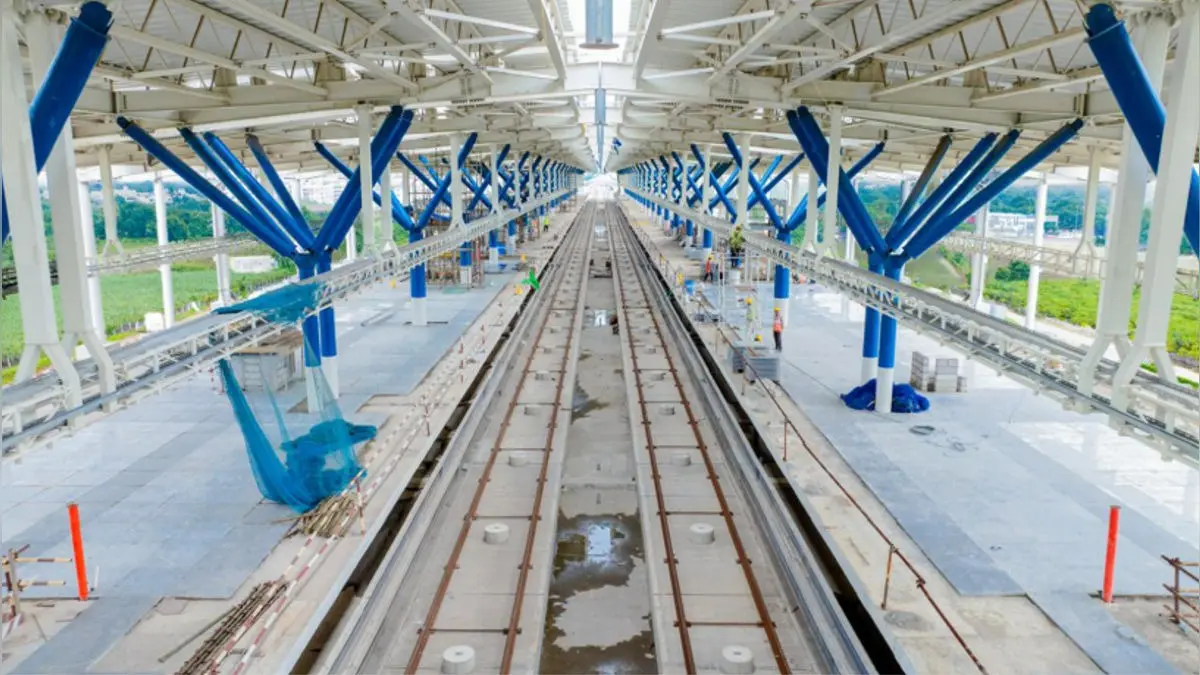
In a statement, the Ministry of External Affairs (MEA) stated that discussions with Tokyo were moving forward and that construction had gathered pace across Gujarat and Maharashtra. The government also confirmed that the first section of the corridor is slated to open in 2027, and that work on viaducts, tunnels and stations has accelerated in recent months.
The exchange outlined the global scrutiny around India’s first high-speed rail line, modelled on Japan’s Shinkansen. Though the officials in both countries insisted cooperation remains intact, Makihara’s remarks have drawn attention to differences over timelines, technology and procurement.
What Makihara Alleged On India's Bullet Train Project
Notably, Makihara took to X on July 15 to criticise the pace of the project, alleging that the delay was "entirely on the Indian side". He accused Indian officials of repeatedly failing to honour commitments and of pursuing "self-interest" during negotiations. His post was a response to an opinion piece published the same day on a Tokyo-based business news portal by Isao Tsujimura, a senior Japanese railway engineer and Delhi-based metro vehicle consultant, who asserted that India’s Bullet Train had diverged from the Shinkansen model.
Advertisement
The MEA spokesperson Randhir Jaiswal rejected the characterisation, saying, “We have seen the post you are referring to. It is an individual opinion, and at considerable variance with facts……India-Japan discussions on the Mumbai-Ahmedabad High Speed Rail are, in fact, progressing well. Japan will provide the E20 train series, but only in the early 2030s. The train in question is under development."
India's Bullet Train First Operational Section
Despite the criticism, Randhir Jaiswal pointed to tangible progress on the ground, saying, “The construction work of the project has rapidly progressed, and the first section will be opened in 2027 itself.” Notably, the government had earlier announced on July 15 that the first operational stretch would likely run between Surat and Bilimora in Gujarat.
Advertisement
The officials emphasised that work has picked up speed after years of setbacks linked largely to land acquisition and political changes in Maharashtra. The corridor is now seeing rapid advancement on elevated viaducts, tunnels and station structures. Alongside the Japanese-built initial fleet, India is also preparing domestic capacity, with the Indian Railways’ Integral Coach Factory and BEML Limited laying the groundwork to manufacture future high-speed trainsets, with Japanese technological support continuing for the first batch.
Rejection Of Signalling Claims
In his statement, Makihara also claimed that there had been "no results" from Japanese Prime Minister Sanae Takaichi’s visit to New Delhi in July, and alleged that India had "excluded Japan from the signal system", a component critical to the safety of high-speed operations.
Addressing the point directly, Jaiswal stated, "The signalling equipment has been ordered accordingly and is in line with international specifications…….No Japanese offer was received in this context. The project execution is in line with the common goal of starting the high-speed train project at the earliest."
The government maintained that engagement with Tokyo remains on track. The Mumbai-Ahmedabad line is also seen as the starting point for wider plans, with proposed corridors under consideration to connect Delhi, Varanasi, Bengaluru, Chennai and Hyderabad.
Get Current Updates on India News, Entertainment News, Cricket News along with Latest News and Web Stories from India and around the world.