
Beldanga Unrest Timeline: How Protests Over Migrant Worker’s Death Shut NH-12 and Rail Lines
Violent protests over the killing of a migrant worker in Jharkhand have kept West Bengal’s Murshidabad district tense for two days as demonstrators in the Beldanga area have blocked National Highway 12, a vital road link for the region and the northeast.
- India News
- 5 min read

;'%3e%3cpath%20d='m8,15.99c4.41,0,7.99-3.58,7.99-7.99S12.41,0,8,0,0,3.59,0,8s3.58,7.99,7.99,7.99Z'%20style='stroke:%23fff;%20stroke-miterlimit:10;%20stroke-width:.02px;'/%3e%3cpath%20d='m3.08,3.37l3.82,5.11-3.84,4.15h.87l3.37-3.64,2.72,3.64h2.94l-4.04-5.39,3.58-3.87h-.86l-3.1,3.35-2.5-3.35h-2.94Zm1.27.64h1.35l5.97,7.99h-1.35l-5.97-7.99Z'%20style='fill:%23fff;'/%3e%3c/g%3e%3c/svg%3e)


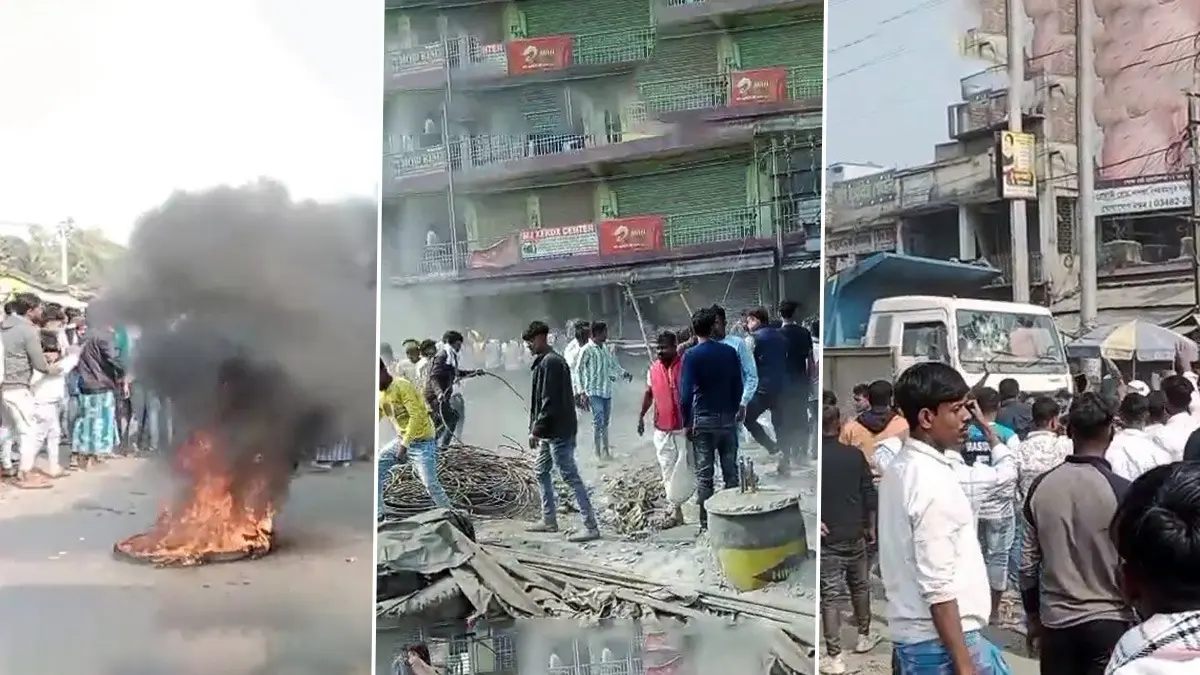
Murshidabad: West Bengal’s Murshidabad district remained on edge for the second consecutive day on Saturday as violent protests rocked the Beldanga region over the killing of a migrant worker in Jharkhand, bringing road and rail traffic to a standstill and triggering heavy security deployment.
The unrest paralysed National Highway 12, a critical arterial road connecting North and South Bengal and serving as a key corridor to the northeastern states. Protesters also blocked railway tracks at Beldanga, disrupting train movement on a crucial rail route.
The protests coincided with Prime Minister Narendra Modi flagging off the country’s first Vande Bharat Sleeper Train from Guwahati to Howrah and launching a series of railway projects in West Bengal.
Chronology of violence in Beldanga
The agitation began on Friday following the suspicious death of a migrant worker, Alauddin Sheikh, in Jharkhand. Anger over the incident spilt onto the streets of Beldanga, with mobs clashing with police and damaging public property.
Advertisement
10 AM
The situation deteriorated rapidly through the morning hours on Saturday, around 10 am, as crowds began gathering at Barua Crossing in Beldanga, leading to congestion on National Highway 12.
10:15 AM
By 10.15 am, protesters had completely blocked National Highway 12, posing a national security threat, as it leads to the "Chicken’s Neck" (the Siliguri Corridor), and this narrow strip of land is India's only terrestrial link to its eight Northeastern states.
Advertisement
It is a key lifeline that connects north and south Bengal, as well as the northeastern part of the country, and if this specific highway (NH-12) or the parallel rail lines are blocked, 45 million people across states like Assam, Sikkim, and Arunachal Pradesh are effectively cut off from the rest of India.
Every litre of fuel, grain of rice, and medical supply for the Northeast moves through this bottleneck. A prolonged blockade triggers immediate shortages and inflation across the entire region.
10:30 AM
The protest soon turned violent at around 10.30 am; vehicles were attacked, triggering long queues of stranded vehicles, while protesters also damaged a railway gate and attempted to disrupt train services.
10:40: 11AM
This was followed by stone-pelting incidents reported at 10.40 am. By 11 am, protesters went on a rampage, vandalising property.
11:10 AM
At around 11:10 am, the focus was shifted to railway infrastructure as protestors gathered near the Beldanga railway station, another crucial rail link, on the day when Prime Minister Narendra Modi flagged off the nation's first Vande Bharat Sleeper Train, from Guwahati and Howrah.
11:15-11:25 AM
This was again followed by a rampage at a level crossing at 11.15 am, and train services were obstructed by 11.25 am, with protesters attempting to halt rail operations.

11:30 AM
Tensions continued to rise as demonstrations were held before Humayun Kabir around 11.30 am.
11:45 AM
By 11.45 am, a large contingent of police personnel reached the spot in an attempt to restore order, and senior officials rushed to the spot as authorities worked to restore normalcy, officials said.
12:00-12:15 AM
At noon, police and protesters engaged in heated verbal arguments, which soon escalated into scuffles by 12.05 pm. Protesters again went on a rampage at 12.10 pm and resorted to burning tyres at 12.15 pm, sending plumes of smoke across the highway.
12:30 AM
The situation turned more alarming when an ambulance was blocked at 12.30 pm during the protests.
12:45 AM
A goods train was also stopped at around 12.45 pm, further disrupting essential services.
1:00-1:45 AM
By early afternoon, security forces intensified their response. Police patrols reached the railway tracks at around 1.15 pm. At 1.30 pm, police acted against the protesters and attempted to regain control of the situation. By 1.45 pm, a massive deployment of security personnel lined up.
Get Current Updates on India News, Entertainment News, Cricket News along with Latest News and Web Stories from India and around the world.