
Bihar SIR Explained: What Is Voter List Drive—and Why Is It Causing Uproar In Parliament?
The Bihar SIR is meant to clean up voter rolls through house-to-house checks and has seen record participation. However, with around 64 lakh deletions expected and Bihar polls approaching, it has become politically sensitive.
- India News
- 4 min read

;'%3e%3cpath%20d='m8,15.99c4.41,0,7.99-3.58,7.99-7.99S12.41,0,8,0,0,3.59,0,8s3.58,7.99,7.99,7.99Z'%20style='stroke:%23fff;%20stroke-miterlimit:10;%20stroke-width:.02px;'/%3e%3cpath%20d='m3.08,3.37l3.82,5.11-3.84,4.15h.87l3.37-3.64,2.72,3.64h2.94l-4.04-5.39,3.58-3.87h-.86l-3.1,3.35-2.5-3.35h-2.94Zm1.27.64h1.35l5.97,7.99h-1.35l-5.97-7.99Z'%20style='fill:%23fff;'/%3e%3c/g%3e%3c/svg%3e)


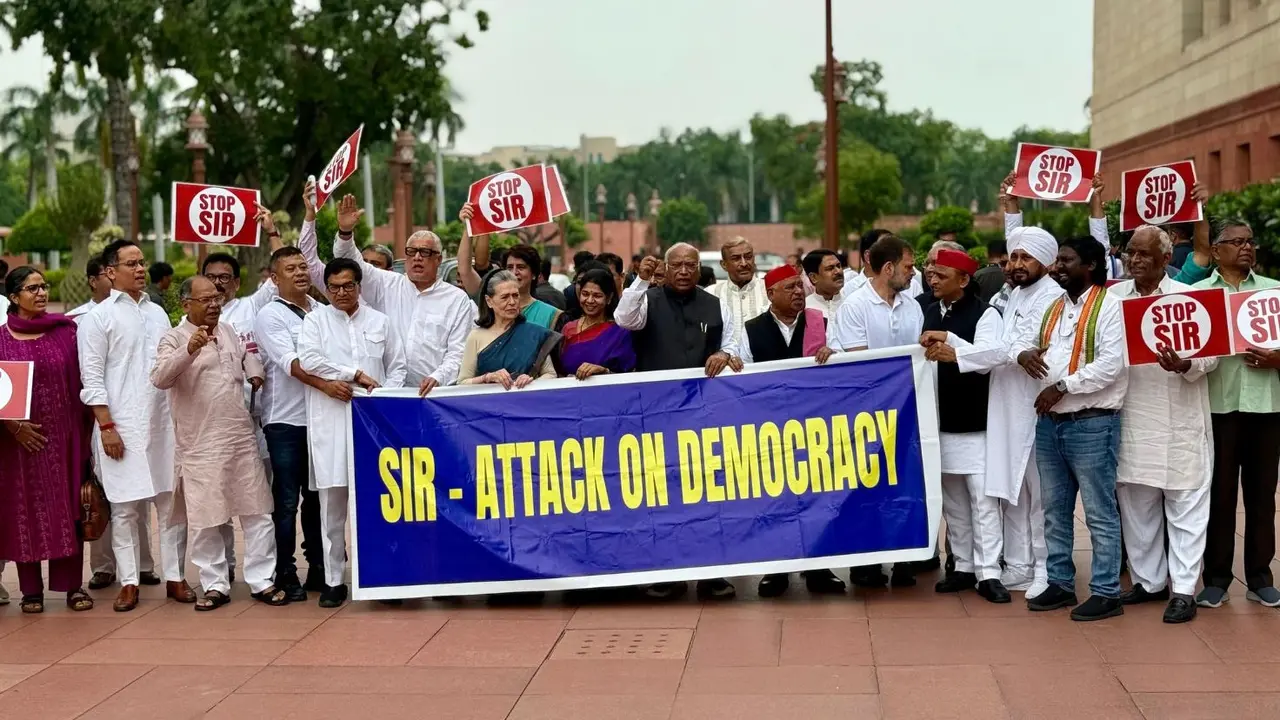
The Monsoon Session of Parliament has seen heated protests from the Opposition over Bihar’s Special Intensive Revision (SIR) of the electoral rolls. Congress leaders Rahul Gandhi and Sonia Gandhi joined the INDIA bloc MPs in a demonstration at Parliament’s Makar Dwar demanding a debate on the issue.
Opposition MPs also submitted Suspension of Business notices in Rajya Sabha on July 25. They argue that the SIR exercise could result in large-scale voter exclusion before Bihar’s assembly elections.
The Election Commission of India (ECI) has called the SIR a “massive and successful citizen participation effort” that aims to make Bihar’s voter rolls more accurate. However, the Opposition insists the timing and the scale of deletions from the voter list require parliamentary scrutiny.
What is the Special Intensive Revision (SIR)?
The Special Intensive Revision is a voter verification drive by the Election Commission where officials visit every household to rebuild electoral rolls from scratch. This is done when the Commission believes existing rolls are inaccurate or need restructuring ahead of major elections.
Advertisement
In Bihar, the SIR began on June 24 and concluded on July 25, covering all 38 districts and 243 constituencies. According to the ECI, out of 7.89 crore registered voters, over 7.24 crore submitted enumeration forms, reflecting 91.69 per cent participation. The ECI said, “The first aim of SIR was the participation of all electors and all political parties.”
Advertisement
The exercise involved 38 District Election Officers (DEOs), 243 Electoral Registration Officers (EROs), 2,976 Assistant EROs, and around 78,000 Booth Level Officers (BLOs). Over 1.60 lakh Booth Level Agents (BLAs) from 12 political parties were engaged, with significant increases in their numbers: CPI(M) by 1083 per cent, CPI(ML) by 542 per cent, and Congress by 105 per cent. BJP saw a 3 per cent rise, while RJD and JD(U) showed smaller increases.
Digital participation was also significant, with 29 lakh forms filled online or downloaded and 16 lakh submitted digitally. To reach migrants, advertisements were placed in 246 newspapers, and Bihar’s Chief Electoral Officer wrote to all states and Union Territories seeking help for migrant voters.
Key Findings of the Bihar SIR
The SIR revealed major discrepancies in Bihar’s voter rolls. According to reports from BLOs and BLAs, 22 lakh voters were found dead, 7 lakh were registered at multiple locations, and 35 lakh voters were untraced or had permanently migrated. This means nearly 64 lakh names could be removed from the list.
The ECI emphasised that names will not be deleted without proper notice. It said, “Names in the electoral rolls will not be deleted without a proper notice and written order by the Electoral Registration Officer.” It also added that BLOs had visited every registered elector’s residence at least three times to ensure coverage.
Opposition’s Concerns
The Opposition fears that the SIR may disenfranchise genuine voters, especially migrants, first-time voters, and those from marginalised communities. Congress leader Rahul Gandhi has accused the government of attempting to “interfere with Bihar’s voter rolls.” The RJD and Left parties have also alleged that the large-scale deletions could be politically motivated.
They argue that conducting such an extensive revision so close to elections is suspicious. The announcement that around 64 lakh names might be struck off has heightened fears of voter suppression. Opposition MPs have also demanded clarity on how duplicates and untraced voters are identified and verified.
Government and ECI’s Response
Union Parliamentary Affairs Minister Kiren Rijiju said, “All issues cannot be discussed together. The Opposition has raised several issues like SIR in Bihar. We told them Operation Sindoor will be discussed first, then we will decide which issues to take up.” He confirmed that the SIR issue would be addressed after the ongoing debate on Operation Sindoor.
The ECI has defended its process, stating that the SIR was carried out transparently with participation from all political parties and extensive public involvement. It described it as “a massive and successful citizen participation effort” aimed at ensuring fairness in the electoral rolls.
What Happens Next?
The ECI will publish the draft electoral roll on August 1, 2025. Claims and objections can be filed until September 1, 2025, and Electoral Registration Officers will review all submissions. The final updated roll will be released on September 30, 2025, ahead of Bihar’s elections.
During this period, any voter or political party can appeal to include missing names or correct errors. The ECI has deployed EROs and Assistant EROs across the state to oversee this scrutiny.
Get Current Updates on India News, Entertainment News, Cricket News along with Latest News and Web Stories from India and around the world.